

12 Quantification and Regionalization of Benthic Reflux
440
12.3.3 Composition of the Sediment
Chapter 1 presented a detailed introduction into
the distribution and diversity of marine sediments.
Here, we will highlight a few aspects on how the
sediment composition, might affect the exchange
of dissolved components moving across the
benthic interface.
The problems that occur from applying biogenic sediment components as control parameters
of benthic flux rates is demonstrated by the
marine silicon cycle. The dispersal and the
proportion of biogenic opal in sediments depends
on three factors: a) the rain rate of biogenic opal,
b) the accumulation of other particles, and c) the
degree of preservation in the sediment. At first
sight the significance of these three factors
appears to be trivial, but all in all there are some
complex interactions. The rain rate of biogenic
silicate as well as the degree of opal preservation
in the sediment are both a function of specific
dissolution rates. These may decrease in the
course from production in the surface waters to
burial in the sediments by some orders of
magnitude due to alteration of the opal skeletons
and changes of the environmental conditions
(Van Cappellen et al. 2002). However, it may occur
that the amount of biogenic opal in the sediment
is below the limit of analytical detection, despite a
significant production and export of siliceous
plankton, which is caused by effective dissolution
before final deposition. From a thermodynamic
point of view, the dissolution of ‘pure’ opal is
mainly a function of temperature, degree of undersaturation and surface area. However, pure phases
almost never occur in nature and thus, simple
approaches proved to be inappropriate in order to
describe the dissolution processes. It is known
from numerous studies that dissolution kinetics of
biogenic opal are seriously affected by the
concentration of absorbed or incorporated trace
elements (e.g. van Bennekom et al. 1991; Dixit et
al. 2001). On the one hand the presence and the
amount of trace metals is a primary signal, but it
also depends on the availability and the concentration of adequate lithogenic elements and may
be subject to strong regional diversification.
Van Cappellen and Qui (1997) and later Dixit et al.
(2001) and Dixit and Van Cappellen (2003) were
able to describe the relation between the primarily
asymptotical increase of silicon concentrations in
pore water, the silicon-specific ratio of lithogenic
components, and the content of opal (Fig. 12.11).
Since no simple correlation between the concentration of silicon in pore water and opal in the
sediment could be found, it is not possible to
estimate the extent of the benthic reflux by simply
knowing the opal flux to the sediment. Furthermore, the diagenetic alteration of diatom shells in
sediments seems to be accompanied with a
change in the surface chemical structure of the
frustules, which consequently results in a
progressive loss of the reactivity of biogenic
silica (Dixit and Van Cappellen 2002). Although the
dissolution of diatom frustules itself is a thermoFig. 12.11
The ratio between the detrital and the opal
content of sediments may be the major controlling factor for
the dissolution capacity of opal and therefore for the asymptotic increase of silicic acid pore water concentrations with
sediment depth and the release of silicic acid to the bottom
water. a) benthic silicic acid flux as a function of the detrital to
opal mass ratio in surface sediments; b) model-predicted fluxes
for two hypothetical sets of sediment. The TOC is assumed
constant with 3 wt%. The data originate from different sources
(modified after Dixit and Van Cappellen 2003).
440
12.3.3 Composition of the Sediment
Chapter 1 presented a detailed introduction into
the distribution and diversity of marine sediments.
Here, we will highlight a few aspects on how the
sediment composition, might affect the exchange
of dissolved components moving across the
benthic interface.
The problems that occur from applying biogenic sediment components as control parameters
of benthic flux rates is demonstrated by the
marine silicon cycle. The dispersal and the
proportion of biogenic opal in sediments depends
on three factors: a) the rain rate of biogenic opal,
b) the accumulation of other particles, and c) the
degree of preservation in the sediment. At first
sight the significance of these three factors
appears to be trivial, but all in all there are some
complex interactions. The rain rate of biogenic
silicate as well as the degree of opal preservation
in the sediment are both a function of specific
dissolution rates. These may decrease in the
course from production in the surface waters to
burial in the sediments by some orders of
magnitude due to alteration of the opal skeletons
and changes of the environmental conditions
(Van Cappellen et al. 2002). However, it may occur
that the amount of biogenic opal in the sediment
is below the limit of analytical detection, despite a
significant production and export of siliceous
plankton, which is caused by effective dissolution
before final deposition. From a thermodynamic
point of view, the dissolution of ‘pure’ opal is
mainly a function of temperature, degree of undersaturation and surface area. However, pure phases
almost never occur in nature and thus, simple
approaches proved to be inappropriate in order to
describe the dissolution processes. It is known
from numerous studies that dissolution kinetics of
biogenic opal are seriously affected by the
concentration of absorbed or incorporated trace
elements (e.g. van Bennekom et al. 1991; Dixit et
al. 2001). On the one hand the presence and the
amount of trace metals is a primary signal, but it
also depends on the availability and the concentration of adequate lithogenic elements and may
be subject to strong regional diversification.
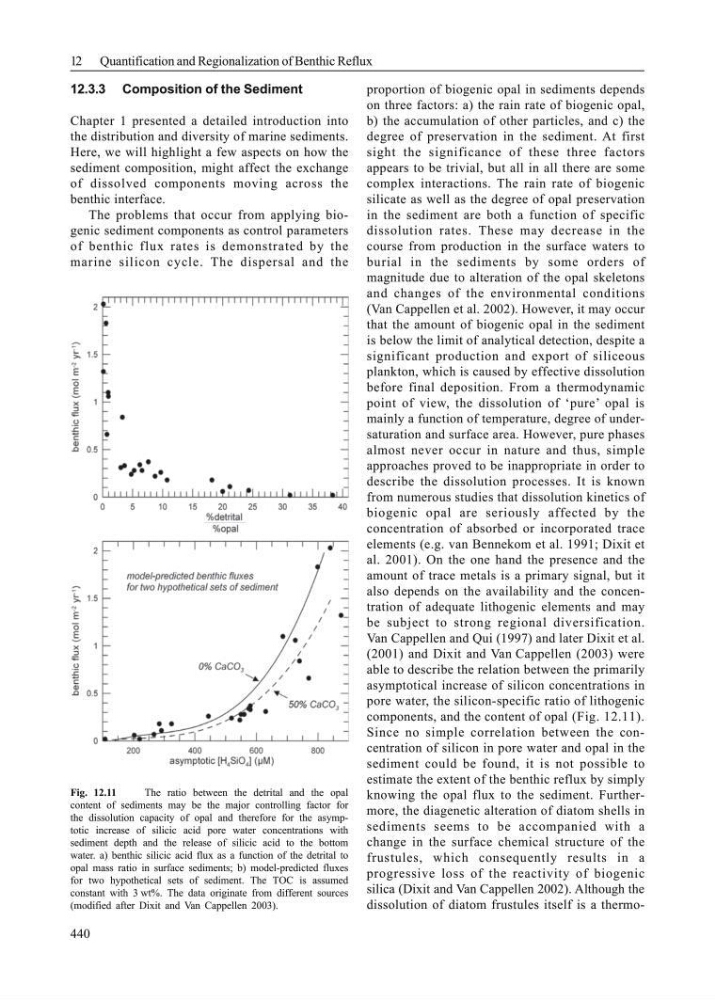
Van Cappellen and Qui (1997) and later Dixit et al.
(2001) and Dixit and Van Cappellen (2003) were
able to describe the relation between the primarily
asymptotical increase of silicon concentrations in
pore water, the silicon-specific ratio of lithogenic
components, and the content of opal (Fig. 12.11).
Since no simple correlation between the concentration of silicon in pore water and opal in the
sediment could be found, it is not possible to
estimate the extent of the benthic reflux by simply
knowing the opal flux to the sediment. Furthermore, the diagenetic alteration of diatom shells in
sediments seems to be accompanied with a
change in the surface chemical structure of the
frustules, which consequently results in a
progressive loss of the reactivity of biogenic
silica (Dixit and Van Cappellen 2002). Although the
dissolution of diatom frustules itself is a thermoFig. 12.11
The ratio between the detrital and the opal
content of sediments may be the major controlling factor for
the dissolution capacity of opal and therefore for the asymptotic increase of silicic acid pore water concentrations with
sediment depth and the release of silicic acid to the bottom
water. a) benthic silicic acid flux as a function of the detrital to
opal mass ratio in surface sediments; b) model-predicted fluxes
for two hypothetical sets of sediment. The TOC is assumed
constant with 3 wt%. The data originate from different sources
(modified after Dixit and Van Cappellen 2003).