

439
12.3
The Interpretation of Patterns of Regionally Distributed Data
proven, however, that a comparison of the particle
fluxes – either determined in the water column or
calculated on the basis of the primary production
– with benthic remineralization data do not
produce a conclusive picture (e.g. Walsh 1991;
Rowe et al. 1994; Hensen et al. 2000). Increasing
current velocities may lead to erosion and resuspension of older sediments and thus, provide
an additional transport component. This so-called
winnowing effect is of significance for material
balances of most shelf regions. Depending on the
velocity of the bottom currents, the accumulation
of the smaller or lighter components (like organic
material) can be reduced or completely prevented.
The effect of resuspension processes result in a
rise in the number of particles in the water layer
near the bottom, the nepheloid boundary layer
(Fig. 12.9). Its thickness might range from several
tens to hundreds of meters. Where the currents
subside the particles previously kept in suspension will deposit. This accumulation process is
referred to as focussing and occurs preferentially
at mid slope depths. Frequently described,
organic-rich depot centers develop (Fig. 12.9). The
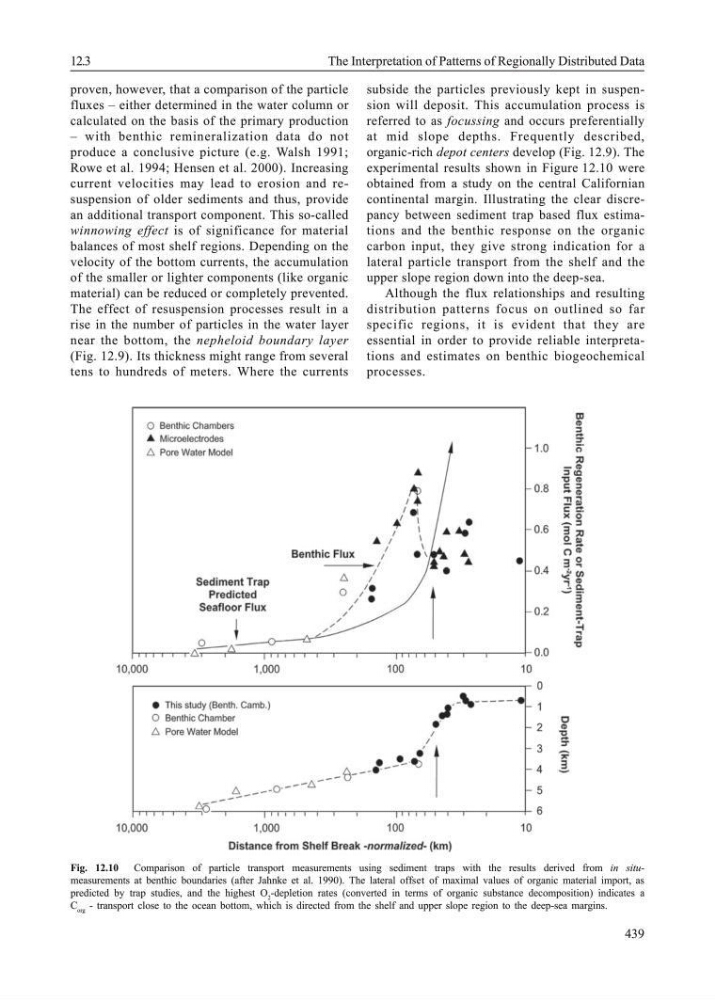
experimental results shown in Figure 12.10 were
obtained from a study on the central Californian
continental margin. Illustrating the clear discrepancy between sediment trap based flux estimations and the benthic response on the organic
carbon input, they give strong indication for a
lateral particle transport from the shelf and the
upper slope region down into the deep-sea.
Although the flux relationships and resulting
distribution patterns focus on outlined so far
specific regions, it is evident that they are
essential in order to provide reliable interpretations and estimates on benthic biogeochemical
processes.
Fig. 12.10 Comparison of particle transport measurements using sediment traps with the results derived from in situmeasurements at benthic boundaries (after Jahnke et al. 1990). The lateral offset of maximal values of organic material import, as
predicted by trap studies, and the highest O 2 -depletion rates (converted in terms of organic substance decomposition) indicates a
C org - transport close to the ocean bottom, which is directed from the shelf and upper slope region to the deep-sea margins.
12.3
The Interpretation of Patterns of Regionally Distributed Data
proven, however, that a comparison of the particle
fluxes – either determined in the water column or
calculated on the basis of the primary production
– with benthic remineralization data do not
produce a conclusive picture (e.g. Walsh 1991;
Rowe et al. 1994; Hensen et al. 2000). Increasing
current velocities may lead to erosion and resuspension of older sediments and thus, provide
an additional transport component. This so-called
winnowing effect is of significance for material
balances of most shelf regions. Depending on the
velocity of the bottom currents, the accumulation
of the smaller or lighter components (like organic
material) can be reduced or completely prevented.
The effect of resuspension processes result in a
rise in the number of particles in the water layer
near the bottom, the nepheloid boundary layer
(Fig. 12.9). Its thickness might range from several
tens to hundreds of meters. Where the currents
subside the particles previously kept in suspension will deposit. This accumulation process is
referred to as focussing and occurs preferentially
at mid slope depths. Frequently described,
organic-rich depot centers develop (Fig. 12.9). The
experimental results shown in Figure 12.10 were
obtained from a study on the central Californian
continental margin. Illustrating the clear discrepancy between sediment trap based flux estimations and the benthic response on the organic
carbon input, they give strong indication for a
lateral particle transport from the shelf and the
upper slope region down into the deep-sea.
Although the flux relationships and resulting
distribution patterns focus on outlined so far
specific regions, it is evident that they are
essential in order to provide reliable interpretations and estimates on benthic biogeochemical
processes.
Fig. 12.10 Comparison of particle transport measurements using sediment traps with the results derived from in situmeasurements at benthic boundaries (after Jahnke et al. 1990). The lateral offset of maximal values of organic material import, as
predicted by trap studies, and the highest O 2 -depletion rates (converted in terms of organic substance decomposition) indicates a
C org - transport close to the ocean bottom, which is directed from the shelf and upper slope region to the deep-sea margins.