

441
dynamic process caused by the undersaturation
of pore fluids with respect to biogenic silica, the
alteration process is probably closely linked to
bacterial activity (Bidle and Azam 1999). Some
recent studies have provided evidence that
bacterial ectoprotease action on marine diatom
detritus strongly accelerates silica dissolution
rates by removing the organic coatings that
normally protect frustules from direct exposure to
the unsaturated pore and seawater (Bidle and
Azam 2001; Bidle et al. 2002, 2003). The systematic
investigation of pore water profiles of oxygen and
silica revealed this inherent linkage of oxic
respiration and opal dissolution. Holstein and
Hensen (subm.) could derive a simple empirical
formulation relating the Si flux to the oxygen flux
with
2
54
.
0
O
Si
F
F
⋅
=
(12.1)
where the calculated Si-Flux reaches a confidence
level of approximately 70%. This approach has
successfully been applied by Seiter et al. (subm.)
who estimated the total Si reflux and thus, the
minimum opal rain rate to the sea floor for the
southern Atlantic Ocean. The combination of such
simple empirical equations may provide a powerful
tool in order to estimate total dissolution or material fluxes.
Dilution by quasi-non-reactive terrestrial particles, mainly clay minerals, feldspars and quartz
provides another example emphasizing the
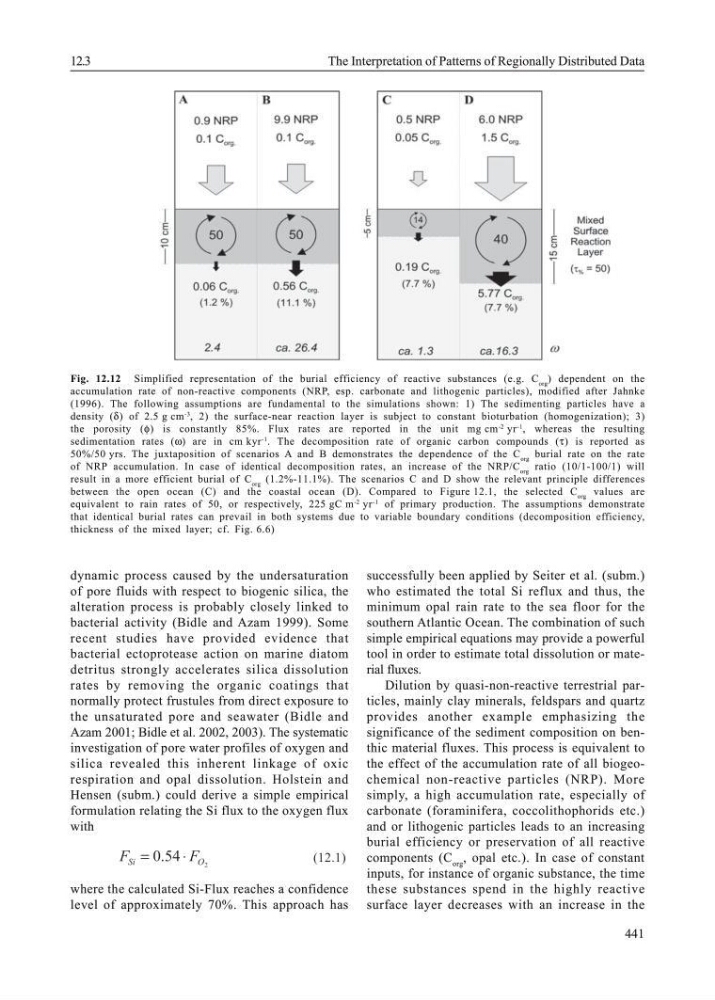
significance of the sediment composition on benthic material fluxes. This process is equivalent to
the effect of the accumulation rate of all biogeochemical non-reactive particles (NRP). More
simply, a high accumulation rate, especially of
carbonate (foraminifera, coccolithophorids etc.)
and or lithogenic particles leads to an increasing
burial efficiency or preservation of all reactive
components (C org , opal etc.). In case of constant
inputs, for instance of organic substance, the time
these substances spend in the highly reactive
surface layer decreases with an increase in the
Fig. 12.12 Simplified representation of the burial efficiency of reactive substances (e.g. C org ) dependent on the
accumulation rate of non-reactive components (NRP, esp. carbonate and lithogenic particles), modified after Jahnke
(1996). The following assumptions are fundamental to the simulations shown: 1) The sedimenting particles have a
density (δ) of 2.5 g cm
-3 , 2) the surface-near reaction layer is subject to constant bioturbation (homogenization); 3)
the porosity (φ) is constantly 85%. Flux rates are reported in the unit mg cm
-2 yr
-1 , whereas the resulting
sedimentation rates (ω) are in cm kyr
-1 . The decomposition rate of organic carbon compounds (τ) is reported as
50%/50 yrs. The juxtaposition of scenarios A and B demonstrates the dependence of the C org burial rate on the rate
of NRP accumulation. In case of identical decomposition rates, an increase of the NRP/C org ratio (10/1-100/1) will
result in a more efficient burial of C org (1.2%-11.1%). The scenarios C and D show the relevant principle differences
between the open ocean (C) and the coastal ocean (D). Compared to Figure 12.1, the selected C org values are
equivalent to rain rates of 50, or respectively, 225 gC m
-2 yr
-1 of primary production. The assumptions demonstrate
that identical burial rates can prevail in both systems due to variable boundary conditions (decomposition efficiency,
thickness of the mixed layer; cf. Fig. 6.6)
12.3
The Interpretation of Patterns of Regionally Distributed Data
dynamic process caused by the undersaturation
of pore fluids with respect to biogenic silica, the
alteration process is probably closely linked to
bacterial activity (Bidle and Azam 1999). Some
recent studies have provided evidence that
bacterial ectoprotease action on marine diatom
detritus strongly accelerates silica dissolution
rates by removing the organic coatings that
normally protect frustules from direct exposure to
the unsaturated pore and seawater (Bidle and
Azam 2001; Bidle et al. 2002, 2003). The systematic
investigation of pore water profiles of oxygen and
silica revealed this inherent linkage of oxic
respiration and opal dissolution. Holstein and
Hensen (subm.) could derive a simple empirical
formulation relating the Si flux to the oxygen flux
with
2
54
.
0
O
Si
F
F
⋅
=
(12.1)
where the calculated Si-Flux reaches a confidence
level of approximately 70%. This approach has
successfully been applied by Seiter et al. (subm.)
who estimated the total Si reflux and thus, the
minimum opal rain rate to the sea floor for the
southern Atlantic Ocean. The combination of such
simple empirical equations may provide a powerful
tool in order to estimate total dissolution or material fluxes.
Dilution by quasi-non-reactive terrestrial particles, mainly clay minerals, feldspars and quartz
provides another example emphasizing the
significance of the sediment composition on benthic material fluxes. This process is equivalent to
the effect of the accumulation rate of all biogeochemical non-reactive particles (NRP). More
simply, a high accumulation rate, especially of
carbonate (foraminifera, coccolithophorids etc.)
and or lithogenic particles leads to an increasing
burial efficiency or preservation of all reactive
components (C org , opal etc.). In case of constant
inputs, for instance of organic substance, the time
these substances spend in the highly reactive
surface layer decreases with an increase in the
Fig. 12.12 Simplified representation of the burial efficiency of reactive substances (e.g. C org ) dependent on the
accumulation rate of non-reactive components (NRP, esp. carbonate and lithogenic particles), modified after Jahnke
(1996). The following assumptions are fundamental to the simulations shown: 1) The sedimenting particles have a
density (δ) of 2.5 g cm
-3 , 2) the surface-near reaction layer is subject to constant bioturbation (homogenization); 3)
the porosity (φ) is constantly 85%. Flux rates are reported in the unit mg cm
-2 yr
-1 , whereas the resulting
sedimentation rates (ω) are in cm kyr
-1 . The decomposition rate of organic carbon compounds (τ) is reported as
50%/50 yrs. The juxtaposition of scenarios A and B demonstrates the dependence of the C org burial rate on the rate
of NRP accumulation. In case of identical decomposition rates, an increase of the NRP/C org ratio (10/1-100/1) will
result in a more efficient burial of C org (1.2%-11.1%). The scenarios C and D show the relevant principle differences
between the open ocean (C) and the coastal ocean (D). Compared to Figure 12.1, the selected C org values are
equivalent to rain rates of 50, or respectively, 225 gC m
-2 yr
-1 of primary production. The assumptions demonstrate
that identical burial rates can prevail in both systems due to variable boundary conditions (decomposition efficiency,
thickness of the mixed layer; cf. Fig. 6.6)
12.3
The Interpretation of Patterns of Regionally Distributed Data