

433
12.2
Fundamental Considerations and Assessment Criteria for Benthic Flux Rates
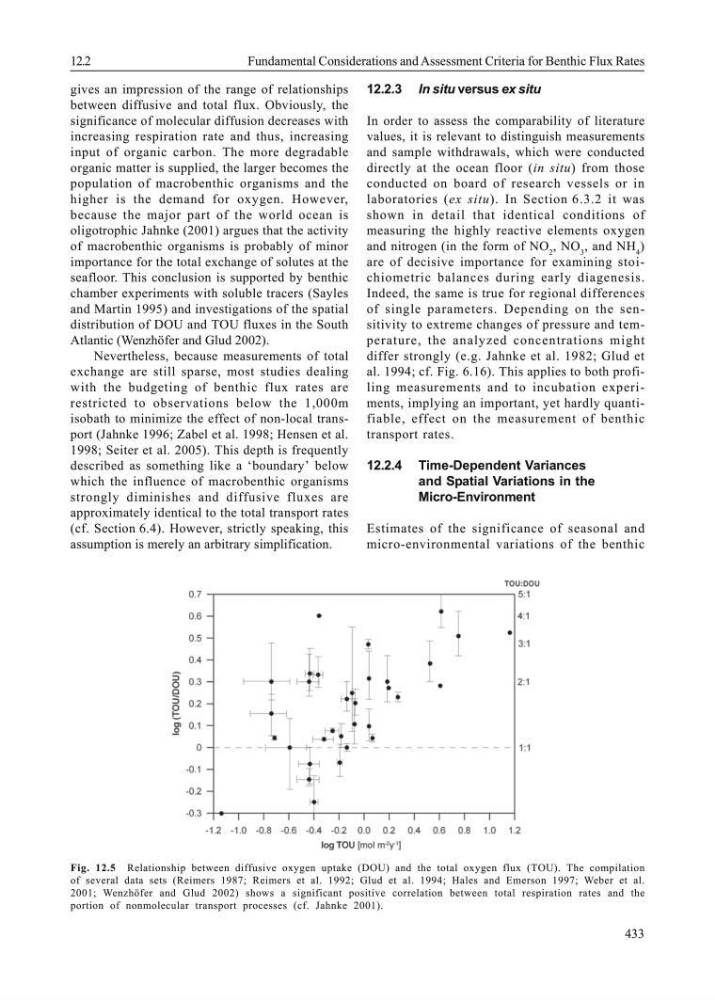
gives an impression of the range of relationships
between diffusive and total flux. Obviously, the
significance of molecular diffusion decreases with
increasing respiration rate and thus, increasing
input of organic carbon. The more degradable
organic matter is supplied, the larger becomes the
population of macrobenthic organisms and the
higher is the demand for oxygen. However,
because the major part of the world ocean is
oligotrophic Jahnke (2001) argues that the activity
of macrobenthic organisms is probably of minor
importance for the total exchange of solutes at the
seafloor. This conclusion is supported by benthic
chamber experiments with soluble tracers (Sayles
and Martin 1995) and investigations of the spatial
distribution of DOU and TOU fluxes in the South
Atlantic (Wenzhöfer and Glud 2002).
Nevertheless, because measurements of total
exchange are still sparse, most studies dealing
with the budgeting of benthic flux rates are
restricted to observations below the 1,000m
isobath to minimize the effect of non-local transport (Jahnke 1996; Zabel et al. 1998; Hensen et al.
1998; Seiter et al. 2005). This depth is frequently
described as something like a ‘boundary’ below
which the influence of macrobenthic organisms
strongly diminishes and diffusive fluxes are
approximately identical to the total transport rates
(cf. Section 6.4). However, strictly speaking, this
assumption is merely an arbitrary simplification.
12.2.3 In situ versus ex situ
In order to assess the comparability of literature
values, it is relevant to distinguish measurements
and sample withdrawals, which were conducted
directly at the ocean floor (in situ) from those
conducted on board of research vessels or in
laboratories (ex situ). In Section 6.3.2 it was
shown in detail that identical conditions of
measuring the highly reactive elements oxygen
and nitrogen (in the form of NO 2 , NO 3 , and NH 4 )
are of decisive importance for examining stoichiometric balances during early diagenesis.
Indeed, the same is true for regional differences
of single parameters. Depending on the sensitivity to extreme changes of pressure and temperature, the analyzed concentrations might
differ strongly (e.g. Jahnke et al. 1982; Glud et
al. 1994; cf. Fig. 6.16). This applies to both profiling measurements and to incubation experiments, implying an important, yet hardly quantifiable, effect on the measurement of benthic
transport rates.
12.2.4 Time-Dependent Variances
and Spatial Variations in the
Micro-Environment
Estimates of the significance of seasonal and
micro-environmental variations of the benthic
Fig. 12.5 Relationship between diffusive oxygen uptake (DOU) and the total oxygen flux (TOU). The compilation
of several data sets (Reimers 1987; Reimers et al. 1992; Glud et al. 1994; Hales and Emerson 1997; Weber et al.
2001; Wenzhöfer and Glud 2002) shows a significant positive correlation between total respiration rates and the
portion of nonmolecular transport processes (cf. Jahnke 2001).
12.2
Fundamental Considerations and Assessment Criteria for Benthic Flux Rates
gives an impression of the range of relationships
between diffusive and total flux. Obviously, the
significance of molecular diffusion decreases with
increasing respiration rate and thus, increasing
input of organic carbon. The more degradable
organic matter is supplied, the larger becomes the
population of macrobenthic organisms and the
higher is the demand for oxygen. However,
because the major part of the world ocean is
oligotrophic Jahnke (2001) argues that the activity
of macrobenthic organisms is probably of minor
importance for the total exchange of solutes at the
seafloor. This conclusion is supported by benthic
chamber experiments with soluble tracers (Sayles
and Martin 1995) and investigations of the spatial
distribution of DOU and TOU fluxes in the South
Atlantic (Wenzhöfer and Glud 2002).
Nevertheless, because measurements of total
exchange are still sparse, most studies dealing
with the budgeting of benthic flux rates are
restricted to observations below the 1,000m
isobath to minimize the effect of non-local transport (Jahnke 1996; Zabel et al. 1998; Hensen et al.
1998; Seiter et al. 2005). This depth is frequently
described as something like a ‘boundary’ below
which the influence of macrobenthic organisms
strongly diminishes and diffusive fluxes are
approximately identical to the total transport rates
(cf. Section 6.4). However, strictly speaking, this
assumption is merely an arbitrary simplification.
12.2.3 In situ versus ex situ
In order to assess the comparability of literature
values, it is relevant to distinguish measurements
and sample withdrawals, which were conducted
directly at the ocean floor (in situ) from those
conducted on board of research vessels or in
laboratories (ex situ). In Section 6.3.2 it was
shown in detail that identical conditions of
measuring the highly reactive elements oxygen
and nitrogen (in the form of NO 2 , NO 3 , and NH 4 )
are of decisive importance for examining stoichiometric balances during early diagenesis.
Indeed, the same is true for regional differences
of single parameters. Depending on the sensitivity to extreme changes of pressure and temperature, the analyzed concentrations might
differ strongly (e.g. Jahnke et al. 1982; Glud et
al. 1994; cf. Fig. 6.16). This applies to both profiling measurements and to incubation experiments, implying an important, yet hardly quantifiable, effect on the measurement of benthic
transport rates.
12.2.4 Time-Dependent Variances
and Spatial Variations in the
Micro-Environment
Estimates of the significance of seasonal and
micro-environmental variations of the benthic
Fig. 12.5 Relationship between diffusive oxygen uptake (DOU) and the total oxygen flux (TOU). The compilation
of several data sets (Reimers 1987; Reimers et al. 1992; Glud et al. 1994; Hales and Emerson 1997; Weber et al.
2001; Wenzhöfer and Glud 2002) shows a significant positive correlation between total respiration rates and the
portion of nonmolecular transport processes (cf. Jahnke 2001).