

431
12.2
Fundamental Considerations and Assessment Criteria for Benthic Flux Rates
gress also implies the improvement and often
diversification of the applied methods, which may
lead to a limited comparability of the collected
data. This is emphasized by a comprehensive summary of the technical equipment and the analytical
methods currently employed for geochemical
studies at the benthic boundary in Chapter 3. As
the knowledge of detailed results obtained from
applying these methods is an imperative criterion
for selecting literature references on benthic flux
rates, a brief compilation of the essential aspects
related to this subject will follow.
Irrespective of the differences between in situ
and ex situ measurements (see below and
Chapter 6), there are generally two ways to
determine the transport rates of dissolved substances across the water/sediment boundary:
determination of the concentration differences
along the depth profiles (gradient approach) and
measurement of the time-dependent concentration
changes of dissolved species within a closed
reservoir (chamber experiments; Reimers et al.
2001; cf. Chapters 3 and 6).
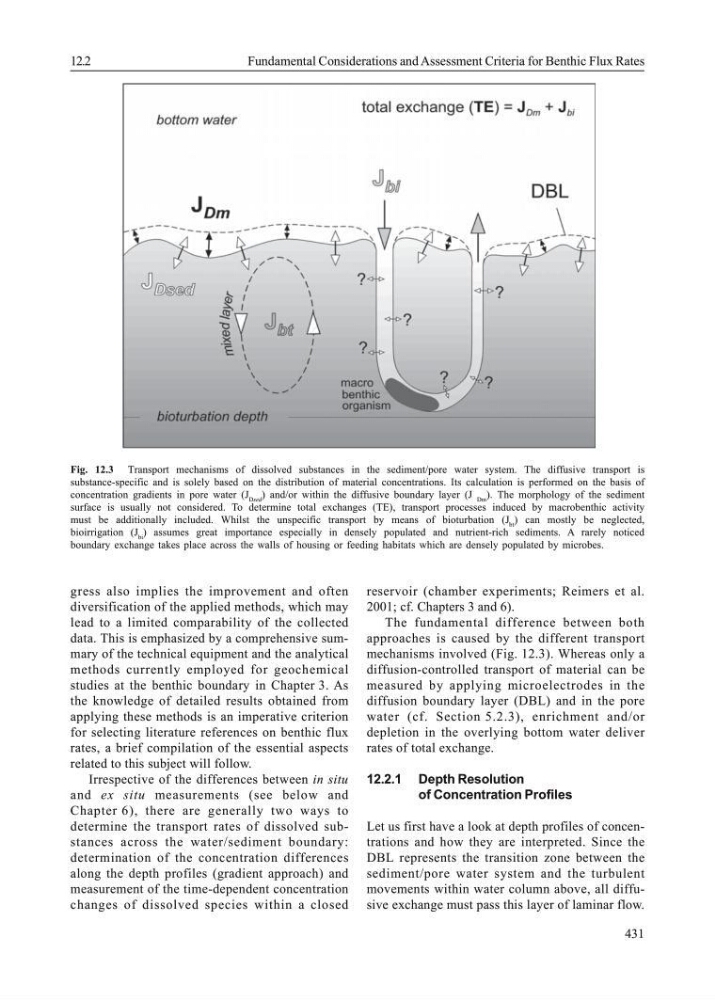
The fundamental difference between both
approaches is caused by the different transport
mechanisms involved (Fig. 12.3). Whereas only a
diffusion-controlled transport of material can be
measured by applying microelectrodes in the
diffusion boundary layer (DBL) and in the pore
water (cf. Section 5.2.3), enrichment and/or
depletion in the overlying bottom water deliver
rates of total exchange.
12.2.1 Depth Resolution
of Concentration Profiles
Let us first have a look at depth profiles of concentrations and how they are interpreted. Since the
DBL represents the transition zone between the
sediment/pore water system and the turbulent
movements within water column above, all diffusive exchange must pass this layer of laminar flow.
Fig. 12.3 Transport mechanisms of dissolved substances in the sediment/pore water system. The diffusive transport is
substance-specific and is solely based on the distribution of material concentrations. Its calculation is performed on the basis of
concentration gradients in pore water (J Dsed ) and/or within the diffusive boundary layer (J Dm ). The morphology of the sediment
surface is usually not considered. To determine total exchanges (TE), transport processes induced by macrobenthic activity
must be additionally included. Whilst the unspecific transport by means of bioturbation (J bt ) can mostly be neglected,
bioirrigation (J bi ) assumes great importance especially in densely populated and nutrient-rich sediments. A rarely noticed
boundary exchange takes place across the walls of housing or feeding habitats which are densely populated by microbes.
12.2
Fundamental Considerations and Assessment Criteria for Benthic Flux Rates
gress also implies the improvement and often
diversification of the applied methods, which may
lead to a limited comparability of the collected
data. This is emphasized by a comprehensive summary of the technical equipment and the analytical
methods currently employed for geochemical
studies at the benthic boundary in Chapter 3. As
the knowledge of detailed results obtained from
applying these methods is an imperative criterion
for selecting literature references on benthic flux
rates, a brief compilation of the essential aspects
related to this subject will follow.
Irrespective of the differences between in situ
and ex situ measurements (see below and
Chapter 6), there are generally two ways to
determine the transport rates of dissolved substances across the water/sediment boundary:
determination of the concentration differences
along the depth profiles (gradient approach) and
measurement of the time-dependent concentration
changes of dissolved species within a closed
reservoir (chamber experiments; Reimers et al.
2001; cf. Chapters 3 and 6).
The fundamental difference between both
approaches is caused by the different transport
mechanisms involved (Fig. 12.3). Whereas only a
diffusion-controlled transport of material can be
measured by applying microelectrodes in the
diffusion boundary layer (DBL) and in the pore
water (cf. Section 5.2.3), enrichment and/or
depletion in the overlying bottom water deliver
rates of total exchange.
12.2.1 Depth Resolution
of Concentration Profiles
Let us first have a look at depth profiles of concentrations and how they are interpreted. Since the
DBL represents the transition zone between the
sediment/pore water system and the turbulent
movements within water column above, all diffusive exchange must pass this layer of laminar flow.
Fig. 12.3 Transport mechanisms of dissolved substances in the sediment/pore water system. The diffusive transport is
substance-specific and is solely based on the distribution of material concentrations. Its calculation is performed on the basis of
concentration gradients in pore water (J Dsed ) and/or within the diffusive boundary layer (J Dm ). The morphology of the sediment
surface is usually not considered. To determine total exchanges (TE), transport processes induced by macrobenthic activity
must be additionally included. Whilst the unspecific transport by means of bioturbation (J bt ) can mostly be neglected,
bioirrigation (J bi ) assumes great importance especially in densely populated and nutrient-rich sediments. A rarely noticed
boundary exchange takes place across the walls of housing or feeding habitats which are densely populated by microbes.