

12 Quantification and Regionalization of Benthic Reflux
430
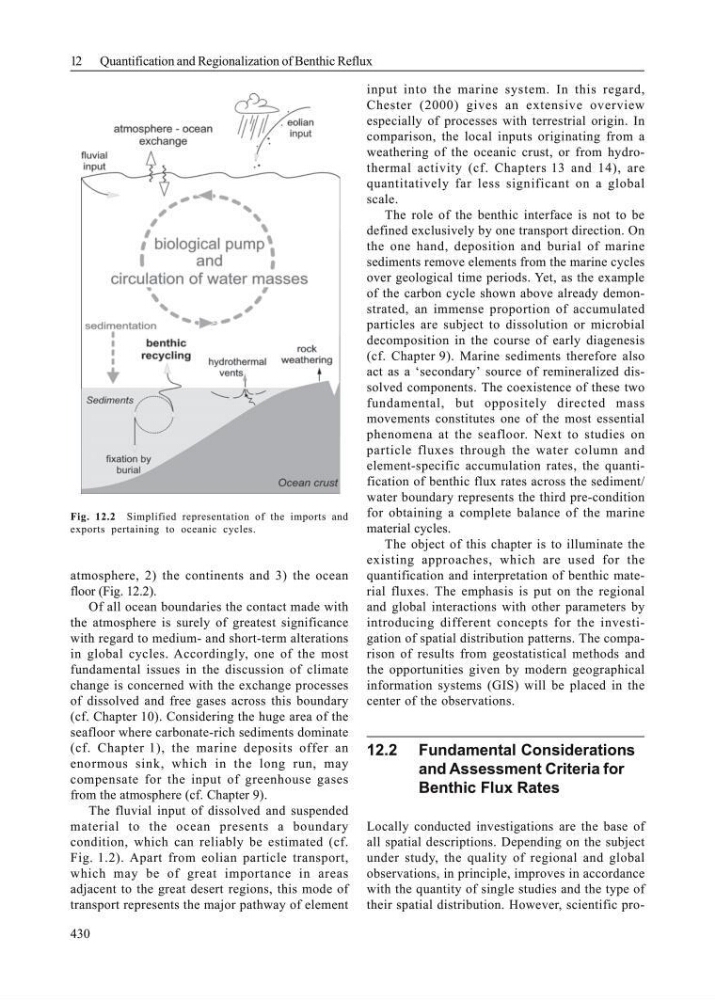
atmosphere, 2) the continents and 3) the ocean
floor (Fig. 12.2).
Of all ocean boundaries the contact made with
the atmosphere is surely of greatest significance
with regard to medium- and short-term alterations
in global cycles. Accordingly, one of the most
fundamental issues in the discussion of climate
change is concerned with the exchange processes
of dissolved and free gases across this boundary
(cf. Chapter 10). Considering the huge area of the
seafloor where carbonate-rich sediments dominate
(cf. Chapter 1), the marine deposits offer an
enormous sink, which in the long run, may
compensate for the input of greenhouse gases
from the atmosphere (cf. Chapter 9).
The fluvial input of dissolved and suspended
material to the ocean presents a boundary
condition, which can reliably be estimated (cf.
Fig. 1.2). Apart from eolian particle transport,
which may be of great importance in areas
adjacent to the great desert regions, this mode of
transport represents the major pathway of element
input into the marine system. In this regard,
Chester (2000) gives an extensive overview
especially of processes with terrestrial origin. In
comparison, the local inputs originating from a
weathering of the oceanic crust, or from hydrothermal activity (cf. Chapters 13 and 14), are
quantitatively far less significant on a global
scale.
The role of the benthic interface is not to be
defined exclusively by one transport direction. On
the one hand, deposition and burial of marine
sediments remove elements from the marine cycles
over geological time periods. Yet, as the example
of the carbon cycle shown above already demonstrated, an immense proportion of accumulated
particles are subject to dissolution or microbial
decomposition in the course of early diagenesis
(cf. Chapter 9). Marine sediments therefore also
act as a ‘secondary’ source of remineralized dissolved components. The coexistence of these two
fundamental, but oppositely directed mass
movements constitutes one of the most essential
phenomena at the seafloor. Next to studies on
particle fluxes through the water column and
element-specific accumulation rates, the quantification of benthic flux rates across the sediment/
water boundary represents the third pre-condition
for obtaining a complete balance of the marine
material cycles.
The object of this chapter is to illuminate the
existing approaches, which are used for the
quantification and interpretation of benthic material fluxes. The emphasis is put on the regional
and global interactions with other parameters by
introducing different concepts for the investigation of spatial distribution patterns. The comparison of results from geostatistical methods and
the opportunities given by modern geographical
information systems (GIS) will be placed in the
center of the observations.
12.2 Fundamental Considerations
and Assessment Criteria for
Benthic Flux Rates
Locally conducted investigations are the base of
all spatial descriptions. Depending on the subject
under study, the quality of regional and global
observations, in principle, improves in accordance
with the quantity of single studies and the type of
their spatial distribution. However, scientific proFig. 12.2 Simplified representation of the imports and
exports pertaining to oceanic cycles.
430
atmosphere, 2) the continents and 3) the ocean
floor (Fig. 12.2).
Of all ocean boundaries the contact made with
the atmosphere is surely of greatest significance
with regard to medium- and short-term alterations
in global cycles. Accordingly, one of the most
fundamental issues in the discussion of climate
change is concerned with the exchange processes
of dissolved and free gases across this boundary
(cf. Chapter 10). Considering the huge area of the
seafloor where carbonate-rich sediments dominate
(cf. Chapter 1), the marine deposits offer an
enormous sink, which in the long run, may
compensate for the input of greenhouse gases
from the atmosphere (cf. Chapter 9).
The fluvial input of dissolved and suspended
material to the ocean presents a boundary
condition, which can reliably be estimated (cf.
Fig. 1.2). Apart from eolian particle transport,
which may be of great importance in areas
adjacent to the great desert regions, this mode of
transport represents the major pathway of element
input into the marine system. In this regard,
Chester (2000) gives an extensive overview
especially of processes with terrestrial origin. In
comparison, the local inputs originating from a
weathering of the oceanic crust, or from hydrothermal activity (cf. Chapters 13 and 14), are
quantitatively far less significant on a global
scale.
The role of the benthic interface is not to be
defined exclusively by one transport direction. On
the one hand, deposition and burial of marine
sediments remove elements from the marine cycles
over geological time periods. Yet, as the example
of the carbon cycle shown above already demonstrated, an immense proportion of accumulated
particles are subject to dissolution or microbial
decomposition in the course of early diagenesis
(cf. Chapter 9). Marine sediments therefore also
act as a ‘secondary’ source of remineralized dissolved components. The coexistence of these two
fundamental, but oppositely directed mass
movements constitutes one of the most essential
phenomena at the seafloor. Next to studies on
particle fluxes through the water column and
element-specific accumulation rates, the quantification of benthic flux rates across the sediment/
water boundary represents the third pre-condition
for obtaining a complete balance of the marine
material cycles.
The object of this chapter is to illuminate the
existing approaches, which are used for the
quantification and interpretation of benthic material fluxes. The emphasis is put on the regional
and global interactions with other parameters by
introducing different concepts for the investigation of spatial distribution patterns. The comparison of results from geostatistical methods and
the opportunities given by modern geographical
information systems (GIS) will be placed in the
center of the observations.
12.2 Fundamental Considerations
and Assessment Criteria for
Benthic Flux Rates
Locally conducted investigations are the base of
all spatial descriptions. Depending on the subject
under study, the quality of regional and global
observations, in principle, improves in accordance
with the quantity of single studies and the type of
their spatial distribution. However, scientific proFig. 12.2 Simplified representation of the imports and
exports pertaining to oceanic cycles.