

429
12.1 Introduction
The observations made in the preceding chapters
have demonstrated that the upper sediment layers
usually contain the highest biochemical reaction
rates within marine deposits.
The decomposition of organic matter represents the major motive force of the benthic system
and its processes which are mostly catalyzed by
microbial activity. How important is the boundary
between free water mass and the pore water
system? In this chapter, we will be concerned with
finding answers to this question.
It is well established by a large number of
long-term studies that most part of the primary
organic substance is remineralized in the upper
water zones after the organisms have died (cf.
Chapter 4 and Section 5.5). Estimates on the
marine carbon cycle, which were made for pelagic
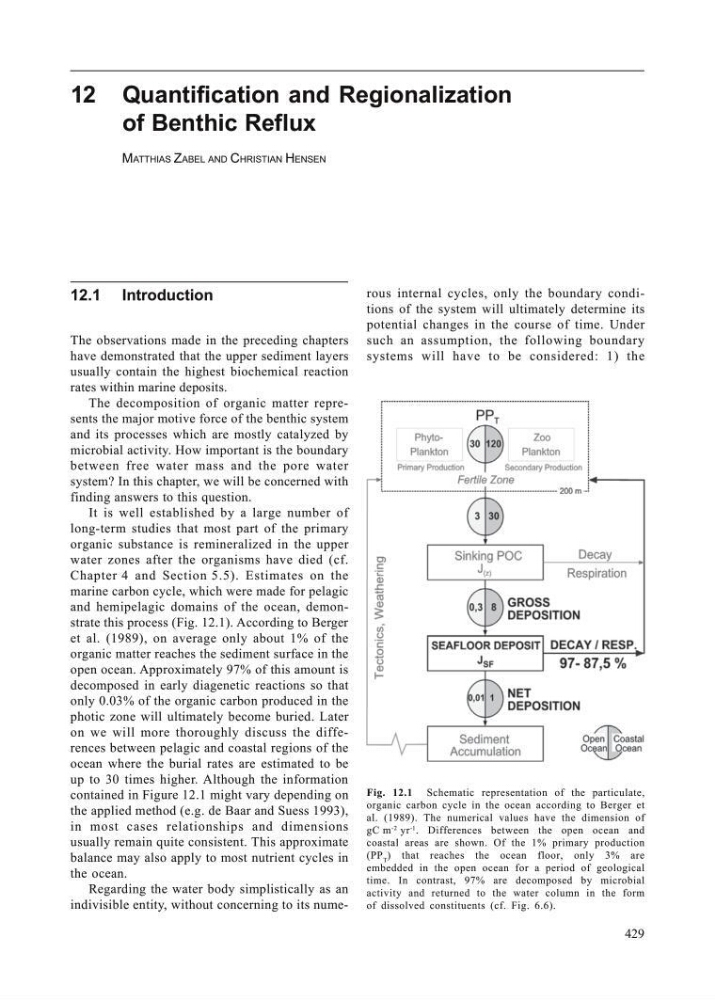
and hemipelagic domains of the ocean, demonstrate this process (Fig. 12.1). According to Berger
et al. (1989), on average only about 1% of the
organic matter reaches the sediment surface in the
open ocean. Approximately 97% of this amount is
decomposed in early diagenetic reactions so that
only 0.03% of the organic carbon produced in the
photic zone will ultimately become buried. Later
on we will more thoroughly discuss the differences between pelagic and coastal regions of the
ocean where the burial rates are estimated to be
up to 30 times higher. Although the information
contained in Figure 12.1 might vary depending on
the applied method (e.g. de Baar and Suess 1993),
in most cases relationships and dimensions
usually remain quite consistent. This approximate
balance may also apply to most nutrient cycles in
the ocean.
Regarding the water body simplistically as an
indivisible entity, without concerning to its nume12 Quantification and Regionalization
of Benthic Reflux
MATTHIAS ZABEL AND CHRISTIAN HENSEN
rous internal cycles, only the boundary conditions of the system will ultimately determine its
potential changes in the course of time. Under
such an assumption, the following boundary
systems will have to be considered: 1) the
Fig. 12.1 Schematic representation of the particulate,
organic carbon cycle in the ocean according to Berger et
al. (1989). The numerical values have the dimension of
gC m
-2 yr
-1 . Differences between the open ocean and
coastal areas are shown. Of the 1% primary production
(PP T ) that reaches the ocean floor, only 3% are
embedded in the open ocean for a period of geological
time. In contrast, 97% are decomposed by microbial
activity and returned to the water column in the form
of dissolved constituents (cf. Fig. 6.6).
12.1 Introduction
The observations made in the preceding chapters
have demonstrated that the upper sediment layers
usually contain the highest biochemical reaction
rates within marine deposits.
The decomposition of organic matter represents the major motive force of the benthic system
and its processes which are mostly catalyzed by
microbial activity. How important is the boundary
between free water mass and the pore water
system? In this chapter, we will be concerned with
finding answers to this question.
It is well established by a large number of
long-term studies that most part of the primary
organic substance is remineralized in the upper
water zones after the organisms have died (cf.
Chapter 4 and Section 5.5). Estimates on the
marine carbon cycle, which were made for pelagic
and hemipelagic domains of the ocean, demonstrate this process (Fig. 12.1). According to Berger
et al. (1989), on average only about 1% of the
organic matter reaches the sediment surface in the
open ocean. Approximately 97% of this amount is
decomposed in early diagenetic reactions so that
only 0.03% of the organic carbon produced in the
photic zone will ultimately become buried. Later
on we will more thoroughly discuss the differences between pelagic and coastal regions of the
ocean where the burial rates are estimated to be
up to 30 times higher. Although the information
contained in Figure 12.1 might vary depending on
the applied method (e.g. de Baar and Suess 1993),
in most cases relationships and dimensions
usually remain quite consistent. This approximate
balance may also apply to most nutrient cycles in
the ocean.
Regarding the water body simplistically as an
indivisible entity, without concerning to its nume12 Quantification and Regionalization
of Benthic Reflux
MATTHIAS ZABEL AND CHRISTIAN HENSEN
rous internal cycles, only the boundary conditions of the system will ultimately determine its
potential changes in the course of time. Under
such an assumption, the following boundary
systems will have to be considered: 1) the
Fig. 12.1 Schematic representation of the particulate,
organic carbon cycle in the ocean according to Berger et
al. (1989). The numerical values have the dimension of
gC m
-2 yr
-1 . Differences between the open ocean and
coastal areas are shown. Of the 1% primary production
(PP T ) that reaches the ocean floor, only 3% are
embedded in the open ocean for a period of geological
time. In contrast, 97% are decomposed by microbial
activity and returned to the water column in the form
of dissolved constituents (cf. Fig. 6.6).