

414
11 Manganese: Predominant Role of Nodules and Crusts
involves the deployment of a self-propelled dredge
which crawls along the bottom, collects the nodules,
crushes them and introduces them to a 600 m long
flexible hose connected to a rigid pipe. The crushed
nodules are then lifted to a semi-submersible surface
platform in a 4,800 m rigid steel pipe by airlift or pumps.
They are then transferred from the platform to the ore
carrier through a flexible hose as thick slurry. The
recovery rate using this method would be of the order
of 1.5 Mt of nodules on a dry-weight basis per year.
Mining systems for the recovery of Co-rich Mn
crusts have been described by Hein (2004). According
to this author, mining crusts is technically much more
difficult than mining nodules because the crusts are
attached to a substrate and occur in undulating
terrain. It is therefore necessary to separate the crust
from the underlying substrate at the seafloor. One
proposed mining system consists of a bottom crawling
vehicle attached to the surface mining vessel by a
hydraulic pipe lift system. The mining machine
provides its own propulsion and travels at a speed of
about 20 cm sec
-1
. The miner has articulated cutters
that would fragment the crusts and reduce the amount
of substrate material collected. This system could
possibly mine 1 Mt of crust with a 25% dilution by
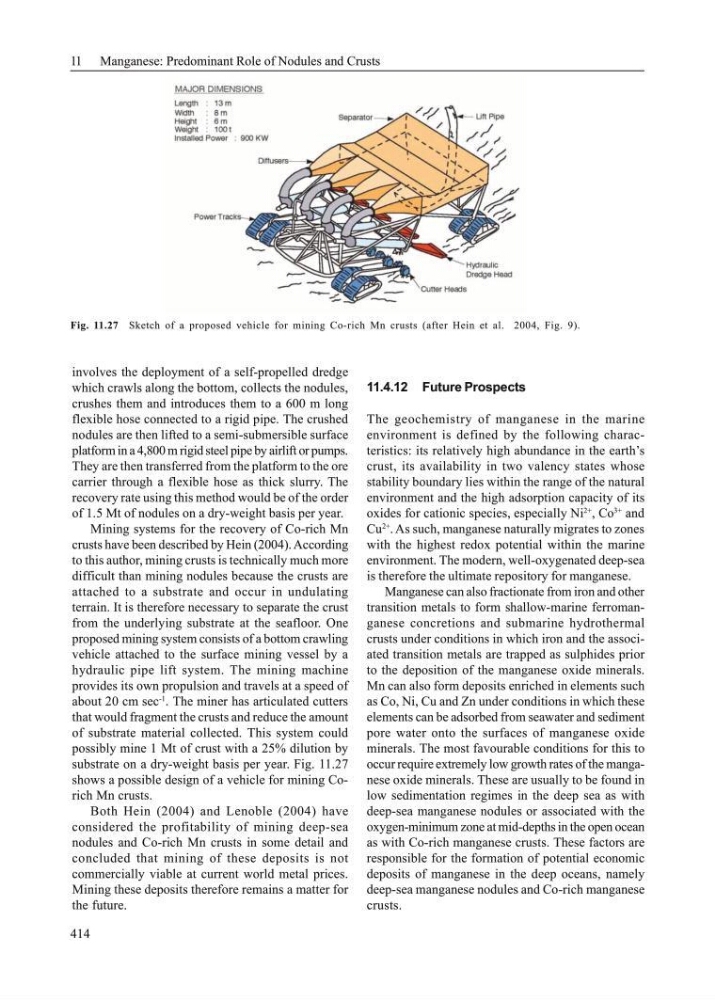
substrate on a dry-weight basis per year. Fig. 11.27
shows a possible design of a vehicle for mining Corich Mn crusts.
Both Hein (2004) and Lenoble (2004) have
considered the profitability of mining deep-sea
nodules and Co-rich Mn crusts in some detail and
concluded that mining of these deposits is not
commercially viable at current world metal prices.
Mining these deposits therefore remains a matter for
the future.
11.4.12 Future Prospects
The geochemistry of manganese in the marine
environment is defined by the following characteristics: its relatively high abundance in the earth’s
crust, its availability in two valency states whose
stability boundary lies within the range of the natural
environment and the high adsorption capacity of its
oxides for cationic species, especially Ni
2+
, Co
3+
and
Cu
2+
. As such, manganese naturally migrates to zones
with the highest redox potential within the marine
environment. The modern, well-oxygenated deep-sea
is therefore the ultimate repository for manganese.
Manganese can also fractionate from iron and other
transition metals to form shallow-marine ferromanganese concretions and submarine hydrothermal
crusts under conditions in which iron and the associated transition metals are trapped as sulphides prior
to the deposition of the manganese oxide minerals.
Mn can also form deposits enriched in elements such
as Co, Ni, Cu and Zn under conditions in which these
elements can be adsorbed from seawater and sediment
pore water onto the surfaces of manganese oxide
minerals. The most favourable conditions for this to
occur require extremely low growth rates of the manganese oxide minerals. These are usually to be found in
low sedimentation regimes in the deep sea as with
deep-sea manganese nodules or associated with the
oxygen-minimum zone at mid-depths in the open ocean
as with Co-rich manganese crusts. These factors are
responsible for the formation of potential economic
deposits of manganese in the deep oceans, namely
deep-sea manganese nodules and Co-rich manganese
crusts.
Fig. 11.27 Sketch of a proposed vehicle for mining Co-rich Mn crusts (after Hein et al. 2004, Fig. 9).
11 Manganese: Predominant Role of Nodules and Crusts
involves the deployment of a self-propelled dredge
which crawls along the bottom, collects the nodules,
crushes them and introduces them to a 600 m long
flexible hose connected to a rigid pipe. The crushed
nodules are then lifted to a semi-submersible surface
platform in a 4,800 m rigid steel pipe by airlift or pumps.
They are then transferred from the platform to the ore
carrier through a flexible hose as thick slurry. The
recovery rate using this method would be of the order
of 1.5 Mt of nodules on a dry-weight basis per year.
Mining systems for the recovery of Co-rich Mn
crusts have been described by Hein (2004). According
to this author, mining crusts is technically much more
difficult than mining nodules because the crusts are
attached to a substrate and occur in undulating
terrain. It is therefore necessary to separate the crust
from the underlying substrate at the seafloor. One
proposed mining system consists of a bottom crawling
vehicle attached to the surface mining vessel by a
hydraulic pipe lift system. The mining machine
provides its own propulsion and travels at a speed of
about 20 cm sec
-1
. The miner has articulated cutters
that would fragment the crusts and reduce the amount
of substrate material collected. This system could
possibly mine 1 Mt of crust with a 25% dilution by
substrate on a dry-weight basis per year. Fig. 11.27
shows a possible design of a vehicle for mining Corich Mn crusts.
Both Hein (2004) and Lenoble (2004) have
considered the profitability of mining deep-sea
nodules and Co-rich Mn crusts in some detail and
concluded that mining of these deposits is not
commercially viable at current world metal prices.
Mining these deposits therefore remains a matter for
the future.
11.4.12 Future Prospects
The geochemistry of manganese in the marine
environment is defined by the following characteristics: its relatively high abundance in the earth’s
crust, its availability in two valency states whose
stability boundary lies within the range of the natural
environment and the high adsorption capacity of its
oxides for cationic species, especially Ni
2+
, Co
3+
and
Cu
2+
. As such, manganese naturally migrates to zones
with the highest redox potential within the marine
environment. The modern, well-oxygenated deep-sea
is therefore the ultimate repository for manganese.
Manganese can also fractionate from iron and other
transition metals to form shallow-marine ferromanganese concretions and submarine hydrothermal
crusts under conditions in which iron and the associated transition metals are trapped as sulphides prior
to the deposition of the manganese oxide minerals.
Mn can also form deposits enriched in elements such
as Co, Ni, Cu and Zn under conditions in which these
elements can be adsorbed from seawater and sediment
pore water onto the surfaces of manganese oxide
minerals. The most favourable conditions for this to
occur require extremely low growth rates of the manganese oxide minerals. These are usually to be found in
low sedimentation regimes in the deep sea as with
deep-sea manganese nodules or associated with the
oxygen-minimum zone at mid-depths in the open ocean
as with Co-rich manganese crusts. These factors are
responsible for the formation of potential economic
deposits of manganese in the deep oceans, namely
deep-sea manganese nodules and Co-rich manganese
crusts.
Fig. 11.27 Sketch of a proposed vehicle for mining Co-rich Mn crusts (after Hein et al. 2004, Fig. 9).