

413
looking for a strategic source of metals rather than a
resource that is economically cost competitive.
For deep-sea nodules, only those nodules with
Cu+Ni+Co >2.5% and abundance >10 kg m
-2
can be
considered to be a potential economic resource. This
represents only a small percentage of total quantity of
nodules worldwide (i.e. diagenetic nodules from the
C-C F.Z. and Central Indian Ocean Basin). To be
economic, a 20 year-mine-site would be required to
produce 3 Mt of nodules per year. This would cover
an area >6,000 km
2
. According to Lenoble (2004), the
estimated total number of potential mine sites varies
from 8 to 225 corresponding to a total of between 48013,500 Mt of nodules. However, if the capacity of world
metal markets to absorb production from the deep sea
is taken into account, a more realistic assessment was
taken to be 3-10 mine sites with a total tonnage of 100600 Mt over this period. This reflects the marked
differences in the ratios of the amounts of metals in
nodules (Ni 7: Cu 6: Co 1) compared to the ratios of
their consumption (Ni 27: Cu 267: Co 1) (Bernhard and
Blissenbach 1988). As a result, if large tonnages of
nodules were to be mined for Ni and Cu, it would lead
to overproduction of Co with an associated drop in its
world price. The markets would therefore have to be
manipulated to avoid such disruptions. Based on an
annual worldwide production rate of Ni of 0.9 Mt in
1998; Morgan (2000) considered Ni to be the primary
metal of commercial interest in deep-sea nodules. Because
deep-sea nodules occur at great depths in the oceans
(greater than 4,000 m), they require sophisticated capitalintensive technology to mine and are in direct competition with land-based mineral resources. A decision to
mine them must therefore ultimately be based on economic
rather than technological considerations.
For Co-rich manganese crusts, the crusts should
contain >0.8% Co and be >40 mm thick to be
considered economically viable. The crusts occur in
shallower water depths (1,000-2,500 m) than deep-sea
nodules (>4,000 m) and could be mined within national
Exclusive Economic Zones (EEZs) and therefore under
national jurisdiction. Excellent accounts of the
distribution and composition of Co-rich crusts in the
world ocean have been presented by Andreev and
Gramberg (1998) and Hein (2000) and several authors
have attempted to assess of their economic potential
(Wiltshire et al. 1999; Hein 2000, 2004; Wiltshire 2000).
Andreev and Gramberg (2002) have estimated the total
abundance of Co-rich crusts in the world ocean to be
about 21·10
9
t.
The types of mining systems likely to be used for
the recovery of deep-sea nodules and Co-rich Mn
crusts are not well known. For nodules, Lenoble (2004)
has described a system to mine the French area. This
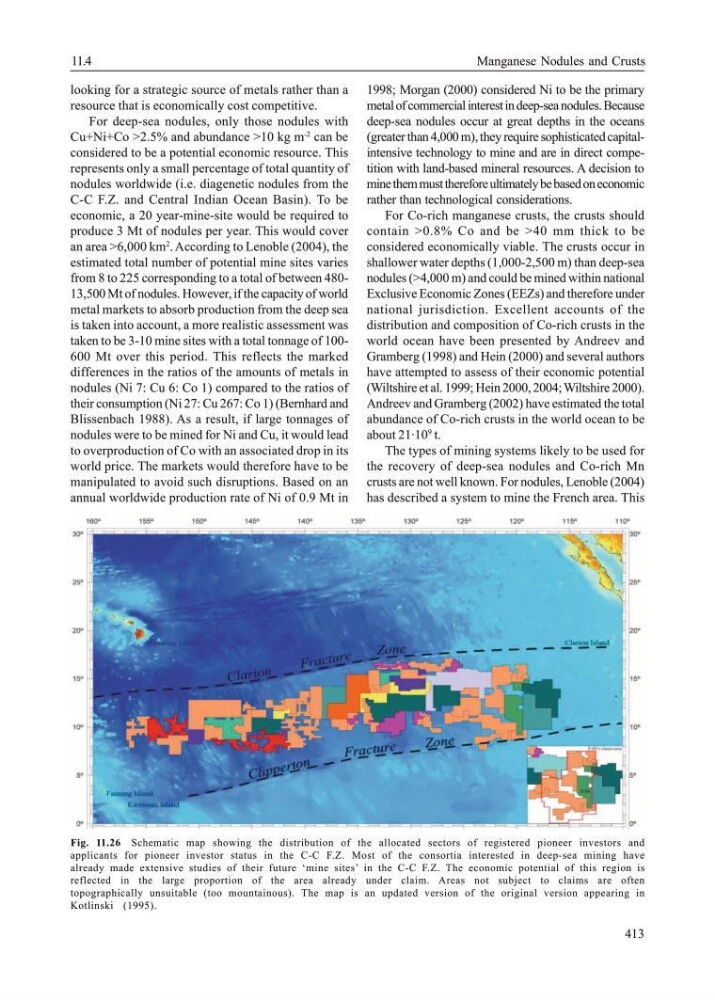
Fig. 11.26 Schematic map showing the distribution of the allocated sectors of registered pioneer investors and
applicants for pioneer investor status in the C-C F.Z. Most of the consortia interested in deep-sea mining have
already made extensive studies of their future ‘mine sites’ in the C-C F.Z. The economic potential of this region is
reflected in the large proportion of the area already under claim. Areas not subject to claims are often
topographically unsuitable (too mountainous). The map is an updated version of the original version appearing in
Kotlinski (1995).
11.4
Manganese Nodules and Crusts
looking for a strategic source of metals rather than a
resource that is economically cost competitive.
For deep-sea nodules, only those nodules with
Cu+Ni+Co >2.5% and abundance >10 kg m
-2
can be
considered to be a potential economic resource. This
represents only a small percentage of total quantity of
nodules worldwide (i.e. diagenetic nodules from the
C-C F.Z. and Central Indian Ocean Basin). To be
economic, a 20 year-mine-site would be required to
produce 3 Mt of nodules per year. This would cover
an area >6,000 km
2
. According to Lenoble (2004), the
estimated total number of potential mine sites varies
from 8 to 225 corresponding to a total of between 48013,500 Mt of nodules. However, if the capacity of world
metal markets to absorb production from the deep sea
is taken into account, a more realistic assessment was
taken to be 3-10 mine sites with a total tonnage of 100600 Mt over this period. This reflects the marked
differences in the ratios of the amounts of metals in
nodules (Ni 7: Cu 6: Co 1) compared to the ratios of
their consumption (Ni 27: Cu 267: Co 1) (Bernhard and
Blissenbach 1988). As a result, if large tonnages of
nodules were to be mined for Ni and Cu, it would lead
to overproduction of Co with an associated drop in its
world price. The markets would therefore have to be
manipulated to avoid such disruptions. Based on an
annual worldwide production rate of Ni of 0.9 Mt in
1998; Morgan (2000) considered Ni to be the primary
metal of commercial interest in deep-sea nodules. Because
deep-sea nodules occur at great depths in the oceans
(greater than 4,000 m), they require sophisticated capitalintensive technology to mine and are in direct competition with land-based mineral resources. A decision to
mine them must therefore ultimately be based on economic
rather than technological considerations.
For Co-rich manganese crusts, the crusts should
contain >0.8% Co and be >40 mm thick to be
considered economically viable. The crusts occur in
shallower water depths (1,000-2,500 m) than deep-sea
nodules (>4,000 m) and could be mined within national
Exclusive Economic Zones (EEZs) and therefore under
national jurisdiction. Excellent accounts of the
distribution and composition of Co-rich crusts in the
world ocean have been presented by Andreev and
Gramberg (1998) and Hein (2000) and several authors
have attempted to assess of their economic potential
(Wiltshire et al. 1999; Hein 2000, 2004; Wiltshire 2000).
Andreev and Gramberg (2002) have estimated the total
abundance of Co-rich crusts in the world ocean to be
about 21·10
9
t.
The types of mining systems likely to be used for
the recovery of deep-sea nodules and Co-rich Mn
crusts are not well known. For nodules, Lenoble (2004)
has described a system to mine the French area. This
Fig. 11.26 Schematic map showing the distribution of the allocated sectors of registered pioneer investors and
applicants for pioneer investor status in the C-C F.Z. Most of the consortia interested in deep-sea mining have
already made extensive studies of their future ‘mine sites’ in the C-C F.Z. The economic potential of this region is
reflected in the large proportion of the area already under claim. Areas not subject to claims are often
topographically unsuitable (too mountainous). The map is an updated version of the original version appearing in
Kotlinski (1995).
11.4
Manganese Nodules and Crusts