

407
11.4.10.2 Application of Isotopic Studies of
Co-rich Mn Crusts to the Study of
Present-day Deep-ocean Circulation
The release of trace metals with different isotopic ratios
from the Earth’s crust by weathering or hydrothermal
activity is the basis for the observed variability of
isotopic composition of these metals in the oceans
(Frank 2002). Albarède and Goldstein (1992) pioneered
the application of isotopic studies of ferromanganese
deposits to the study of present-day deep-ocean
circulation by mapping the Nd isotopic composition of
270 samples of ferromanganese crusts and nodules from
the world ocean. The results showed a marked similarity
between regional Nd isotopic variations of the crusts
and nodules and the broad pattern of present-day deepocean circulation. This was somewhat surprising in view
of the short residence time of Nd in seawater (~10 - 10
3
years) compared with the much longer time scale of
ferromanganese formation which is measured in millions
of years but reflects the stability of deep-sea circulation
since the Pliocene integrated over time. Subsequently,
von Blanckenburg et al. (1996a) measured Pb isotope
ratios (
206
Pb/
204
Pb and
208
Pb/
204
Pb) in ferromanganese
crusts from the world ocean and showed that these
isotopic ratios are remarkably uniform in the Pacific
reflecting the fact that Pb is extremely well mixed as a
result of its short residence time in ocean bottom waters
(80-100 years).
The Pb isotope ratios also indicated that Pb is more
juvenile in the Pacific than in the Atlantic Ocean. From
this, it was deduced that the Pb in the Pacific Ocean is
derived principally from the subduction of MORB and
pelagic sediment at volcanic arcs and from continental
margin volcanics whereas in the Atlantic Ocean it is
derived principally from riverine particulate matter. Von
Blanckenburg et al. (1996b) also measured beryllium
isotope ratios (
10
Be/
9
Be) in ferromanganese crusts from
the world ocean and showed that the
10
Be/
9
Be ratios in
the crusts are in close agreement with seawater values
from the same area and that the
10
Be/
9
Be ratios of the
crusts decrease along the path of ocean bottom water
flow and correlate with the ∆
14
C age of the deep-ocean
bottom water flow. The residence time of Be in the Pacific
away from the margins was estimated to be 600 ± 100
years.
These observations enabled Hein et al. (2000) to
prepare a schematic map of deep-ocean flow in the world
ocean showing the characteristic changes in the Nd,
Pb and Be isotopic composition of the ferromanganese
crusts along the bottom water flow path (Fig. 11.22).
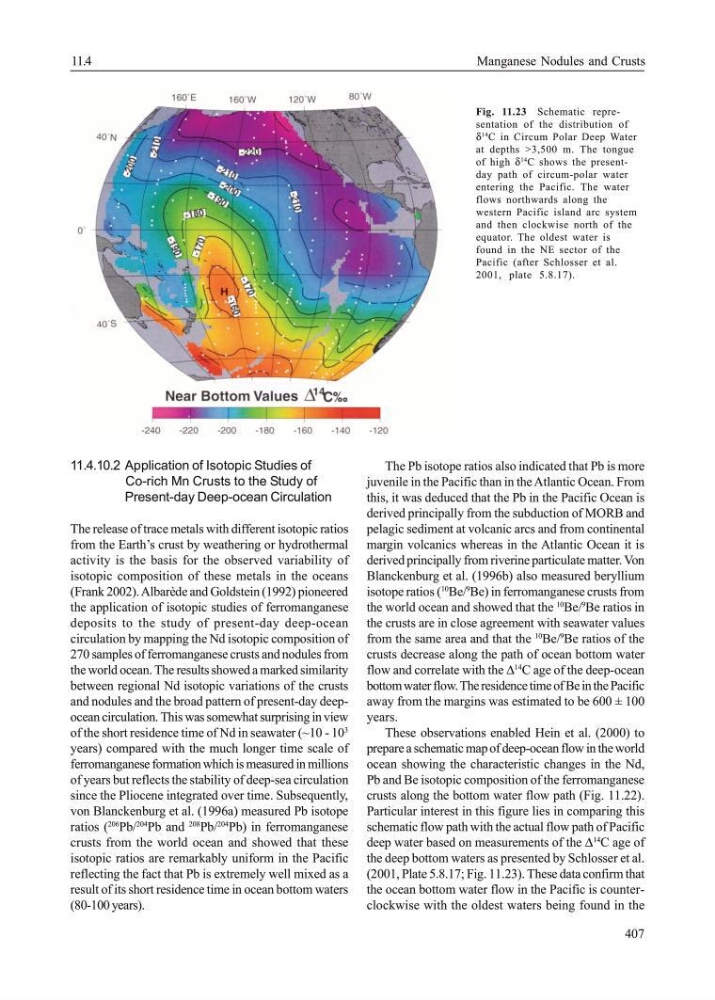
Particular interest in this figure lies in comparing this
schematic flow path with the actual flow path of Pacific
deep water based on measurements of the ∆
14
C age of
the deep bottom waters as presented by Schlosser et al.
(2001, Plate 5.8.17; Fig. 11.23). These data confirm that
the ocean bottom water flow in the Pacific is counterclockwise with the oldest waters being found in the
Fig. 11.23 Schematic representation of the distribution of
δ
14 C in Circum Polar Deep Water
at depths >3,500 m. The tongue
of high δ
14 C shows the presentday path of circum-polar water
entering the Pacific. The water
flows northwards along the
western Pacific island arc system
and then clockwise north of the
equator. The oldest water is
found in the NE sector of the
Pacific (after Schlosser et al.
2001, plate 5.8.17).
11.4
Manganese Nodules and Crusts
11.4.10.2 Application of Isotopic Studies of
Co-rich Mn Crusts to the Study of
Present-day Deep-ocean Circulation
The release of trace metals with different isotopic ratios
from the Earth’s crust by weathering or hydrothermal
activity is the basis for the observed variability of
isotopic composition of these metals in the oceans
(Frank 2002). Albarède and Goldstein (1992) pioneered
the application of isotopic studies of ferromanganese
deposits to the study of present-day deep-ocean
circulation by mapping the Nd isotopic composition of
270 samples of ferromanganese crusts and nodules from
the world ocean. The results showed a marked similarity
between regional Nd isotopic variations of the crusts
and nodules and the broad pattern of present-day deepocean circulation. This was somewhat surprising in view
of the short residence time of Nd in seawater (~10 - 10
3
years) compared with the much longer time scale of
ferromanganese formation which is measured in millions
of years but reflects the stability of deep-sea circulation
since the Pliocene integrated over time. Subsequently,
von Blanckenburg et al. (1996a) measured Pb isotope
ratios (
206
Pb/
204
Pb and
208
Pb/
204
Pb) in ferromanganese
crusts from the world ocean and showed that these
isotopic ratios are remarkably uniform in the Pacific
reflecting the fact that Pb is extremely well mixed as a
result of its short residence time in ocean bottom waters
(80-100 years).
The Pb isotope ratios also indicated that Pb is more
juvenile in the Pacific than in the Atlantic Ocean. From
this, it was deduced that the Pb in the Pacific Ocean is
derived principally from the subduction of MORB and
pelagic sediment at volcanic arcs and from continental
margin volcanics whereas in the Atlantic Ocean it is
derived principally from riverine particulate matter. Von
Blanckenburg et al. (1996b) also measured beryllium
isotope ratios (
10
Be/
9
Be) in ferromanganese crusts from
the world ocean and showed that the
10
Be/
9
Be ratios in
the crusts are in close agreement with seawater values
from the same area and that the
10
Be/
9
Be ratios of the
crusts decrease along the path of ocean bottom water
flow and correlate with the ∆
14
C age of the deep-ocean
bottom water flow. The residence time of Be in the Pacific
away from the margins was estimated to be 600 ± 100
years.
These observations enabled Hein et al. (2000) to
prepare a schematic map of deep-ocean flow in the world
ocean showing the characteristic changes in the Nd,
Pb and Be isotopic composition of the ferromanganese
crusts along the bottom water flow path (Fig. 11.22).
Particular interest in this figure lies in comparing this
schematic flow path with the actual flow path of Pacific
deep water based on measurements of the ∆
14
C age of
the deep bottom waters as presented by Schlosser et al.
(2001, Plate 5.8.17; Fig. 11.23). These data confirm that
the ocean bottom water flow in the Pacific is counterclockwise with the oldest waters being found in the
Fig. 11.23 Schematic representation of the distribution of
δ
14 C in Circum Polar Deep Water
at depths >3,500 m. The tongue
of high δ
14 C shows the presentday path of circum-polar water
entering the Pacific. The water
flows northwards along the
western Pacific island arc system
and then clockwise north of the
equator. The oldest water is
found in the NE sector of the
Pacific (after Schlosser et al.
2001, plate 5.8.17).
11.4
Manganese Nodules and Crusts