

406
11 Manganese: Predominant Role of Nodules and Crusts
the rifting and northward drift of Australia from
Antarctica which began at about 55 Ma (and is
associated with an abrupt negative ~3 ppt global carbon
isotope excursion which has been attributed to the
dissociation of 2,000 - 6,000 Gt of methane hydrates;
Norris and Röhling 1999; Zachos et al. 2001; Dickens
2004), the development of the deep-water passage
through the Tasman Strait at about 36 Ma (Ling et al.
1997), the opening of the Drake Passage at about 23 Ma
which is thought to have initiated ocean bottom water
flow through the Samoan Passage (Lonsdale 1981), the
development of Antarctic glaciation about 14 Ma ago,
an increase in ocean bottom circulation rates at 6.2 Ma
and closing of the Panama Isthmus about 3.5 Ma ago
(see also Segl et al. 1989; Xu 1997). Of these, the most
important for the formation of oceanic manganese
nodules and crusts was the Middle Miocene climate
transition which occurred between 14.3 and 13.8 Ma
(Shevenell et al. 2004). This event resulted in a cooling
of the surface waters in the southwest Pacific by 6 - 7°C
at ~55°S and was responsible for the development of
the modern pattern of deep ocean bottom water flow. In
addition, there was a general cooling of the global climate
since the Eocene climate maximum at about 50 Ma,
although this general trend has been punctuated by a
series of steps (Zachos et al. 2001). The observations
presented above show that Co-rich manganese crusts
record these changes in ocean circulation, although
perhaps not with the precision that one might hope for.
It is well known that deep circulation of the oceans
is much more pronounced during periods of „ice house
Earth“ (characterized by Polar ice sheets and a welldeveloped cryosphere) than during periods of „greenhouse Earth“ (when the cryosphere is absent). The
„ice house Earth“ is generally taken to include the
Oligocene, Late Miocene, Pliocene and Pleistocene
and the „greenhouse Earth“ the Cretaceous, Paleocene
and the Eocene (Jenkyns and Wilson 1999; Zachos et
al. 2001). Ventilation, and therefore the degree of
oxygenation, of the deep ocean, is controlled by the
density difference between surface seawater and deep
ocean bottom water which induces deep circulation of
the oceans and is much more pronounced during
periods of „ice house Earth“ than during periods of
the „greenhouse Earth“. This trend is illustrated by
the dominance of deep-sea manganese nodules in
D.S.D.P. cores since the Eocene (Glasby 1978).
Kaiko (1998) has confirmed this trend by demonstrating that the low oxygen events in the oceans
during the past 120 Ma have coincided with warm
episodes in the oceans based on his benthic
foraminiferal dissolved-oxygen index. Pulyaeva (1997)
has also shown that the average Co content of Corich crusts from the Magellan Seamounts has
increased steadily from 0.16% in the Late Cretaceous
to 0.57% in the Eocene and 0.72% in the MiocenePleistocene whereas P 2 O 5 showed the opposite trend
declining from 13.5% to 1.3% during this period (von
Stackelberg et al. 1984; De Carlo 1991; Frank et al.
1999b; see section 11.4.9). This trend reflects the
increased ventilation of the oceans through time and,
in particular, the development of a more pronounced
oxygen minimum zone in the ocean following the
Middle Miocene climate transition.
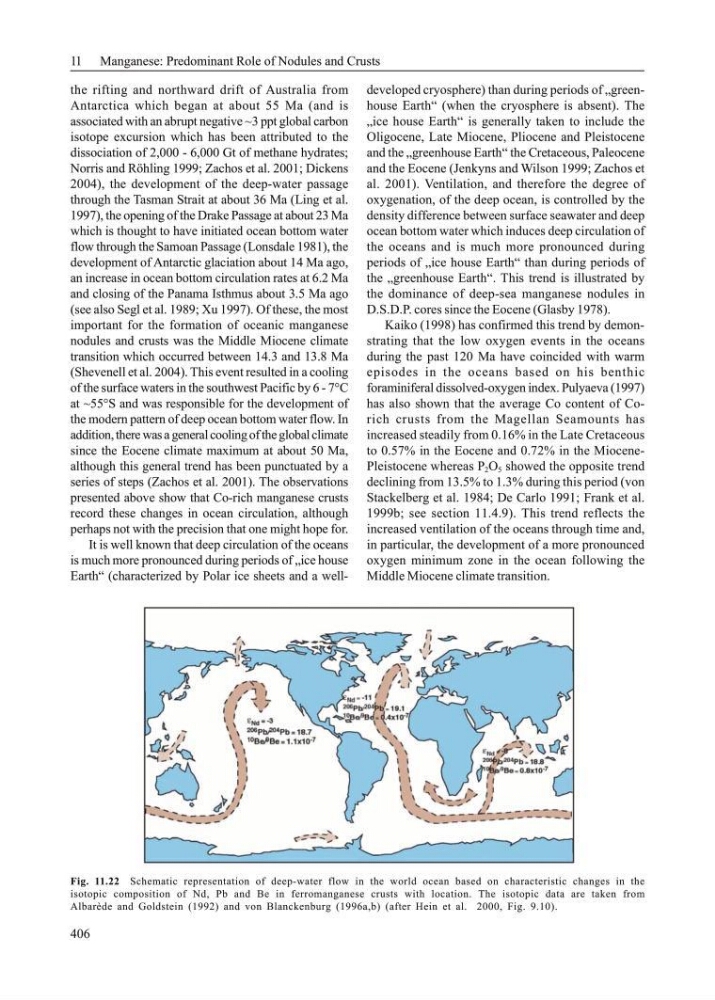
Fig. 11.22 Schematic representation of deep-water flow in the world ocean based on characteristic changes in the
isotopic composition of Nd, Pb and Be in ferromanganese crusts with location. The isotopic data are taken from
Albarède and Goldstein (1992) and von Blanckenburg (1996a,b) (after Hein et al. 2000, Fig. 9.10).
11 Manganese: Predominant Role of Nodules and Crusts
the rifting and northward drift of Australia from
Antarctica which began at about 55 Ma (and is
associated with an abrupt negative ~3 ppt global carbon
isotope excursion which has been attributed to the
dissociation of 2,000 - 6,000 Gt of methane hydrates;
Norris and Röhling 1999; Zachos et al. 2001; Dickens
2004), the development of the deep-water passage
through the Tasman Strait at about 36 Ma (Ling et al.
1997), the opening of the Drake Passage at about 23 Ma
which is thought to have initiated ocean bottom water
flow through the Samoan Passage (Lonsdale 1981), the
development of Antarctic glaciation about 14 Ma ago,
an increase in ocean bottom circulation rates at 6.2 Ma
and closing of the Panama Isthmus about 3.5 Ma ago
(see also Segl et al. 1989; Xu 1997). Of these, the most
important for the formation of oceanic manganese
nodules and crusts was the Middle Miocene climate
transition which occurred between 14.3 and 13.8 Ma
(Shevenell et al. 2004). This event resulted in a cooling
of the surface waters in the southwest Pacific by 6 - 7°C
at ~55°S and was responsible for the development of
the modern pattern of deep ocean bottom water flow. In
addition, there was a general cooling of the global climate
since the Eocene climate maximum at about 50 Ma,
although this general trend has been punctuated by a
series of steps (Zachos et al. 2001). The observations
presented above show that Co-rich manganese crusts
record these changes in ocean circulation, although
perhaps not with the precision that one might hope for.
It is well known that deep circulation of the oceans
is much more pronounced during periods of „ice house
Earth“ (characterized by Polar ice sheets and a welldeveloped cryosphere) than during periods of „greenhouse Earth“ (when the cryosphere is absent). The
„ice house Earth“ is generally taken to include the
Oligocene, Late Miocene, Pliocene and Pleistocene
and the „greenhouse Earth“ the Cretaceous, Paleocene
and the Eocene (Jenkyns and Wilson 1999; Zachos et
al. 2001). Ventilation, and therefore the degree of
oxygenation, of the deep ocean, is controlled by the
density difference between surface seawater and deep
ocean bottom water which induces deep circulation of
the oceans and is much more pronounced during
periods of „ice house Earth“ than during periods of
the „greenhouse Earth“. This trend is illustrated by
the dominance of deep-sea manganese nodules in
D.S.D.P. cores since the Eocene (Glasby 1978).
Kaiko (1998) has confirmed this trend by demonstrating that the low oxygen events in the oceans
during the past 120 Ma have coincided with warm
episodes in the oceans based on his benthic
foraminiferal dissolved-oxygen index. Pulyaeva (1997)
has also shown that the average Co content of Corich crusts from the Magellan Seamounts has
increased steadily from 0.16% in the Late Cretaceous
to 0.57% in the Eocene and 0.72% in the MiocenePleistocene whereas P 2 O 5 showed the opposite trend
declining from 13.5% to 1.3% during this period (von
Stackelberg et al. 1984; De Carlo 1991; Frank et al.
1999b; see section 11.4.9). This trend reflects the
increased ventilation of the oceans through time and,
in particular, the development of a more pronounced
oxygen minimum zone in the ocean following the
Middle Miocene climate transition.
Fig. 11.22 Schematic representation of deep-water flow in the world ocean based on characteristic changes in the
isotopic composition of Nd, Pb and Be in ferromanganese crusts with location. The isotopic data are taken from
Albarède and Goldstein (1992) and von Blanckenburg (1996a,b) (after Hein et al. 2000, Fig. 9.10).