

393
Koschinsky et al. (1997) have also related differences in composition between the older and
younger layers of Co-rich crusts to the expansion of
the oxygen minimium zone during periods of
phosphatization of the older crust layers which led
to the diagenetic remobilization of certain elements
within this layer of the crust.
In order to be of potential economic interest,
crusts should have Co contents >0.8%, average
crustal thicknesses >40 mm and be situated in an
area of subdued small-scale topography. Based on
their extensive experience of studying Co-rich Mn
crusts, Hein et al. (1987) listed a number of other
criteria for locating interesting crusts. The crusts
should be situated on large volcanic edifices shallower than 1,500-1,000 m and older than 20 Ma
occurring in areas of strong oceanic bottom currents.
The volcanic structures should not be capped by
large modern atolls or reefs and the seamount slopes
should be stable. The area should not be influenced
by the input of abundant fluvial or eolian debris and
there should be no local active volcanism. Most
importantly, the area should be characterized by a
shallow and stable oxygen minimum zone. In
particular, the importance of mass wasting of coral
debris from atolls and guyots in tropical environments is stressed. In a detailed sampling programme around islands and seamounts in the area of
the Manihiki Plateau in the equatorial South Pacific,
Meylan et al. (1990) recovered only thin Mn crusts
with a maximum thickness of 20 mm because of the
extensive mass wasting of limestone debris in the
region which gave insufficient time for thick crusts
to develop.
11.4.5 Shallow-Marine Ferromanganese
Concretions
Shallow-water continental margin ferromanganese
concretions have been reported in a number of areas
such as the Baltic Sea, Black Sea, Kara Sea, Loch Fyne,
Scotland, and Jervis Inlet, British Columbia (Calvert
and Price 1977). In fact, these were the first type of
marine Mn deposits to be discovered, during the 1868
Sofia expedition to the Kara Sea led by A.E. Nordenskiøld (Earney 1990).
Ferromanganese concretions from the Baltic Sea
have been described in detail by Glasby et al. (1997a).
Three main types of concretions occur there (spheroidal, discoidal and crusts). The concretions frequently,
although not always, form around a glacial erratic seed
or nucleus and display alternate banding of Fe- and
Mn-rich layers tens to hundreds of µm thick. Mineralogically, the concretions consist of 10 Å manganate
with abundant quartz and lesser amounts of feldspar
and montmorillonite. The composition of the concretions is highly variable reflecting, in part, the variable
amount of erratic material in the concretion. The
composition is controlled by the redox characteristics
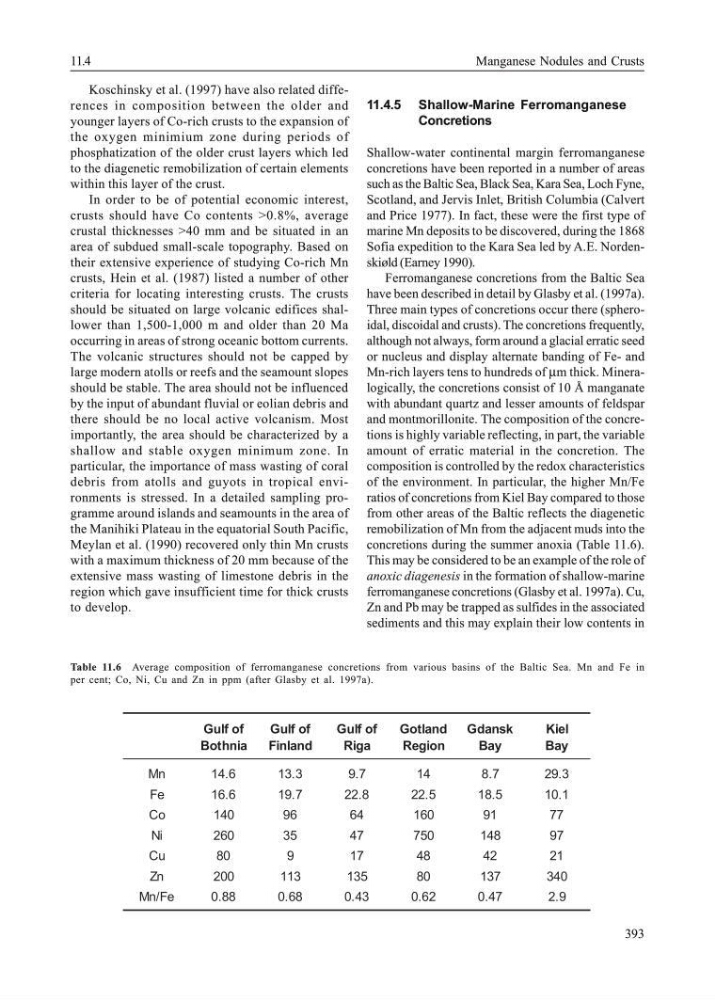
of the environment. In particular, the higher Mn/Fe
ratios of concretions from Kiel Bay compared to those
from other areas of the Baltic reflects the diagenetic
remobilization of Mn from the adjacent muds into the
concretions during the summer anoxia (Table 11.6).
This may be considered to be an example of the role of
anoxic diagenesis in the formation of shallow-marine
ferromanganese concretions (Glasby et al. 1997a). Cu,
Zn and Pb may be trapped as sulfides in the associated
sediments and this may explain their low contents in
Gulf of
Gulf of
Gulf of
Gotland
Gdansk
Kiel
Bothnia
Finland
Riga
Region
Bay
Bay
Mn
14.6
13.3
9.7
14
8.7
29.3
Fe
16.6
19.7
22.8
22.5
18.5
10.1
Co
140
96
64
160
91
77
Ni
260
35
47
750
148
97
C u
8 0
9
1 7
4 8
4 2
2 1
Zn
200
113
135
80
137
340
Mn/Fe
0.88
0.68
0.43
0.62
0.47
2.9
Table 11.6 Average composition of ferromanganese concretions from various basins of the Baltic Sea. Mn and Fe in
per cent; Co, Ni, Cu and Zn in ppm (after Glasby et al. 1997a).
11.4
Manganese Nodules and Crusts
Koschinsky et al. (1997) have also related differences in composition between the older and
younger layers of Co-rich crusts to the expansion of
the oxygen minimium zone during periods of
phosphatization of the older crust layers which led
to the diagenetic remobilization of certain elements
within this layer of the crust.
In order to be of potential economic interest,
crusts should have Co contents >0.8%, average
crustal thicknesses >40 mm and be situated in an
area of subdued small-scale topography. Based on
their extensive experience of studying Co-rich Mn
crusts, Hein et al. (1987) listed a number of other
criteria for locating interesting crusts. The crusts
should be situated on large volcanic edifices shallower than 1,500-1,000 m and older than 20 Ma
occurring in areas of strong oceanic bottom currents.
The volcanic structures should not be capped by
large modern atolls or reefs and the seamount slopes
should be stable. The area should not be influenced
by the input of abundant fluvial or eolian debris and
there should be no local active volcanism. Most
importantly, the area should be characterized by a
shallow and stable oxygen minimum zone. In
particular, the importance of mass wasting of coral
debris from atolls and guyots in tropical environments is stressed. In a detailed sampling programme around islands and seamounts in the area of
the Manihiki Plateau in the equatorial South Pacific,
Meylan et al. (1990) recovered only thin Mn crusts
with a maximum thickness of 20 mm because of the
extensive mass wasting of limestone debris in the
region which gave insufficient time for thick crusts
to develop.
11.4.5 Shallow-Marine Ferromanganese
Concretions
Shallow-water continental margin ferromanganese
concretions have been reported in a number of areas
such as the Baltic Sea, Black Sea, Kara Sea, Loch Fyne,
Scotland, and Jervis Inlet, British Columbia (Calvert
and Price 1977). In fact, these were the first type of
marine Mn deposits to be discovered, during the 1868
Sofia expedition to the Kara Sea led by A.E. Nordenskiøld (Earney 1990).
Ferromanganese concretions from the Baltic Sea
have been described in detail by Glasby et al. (1997a).
Three main types of concretions occur there (spheroidal, discoidal and crusts). The concretions frequently,
although not always, form around a glacial erratic seed
or nucleus and display alternate banding of Fe- and
Mn-rich layers tens to hundreds of µm thick. Mineralogically, the concretions consist of 10 Å manganate
with abundant quartz and lesser amounts of feldspar
and montmorillonite. The composition of the concretions is highly variable reflecting, in part, the variable
amount of erratic material in the concretion. The
composition is controlled by the redox characteristics
of the environment. In particular, the higher Mn/Fe
ratios of concretions from Kiel Bay compared to those
from other areas of the Baltic reflects the diagenetic
remobilization of Mn from the adjacent muds into the
concretions during the summer anoxia (Table 11.6).
This may be considered to be an example of the role of
anoxic diagenesis in the formation of shallow-marine
ferromanganese concretions (Glasby et al. 1997a). Cu,
Zn and Pb may be trapped as sulfides in the associated
sediments and this may explain their low contents in
Gulf of
Gulf of
Gulf of
Gotland
Gdansk
Kiel
Bothnia
Finland
Riga
Region
Bay
Bay
Mn
14.6
13.3
9.7
14
8.7
29.3
Fe
16.6
19.7
22.8
22.5
18.5
10.1
Co
140
96
64
160
91
77
Ni
260
35
47
750
148
97
C u
8 0
9
1 7
4 8
4 2
2 1
Zn
200
113
135
80
137
340
Mn/Fe
0.88
0.68
0.43
0.62
0.47
2.9
Table 11.6 Average composition of ferromanganese concretions from various basins of the Baltic Sea. Mn and Fe in
per cent; Co, Ni, Cu and Zn in ppm (after Glasby et al. 1997a).
11.4
Manganese Nodules and Crusts