

392
11 Manganese: Predominant Role of Nodules and Crusts
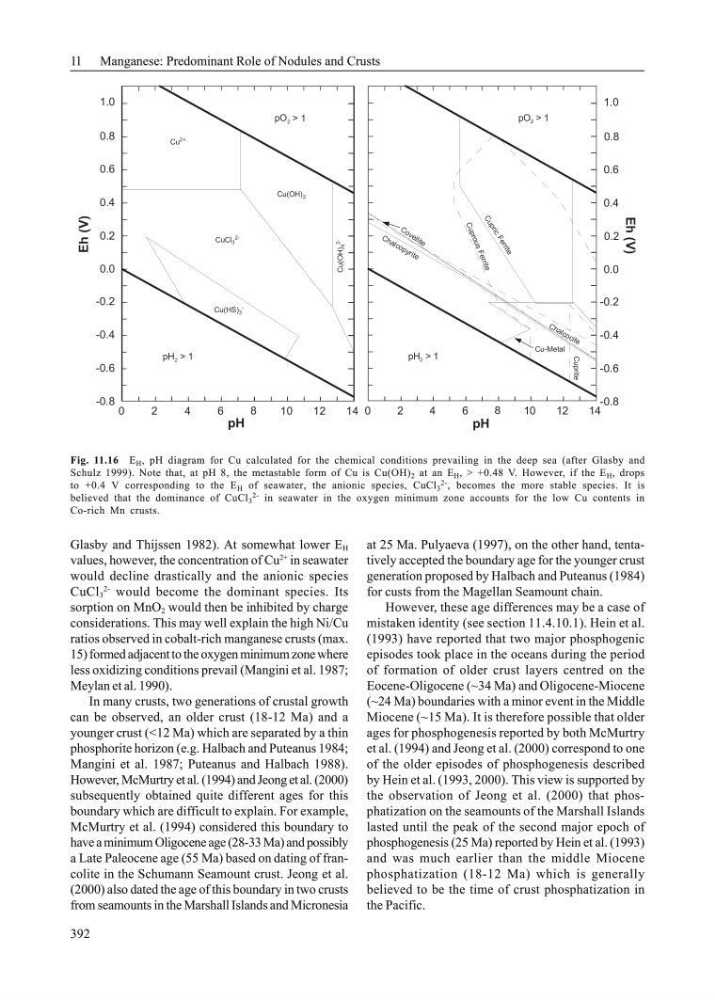
Glasby and Thijssen 1982). At somewhat lower E H
values, however, the concentration of Cu
2+
in seawater
would decline drastically and the anionic species
CuCl 3
2would become the dominant species. Its
sorption on MnO 2 would then be inhibited by charge
considerations. This may well explain the high Ni/Cu
ratios observed in cobalt-rich manganese crusts (max.
15) formed adjacent to the oxygen minimum zone where
less oxidizing conditions prevail (Mangini et al. 1987;
Meylan et al. 1990).
In many crusts, two generations of crustal growth
can be observed, an older crust (18-12 Ma) and a
younger crust (<12 Ma) which are separated by a thin
phosphorite horizon (e.g. Halbach and Puteanus 1984;
Mangini et al. 1987; Puteanus and Halbach 1988).
However, McMurtry et al. (1994) and Jeong et al. (2000)
subsequently obtained quite different ages for this
boundary which are difficult to explain. For example,
McMurtry et al. (1994) considered this boundary to
have a minimum Oligocene age (28-33 Ma) and possibly
a Late Paleocene age (55 Ma) based on dating of francolite in the Schumann Seamount crust. Jeong et al.
(2000) also dated the age of this boundary in two crusts
from seamounts in the Marshall Islands and Micronesia
at 25 Ma. Pulyaeva (1997), on the other hand, tentatively accepted the boundary age for the younger crust
generation proposed by Halbach and Puteanus (1984)
for custs from the Magellan Seamount chain.
However, these age differences may be a case of
mistaken identity (see section 11.4.10.1). Hein et al.
(1993) have reported that two major phosphogenic
episodes took place in the oceans during the period
of formation of older crust layers centred on the
Eocene-Oligocene (~34 Ma) and Oligocene-Miocene
(~24 Ma) boundaries with a minor event in the Middle
Miocene (~15 Ma). It is therefore possible that older
ages for phosphogenesis reported by both McMurtry
et al. (1994) and Jeong et al. (2000) correspond to one
of the older episodes of phosphogenesis described
by Hein et al. (1993, 2000). This view is supported by
the observation of Jeong et al. (2000) that phosphatization on the seamounts of the Marshall Islands
lasted until the peak of the second major epoch of
phosphogenesis (25 Ma) reported by Hein et al. (1993)
and was much earlier than the middle Miocene
phosphatization (18-12 Ma) which is generally
believed to be the time of crust phosphatization in
the Pacific.
pH
0
2
4
6
8
10
12
14
1.0
0.8
0.6
0.4
0.2
0.0
-0.2
-0.4
-0.6
-0.8
Eh (V)
pH 2 > 1
pO 2 > 1
0
2
4
6
8
10
12
14
1.0
0.8
0.6
0.4
0.2
0.0
-0.2
-0.4
-0.6
-0.8
Eh (V)
pH 2 > 1
pO 2 > 1
pH
CuCl 3
2Cu(OH) 2
Cu
2+
Cu(HS) 3
-
Cu(OH)
4
2C u p ri c F e r ri te
C u p ro u s F e rr it e
C h a lc o p y ri te
Cuprite
Cu-Metal
C o v e ll it e
C h a lc o c it e
Fig. 11.16 E H , pH diagram for Cu calculated for the chemical conditions prevailing in the deep sea (after Glasby and
Schulz 1999). Note that, at pH 8, the metastable form of Cu is Cu(OH) 2 at an E H , > +0.48 V. However, if the E H , drops
to +0.4 V corresponding to the E H of seawater, the anionic species, CuCl 3
2- , becomes the more stable species. It is
believed that the dominance of CuCl 3
2- in seawater in the oxygen minimum zone accounts for the low Cu contents in
Co-rich Mn crusts.
11 Manganese: Predominant Role of Nodules and Crusts
Glasby and Thijssen 1982). At somewhat lower E H
values, however, the concentration of Cu
2+
in seawater
would decline drastically and the anionic species
CuCl 3
2would become the dominant species. Its
sorption on MnO 2 would then be inhibited by charge
considerations. This may well explain the high Ni/Cu
ratios observed in cobalt-rich manganese crusts (max.
15) formed adjacent to the oxygen minimum zone where
less oxidizing conditions prevail (Mangini et al. 1987;
Meylan et al. 1990).
In many crusts, two generations of crustal growth
can be observed, an older crust (18-12 Ma) and a
younger crust (<12 Ma) which are separated by a thin
phosphorite horizon (e.g. Halbach and Puteanus 1984;
Mangini et al. 1987; Puteanus and Halbach 1988).
However, McMurtry et al. (1994) and Jeong et al. (2000)
subsequently obtained quite different ages for this
boundary which are difficult to explain. For example,
McMurtry et al. (1994) considered this boundary to
have a minimum Oligocene age (28-33 Ma) and possibly
a Late Paleocene age (55 Ma) based on dating of francolite in the Schumann Seamount crust. Jeong et al.
(2000) also dated the age of this boundary in two crusts
from seamounts in the Marshall Islands and Micronesia
at 25 Ma. Pulyaeva (1997), on the other hand, tentatively accepted the boundary age for the younger crust
generation proposed by Halbach and Puteanus (1984)
for custs from the Magellan Seamount chain.
However, these age differences may be a case of
mistaken identity (see section 11.4.10.1). Hein et al.
(1993) have reported that two major phosphogenic
episodes took place in the oceans during the period
of formation of older crust layers centred on the
Eocene-Oligocene (~34 Ma) and Oligocene-Miocene
(~24 Ma) boundaries with a minor event in the Middle
Miocene (~15 Ma). It is therefore possible that older
ages for phosphogenesis reported by both McMurtry
et al. (1994) and Jeong et al. (2000) correspond to one
of the older episodes of phosphogenesis described
by Hein et al. (1993, 2000). This view is supported by
the observation of Jeong et al. (2000) that phosphatization on the seamounts of the Marshall Islands
lasted until the peak of the second major epoch of
phosphogenesis (25 Ma) reported by Hein et al. (1993)
and was much earlier than the middle Miocene
phosphatization (18-12 Ma) which is generally
believed to be the time of crust phosphatization in
the Pacific.
pH
0
2
4
6
8
10
12
14
1.0
0.8
0.6
0.4
0.2
0.0
-0.2
-0.4
-0.6
-0.8
Eh (V)
pH 2 > 1
pO 2 > 1
0
2
4
6
8
10
12
14
1.0
0.8
0.6
0.4
0.2
0.0
-0.2
-0.4
-0.6
-0.8
Eh (V)
pH 2 > 1
pO 2 > 1
pH
CuCl 3
2Cu(OH) 2
Cu
2+
Cu(HS) 3
-
Cu(OH)
4
2C u p ri c F e r ri te
C u p ro u s F e rr it e
C h a lc o p y ri te
Cuprite
Cu-Metal
C o v e ll it e
C h a lc o c it e
Fig. 11.16 E H , pH diagram for Cu calculated for the chemical conditions prevailing in the deep sea (after Glasby and
Schulz 1999). Note that, at pH 8, the metastable form of Cu is Cu(OH) 2 at an E H , > +0.48 V. However, if the E H , drops
to +0.4 V corresponding to the E H of seawater, the anionic species, CuCl 3
2- , becomes the more stable species. It is
believed that the dominance of CuCl 3
2- in seawater in the oxygen minimum zone accounts for the low Cu contents in
Co-rich Mn crusts.