

391
is controlled by a number of factors such as changes
in oceanic productivity, depth of the lysocline, rate of
CaCO 3 dissolution and strength of AABW flow.
The highest Co contents are found in crusts
occurring in the depth range 1,900-1,100 m which
corresponds to the depth of the oxygen minimum zone.
In samples taken from summits and the upper parts of
slopes at depths less than 1,500 m, the Co contents of
the crusts sometimes exceed 2%. At this depth, Mn
tends to remain in solution because the deposition of
MnO 2 is not favored at these low oxygen contents.
The deposition rate of MnO 2 is therefore at a
minimum and the Mn content in seawater at a maximum of about 2 nmol kg
-1
. The flux of Co to the surface
of the crusts remains constant with water depth at
about 2.9 µg cm
-2
ka
-1
. The Co content of crusts is
therefore a maximum just below the oxygen minimum
zone and no special source of Co is required to explain
their formation (Puteanus and Halbach 1988).
Pt is also significantly enriched in Co-rich crusts
(Hein et al. 1988, 1997; Halbach et al. 1989). However,
the mechanism of enrichment in the crusts is not well
understood. Hodge et al. (1985) argued that Pt is
oxidized from the PtCl 4
2state in seawater to the
tetravalent state in manganese nodules. This process
was thought to be responsible for the anomalously
high Pt/Pd ratios in nodules (50-1,000) compared to
seawater (4.5). However, Halbach et al. (1989) considered that this process would not be possible
because the first formed tetravalent species, PtCl 6
2,
would be very stable in oxygenated seawater. Instead,
they proposed that the PtCl 4
2would be reduced to Pt
metal in the crusts with some minor amounts of Pt
being introduced from cosmic spherules. Mn
2+
was
assumed to be the reducing agent for the reduction of
the PtCl 4
2.
However, Stüben et al. (1999) subsequently plotted
stability field diagrams for Pt and Pd and showed that
Pt is present in seawater dominantly as Pt(OH) 2 ° and
is close to saturation under seawater conditions. From
this, it was argued that Pt is enriched in Co-rich crusts
mainly as a result of the preferential adsorption of
Pt(OH) 2 ° onto the surface of Mn and Fe oxyhydroxide
minerals. Pd, on the other hand, lies at the boundary
of the stability fields of PdCl 4
2and Pd(OH) 2 ° and is
probably undersaturated in seawater. Since PdCl 4
2can
not be adsorbed on Mn oxyhydroxides which have a
negative surface charge, this would explain the socalled negative Pd anomaly in marine manganese
deposits.
For Cu, the EH-pH diagram shows that the
boundary between Cu
2+
and CuCl 3
2as the dominant
species in seawater lies slightly above the normal range
of redox conditions in seawater (E H of +0.48 V) (Fig.
11.16). At an E H of +0.4 V, the concentration of Cu
2+
in
seawater would still be sufficient for it to be incorporated into manganese nodules by sorption on the
surface of negatively charged MnO 2 (Glasby 1974;
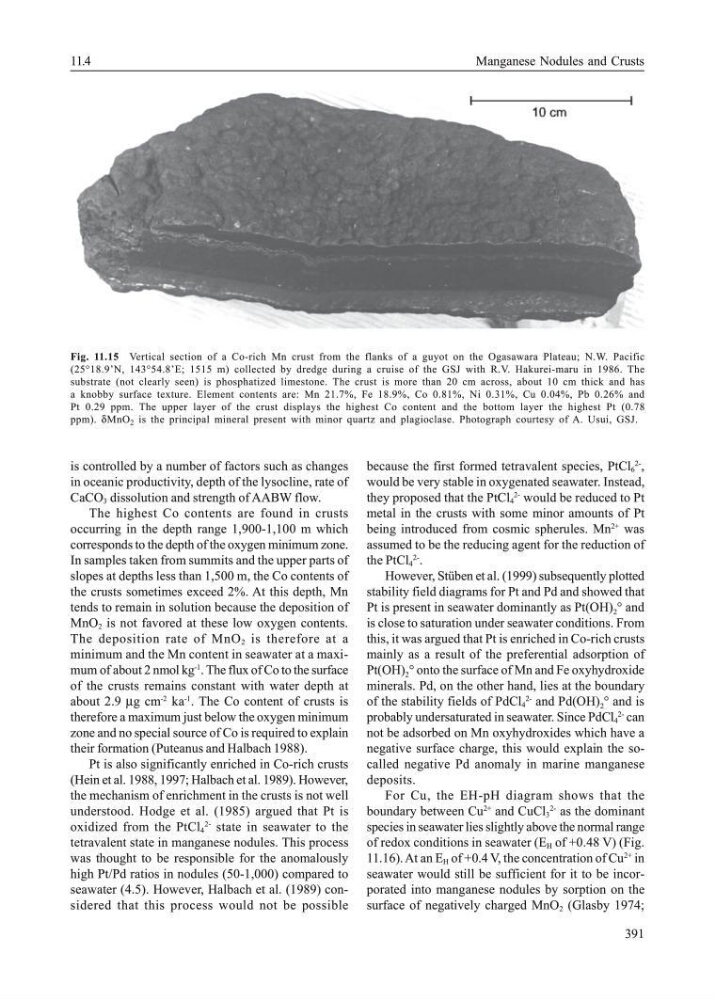
Fig. 11.15 Vertical section of a Co-rich Mn crust from the flanks of a guyot on the Ogasawara Plateau; N.W. Pacific
(25°18.9’N, 143°54.8’E; 1515 m) collected by dredge during a cruise of the GSJ with R.V. Hakurei-maru in 1986. The
substrate (not clearly seen) is phosphatized limestone. The crust is more than 20 cm across, about 10 cm thick and has
a knobby surface texture. Element contents are: Mn 21.7%, Fe 18.9%, Co 0.81%, Ni 0.31%, Cu 0.04%, Pb 0.26% and
Pt 0.29 ppm. The upper layer of the crust displays the highest Co content and the bottom layer the highest Pt (0.78
ppm). δMnO 2 is the principal mineral present with minor quartz and plagioclase. Photograph courtesy of A. Usui, GSJ.
11.4
Manganese Nodules and Crusts
is controlled by a number of factors such as changes
in oceanic productivity, depth of the lysocline, rate of
CaCO 3 dissolution and strength of AABW flow.
The highest Co contents are found in crusts
occurring in the depth range 1,900-1,100 m which
corresponds to the depth of the oxygen minimum zone.
In samples taken from summits and the upper parts of
slopes at depths less than 1,500 m, the Co contents of
the crusts sometimes exceed 2%. At this depth, Mn
tends to remain in solution because the deposition of
MnO 2 is not favored at these low oxygen contents.
The deposition rate of MnO 2 is therefore at a
minimum and the Mn content in seawater at a maximum of about 2 nmol kg
-1
. The flux of Co to the surface
of the crusts remains constant with water depth at
about 2.9 µg cm
-2
ka
-1
. The Co content of crusts is
therefore a maximum just below the oxygen minimum
zone and no special source of Co is required to explain
their formation (Puteanus and Halbach 1988).
Pt is also significantly enriched in Co-rich crusts
(Hein et al. 1988, 1997; Halbach et al. 1989). However,
the mechanism of enrichment in the crusts is not well
understood. Hodge et al. (1985) argued that Pt is
oxidized from the PtCl 4
2state in seawater to the
tetravalent state in manganese nodules. This process
was thought to be responsible for the anomalously
high Pt/Pd ratios in nodules (50-1,000) compared to
seawater (4.5). However, Halbach et al. (1989) considered that this process would not be possible
because the first formed tetravalent species, PtCl 6
2,
would be very stable in oxygenated seawater. Instead,
they proposed that the PtCl 4
2would be reduced to Pt
metal in the crusts with some minor amounts of Pt
being introduced from cosmic spherules. Mn
2+
was
assumed to be the reducing agent for the reduction of
the PtCl 4
2.
However, Stüben et al. (1999) subsequently plotted
stability field diagrams for Pt and Pd and showed that
Pt is present in seawater dominantly as Pt(OH) 2 ° and
is close to saturation under seawater conditions. From
this, it was argued that Pt is enriched in Co-rich crusts
mainly as a result of the preferential adsorption of
Pt(OH) 2 ° onto the surface of Mn and Fe oxyhydroxide
minerals. Pd, on the other hand, lies at the boundary
of the stability fields of PdCl 4
2and Pd(OH) 2 ° and is
probably undersaturated in seawater. Since PdCl 4
2can
not be adsorbed on Mn oxyhydroxides which have a
negative surface charge, this would explain the socalled negative Pd anomaly in marine manganese
deposits.
For Cu, the EH-pH diagram shows that the
boundary between Cu
2+
and CuCl 3
2as the dominant
species in seawater lies slightly above the normal range
of redox conditions in seawater (E H of +0.48 V) (Fig.
11.16). At an E H of +0.4 V, the concentration of Cu
2+
in
seawater would still be sufficient for it to be incorporated into manganese nodules by sorption on the
surface of negatively charged MnO 2 (Glasby 1974;
Fig. 11.15 Vertical section of a Co-rich Mn crust from the flanks of a guyot on the Ogasawara Plateau; N.W. Pacific
(25°18.9’N, 143°54.8’E; 1515 m) collected by dredge during a cruise of the GSJ with R.V. Hakurei-maru in 1986. The
substrate (not clearly seen) is phosphatized limestone. The crust is more than 20 cm across, about 10 cm thick and has
a knobby surface texture. Element contents are: Mn 21.7%, Fe 18.9%, Co 0.81%, Ni 0.31%, Cu 0.04%, Pb 0.26% and
Pt 0.29 ppm. The upper layer of the crust displays the highest Co content and the bottom layer the highest Pt (0.78
ppm). δMnO 2 is the principal mineral present with minor quartz and plagioclase. Photograph courtesy of A. Usui, GSJ.
11.4
Manganese Nodules and Crusts