

390
11 Manganese: Predominant Role of Nodules and Crusts
Site A may be better interpreted in terms of variations
in nodule type within the area rather than local variations in seawater chemistry as proposed by Calvert et
al. (1987).
In addition, De Carlo and McMurtry (1992) have
analyzed 32 samples of Co-rich Mn crusts from the
Hawaiian Archipelago for REE (see section 11.4.4).
These samples contained on average 287 ppm La and
1,277 ppm Ce giving an average Ce/La ratio of 4.5.
This is intermediate between the ratios in nodules from
the Aitutaki Passage (Area K) and the C.C. FZ (Area
C) and is compatible with a hydrogenous origin for
these crusts.
11.4.4 Co-Rich Mn Crusts
Co-rich Mn crusts may be defined as hydrogenous manganese crusts having Co contents >1%
(Manheim 1986; Mangini et al. 1987; Hein et al.
2000). These crusts are typically 5-100 mm thick and
occur on older seamounts (100-60 Ma) in many of the
seamount chains in the equatorial Pacific such as the
Mid-Pacific Mountains and Line Islands. The crusts
are commonly found on exposed rock on seamount
slopes or on the summits of oceanic plateaux at water
depths of 3,000-1,100 m. Principal substrates include
basalts, hyaloclastites, indurated phosphorite and
claystone. A vertical section of a Co-rich Mn crust is
shown in Fig. 11.15. On plateaux and flat terraces
where fragments of rock or manganese crusts have
accumulated, manganese nodules may be seen lying
on the surface of calcareous ooze. Ripple marks
indicating the presence of strong bottom currents are
sometimes observed on this ooze. The average
composition of crusts from the 1,500-1,100 m depth
zone in the Mid-Pacific Mountains has been reported
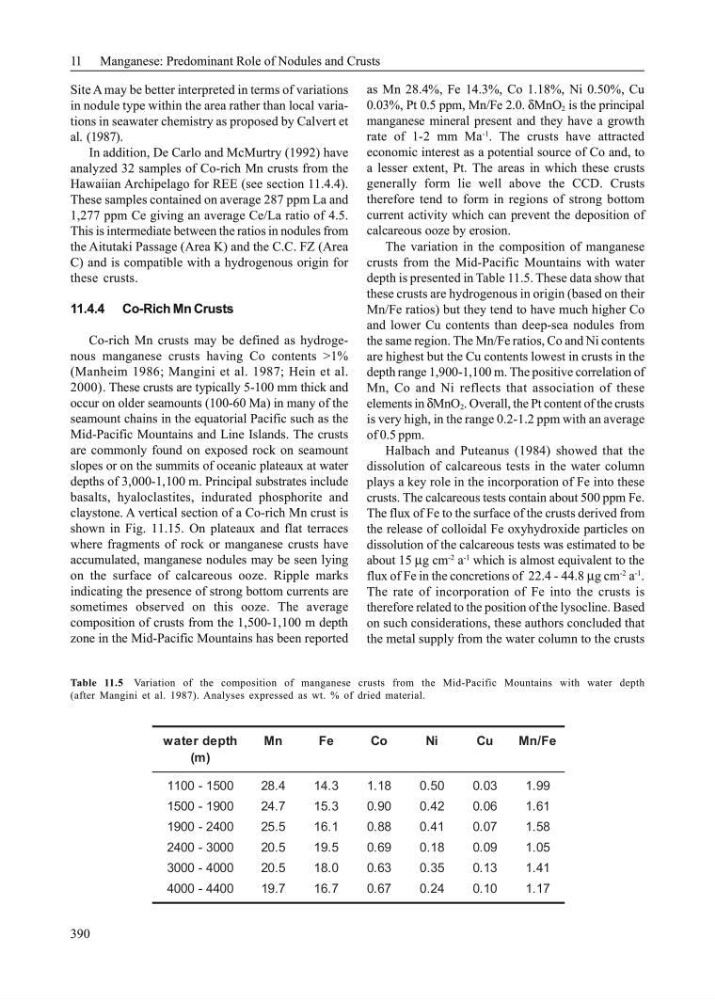
as Mn 28.4%, Fe 14.3%, Co 1.18%, Ni 0.50%, Cu
0.03%, Pt 0.5 ppm, Mn/Fe 2.0. δMnO 2 is the principal
manganese mineral present and they have a growth
rate of 1-2 mm Ma
-1
. The crusts have attracted
economic interest as a potential source of Co and, to
a lesser extent, Pt. The areas in which these crusts
generally form lie well above the CCD. Crusts
therefore tend to form in regions of strong bottom
current activity which can prevent the deposition of
calcareous ooze by erosion.
The variation in the composition of manganese
crusts from the Mid-Pacific Mountains with water
depth is presented in Table 11.5. These data show that
these crusts are hydrogenous in origin (based on their
Mn/Fe ratios) but they tend to have much higher Co
and lower Cu contents than deep-sea nodules from
the same region. The Mn/Fe ratios, Co and Ni contents
are highest but the Cu contents lowest in crusts in the
depth range 1,900-1,100 m. The positive correlation of
Mn, Co and Ni reflects that association of these
elements in δMnO 2 . Overall, the Pt content of the crusts
is very high, in the range 0.2-1.2 ppm with an average
of 0.5 ppm.
Halbach and Puteanus (1984) showed that the
dissolution of calcareous tests in the water column
plays a key role in the incorporation of Fe into these
crusts. The calcareous tests contain about 500 ppm Fe.
The flux of Fe to the surface of the crusts derived from
the release of colloidal Fe oxyhydroxide particles on
dissolution of the calcareous tests was estimated to be
about 15 µg cm
-2
a
-1
which is almost equivalent to the
flux of Fe in the concretions of 22.4 - 44.8 µg cm
-2
a
-1
.
The rate of incorporation of Fe into the crusts is
therefore related to the position of the lysocline. Based
on such considerations, these authors concluded that
the metal supply from the water column to the crusts
water depth
Mn
Fe
Co
Ni
Cu
Mn/Fe
(m)
1100 - 1500
28.4
14.3
1.18
0.50
0.03
1.99
1500 - 1900
24.7
15.3
0.90
0.42
0.06
1.61
1900 - 2400
25.5
16.1
0.88
0.41
0.07
1.58
2400 - 3000
20.5
19.5
0.69
0.18
0.09
1.05
3000 - 4000
20.5
18.0
0.63
0.35
0.13
1.41
4000 - 4400
19.7
16.7
0.67
0.24
0.10
1.17
Table 11.5 Variation of the composition of manganese crusts from the Mid-Pacific Mountains with water depth
(after Mangini et al. 1987). Analyses expressed as wt. % of dried material.
11 Manganese: Predominant Role of Nodules and Crusts
Site A may be better interpreted in terms of variations
in nodule type within the area rather than local variations in seawater chemistry as proposed by Calvert et
al. (1987).
In addition, De Carlo and McMurtry (1992) have
analyzed 32 samples of Co-rich Mn crusts from the
Hawaiian Archipelago for REE (see section 11.4.4).
These samples contained on average 287 ppm La and
1,277 ppm Ce giving an average Ce/La ratio of 4.5.
This is intermediate between the ratios in nodules from
the Aitutaki Passage (Area K) and the C.C. FZ (Area
C) and is compatible with a hydrogenous origin for
these crusts.
11.4.4 Co-Rich Mn Crusts
Co-rich Mn crusts may be defined as hydrogenous manganese crusts having Co contents >1%
(Manheim 1986; Mangini et al. 1987; Hein et al.
2000). These crusts are typically 5-100 mm thick and
occur on older seamounts (100-60 Ma) in many of the
seamount chains in the equatorial Pacific such as the
Mid-Pacific Mountains and Line Islands. The crusts
are commonly found on exposed rock on seamount
slopes or on the summits of oceanic plateaux at water
depths of 3,000-1,100 m. Principal substrates include
basalts, hyaloclastites, indurated phosphorite and
claystone. A vertical section of a Co-rich Mn crust is
shown in Fig. 11.15. On plateaux and flat terraces
where fragments of rock or manganese crusts have
accumulated, manganese nodules may be seen lying
on the surface of calcareous ooze. Ripple marks
indicating the presence of strong bottom currents are
sometimes observed on this ooze. The average
composition of crusts from the 1,500-1,100 m depth
zone in the Mid-Pacific Mountains has been reported
as Mn 28.4%, Fe 14.3%, Co 1.18%, Ni 0.50%, Cu
0.03%, Pt 0.5 ppm, Mn/Fe 2.0. δMnO 2 is the principal
manganese mineral present and they have a growth
rate of 1-2 mm Ma
-1
. The crusts have attracted
economic interest as a potential source of Co and, to
a lesser extent, Pt. The areas in which these crusts
generally form lie well above the CCD. Crusts
therefore tend to form in regions of strong bottom
current activity which can prevent the deposition of
calcareous ooze by erosion.
The variation in the composition of manganese
crusts from the Mid-Pacific Mountains with water
depth is presented in Table 11.5. These data show that
these crusts are hydrogenous in origin (based on their
Mn/Fe ratios) but they tend to have much higher Co
and lower Cu contents than deep-sea nodules from
the same region. The Mn/Fe ratios, Co and Ni contents
are highest but the Cu contents lowest in crusts in the
depth range 1,900-1,100 m. The positive correlation of
Mn, Co and Ni reflects that association of these
elements in δMnO 2 . Overall, the Pt content of the crusts
is very high, in the range 0.2-1.2 ppm with an average
of 0.5 ppm.
Halbach and Puteanus (1984) showed that the
dissolution of calcareous tests in the water column
plays a key role in the incorporation of Fe into these
crusts. The calcareous tests contain about 500 ppm Fe.
The flux of Fe to the surface of the crusts derived from
the release of colloidal Fe oxyhydroxide particles on
dissolution of the calcareous tests was estimated to be
about 15 µg cm
-2
a
-1
which is almost equivalent to the
flux of Fe in the concretions of 22.4 - 44.8 µg cm
-2
a
-1
.
The rate of incorporation of Fe into the crusts is
therefore related to the position of the lysocline. Based
on such considerations, these authors concluded that
the metal supply from the water column to the crusts
water depth
Mn
Fe
Co
Ni
Cu
Mn/Fe
(m)
1100 - 1500
28.4
14.3
1.18
0.50
0.03
1.99
1500 - 1900
24.7
15.3
0.90
0.42
0.06
1.61
1900 - 2400
25.5
16.1
0.88
0.41
0.07
1.58
2400 - 3000
20.5
19.5
0.69
0.18
0.09
1.05
3000 - 4000
20.5
18.0
0.63
0.35
0.13
1.41
4000 - 4400
19.7
16.7
0.67
0.24
0.10
1.17
Table 11.5 Variation of the composition of manganese crusts from the Mid-Pacific Mountains with water depth
(after Mangini et al. 1987). Analyses expressed as wt. % of dried material.