

394
11 Manganese: Predominant Role of Nodules and Crusts
the concretions compared to deep-sea nodules. The
growth rates of the concretions have been estimated to
be 3-4 orders of magnitude higher than those of deepsea nodules. A 20 mm diameter concretion is therefore
about 500-800 years old (Glasby et al. 1996). This means
that these concretions are transient features on the sea
floor. In active areas of the sea floor, concretions may
be buried by sediment during storms and new concretions then begin to form on erratic material exposed
at the sediment surface. Certain anthropogenic elements, notably Zn, are enriched in the outer layers of
the concretions as a result of the pollution of Baltic
seawater over the last 160 years or so. Zn profiles in
the outer layers of these concretions can therefore be
used to monitor heavy-metal pollution in Baltic
(Hlawatsch 1999; Hlawatsch et al. 2002). This
technique will be useful if the planned clean up of the
Baltic Sea is to be achieved during the present century.
Baltic Sea concretions can be classified into three
main types based on their abundance, morphology,
composition and mode of formation: those from the
Gulfs of Bothnia, Finland and Riga, from the Baltic
Proper and from the western Belt Sea.
Concretions from the Gulf of Bothnia are most
abundant in Bothnian Bay where the abundance
reaches 15-40 kg m
-2
in an area of about 200 km
2
. This
is equivalent to about 3 million tons of concretions
and has led to these deposits being evaluated as a
possible economic source of Mn. These concretions
are mainly spheroidal up to 25-30 mm in diameter and
are formed in the uppermost water-rich sediment layers
at well-oxidized sites. They are most abundant where
sedimentation rates are <0.4 mm a
-1
.
Concretions from the Baltic Proper are found mainly
around the margins of the deep basins in a depth range
48-103 m. The concretions are mainly discoidal 20-150
mm in diameter and crusts. Their abundance is mainly
sporadic and more rarely common to abundant. Locally,
abundances of 10-16 kg m
-2
are attained. Their formation
is the result of the build up of Mn and Fe in the anoxic
waters of the deep basins of the Baltic Proper. During
major inflows of North Sea water (>100 km
3
) into the
Baltic which occur on average once every 11 years,
the anoxic waters are flushed out of the basins. Mn
and Fe precipitate out as an unstable gel but are
ultimately incorporated into the concretions as
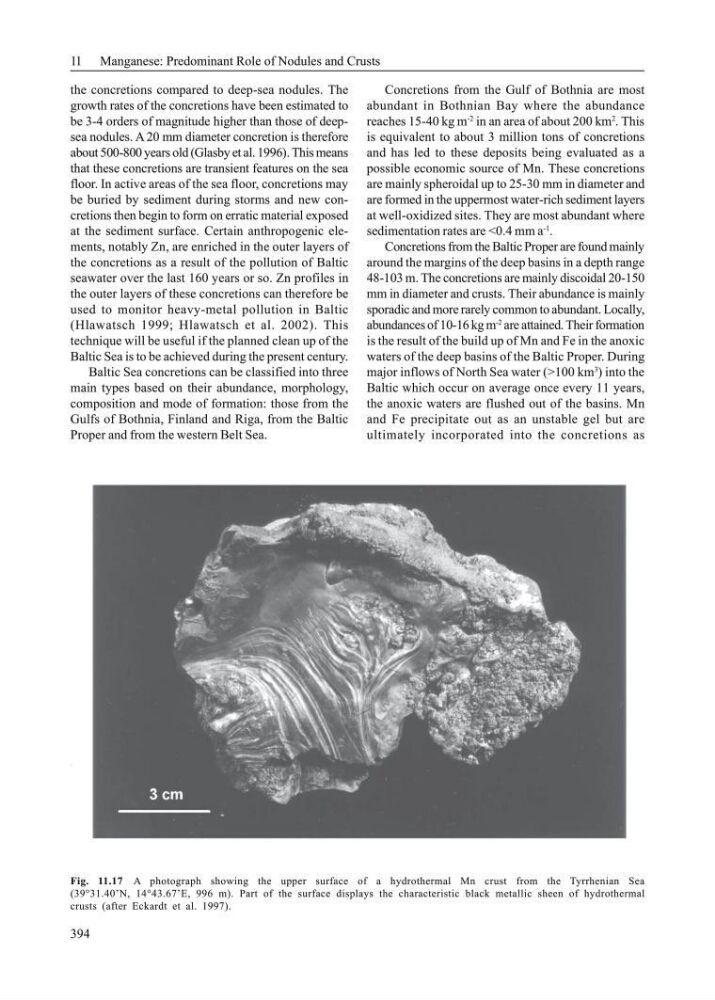
Fig. 11.17 A photograph showing the upper surface of a hydrothermal Mn crust from the Tyrrhenian Sea
(39°31.40’N, 14°43.67’E, 996 m). Part of the surface displays the characteristic black metallic sheen of hydrothermal
crusts (after Eckardt et al. 1997).
11 Manganese: Predominant Role of Nodules and Crusts
the concretions compared to deep-sea nodules. The
growth rates of the concretions have been estimated to
be 3-4 orders of magnitude higher than those of deepsea nodules. A 20 mm diameter concretion is therefore
about 500-800 years old (Glasby et al. 1996). This means
that these concretions are transient features on the sea
floor. In active areas of the sea floor, concretions may
be buried by sediment during storms and new concretions then begin to form on erratic material exposed
at the sediment surface. Certain anthropogenic elements, notably Zn, are enriched in the outer layers of
the concretions as a result of the pollution of Baltic
seawater over the last 160 years or so. Zn profiles in
the outer layers of these concretions can therefore be
used to monitor heavy-metal pollution in Baltic
(Hlawatsch 1999; Hlawatsch et al. 2002). This
technique will be useful if the planned clean up of the
Baltic Sea is to be achieved during the present century.
Baltic Sea concretions can be classified into three
main types based on their abundance, morphology,
composition and mode of formation: those from the
Gulfs of Bothnia, Finland and Riga, from the Baltic
Proper and from the western Belt Sea.
Concretions from the Gulf of Bothnia are most
abundant in Bothnian Bay where the abundance
reaches 15-40 kg m
-2
in an area of about 200 km
2
. This
is equivalent to about 3 million tons of concretions
and has led to these deposits being evaluated as a
possible economic source of Mn. These concretions
are mainly spheroidal up to 25-30 mm in diameter and
are formed in the uppermost water-rich sediment layers
at well-oxidized sites. They are most abundant where
sedimentation rates are <0.4 mm a
-1
.
Concretions from the Baltic Proper are found mainly
around the margins of the deep basins in a depth range
48-103 m. The concretions are mainly discoidal 20-150
mm in diameter and crusts. Their abundance is mainly
sporadic and more rarely common to abundant. Locally,
abundances of 10-16 kg m
-2
are attained. Their formation
is the result of the build up of Mn and Fe in the anoxic
waters of the deep basins of the Baltic Proper. During
major inflows of North Sea water (>100 km
3
) into the
Baltic which occur on average once every 11 years,
the anoxic waters are flushed out of the basins. Mn
and Fe precipitate out as an unstable gel but are
ultimately incorporated into the concretions as
Fig. 11.17 A photograph showing the upper surface of a hydrothermal Mn crust from the Tyrrhenian Sea
(39°31.40’N, 14°43.67’E, 996 m). Part of the surface displays the characteristic black metallic sheen of hydrothermal
crusts (after Eckardt et al. 1997).