

378
11 Manganese: Predominant Role of Nodules and Crusts
characterized by a well-developed halocline which
prevents mixing of the anoxic basinal waters with the
overlying sea-water as well as in the deeper layers of
sediments from well-oxygenated coastal and upwelling
environments. This leads to extensive diffusion of Mn
and Fe into the water column from the underlying
sediments. As an example, the dissolved Mn and Fe
contents attain concentrations of <700 and 120 µg l
-1
respectively in the anoxic waters of the Gotland Deep,
Baltic Sea (Glasby et al. 1997). The diagenetic pathway
taken depends principally on the rate of organic carbon
accumulation in the sediment.
Within red clays, the diffusive flux of Mn is small
(23 µg cm
-2
ka
-1
) and corresponds to about 7% of the
total sedimentation flux of Mn (Glasby 1991). Mn is
therefore largely immobilized in red clays. By
contrast, 96% of the Cu in red clays is regenerated
from the sediment into the bottom water as a result
of the diagenetic flux across the sediment/water
interface. Red clays therefore provide a relatively
low flux of Mn and transition elements to the
sediment surface and this is not an important source
of metals for manganese nodule formation in red
clay areas.
Müller et al. (1988) have distinguished between
‘deep diagenesis’ and ‘surficial diagenesis’. In Pacific
red clays, deep diagenesis results in no significant
net upward flux of Mn, Fe, Ni or Cu. Surficial diagenesis
is more significant. In siliceous ooze sediments, the
regeneration rate of Mn in the surface sediments is of
the same order as the accretion rate of Mn in the
associated Mn nodules. Surficial diagenesis is therefore a significant source of metals to manganese
nodules in siliceous ooze areas. 96% of the metals in
the associated manganese nodules come from this
source.
In general, the thickness of the oxidized layer in
the sediment increases from near-shore and hemipelagic to pelagic environments. This is illustrated in
Figure 11.6 which shows the trends for the eastern
equatorial Pacific. This diagram confirms the inverse
relationship between the thickness of the oxidized layer
in the sediment and the biological productivity in the
overlying surface waters. In general, there is a transition from tan to green within these sediments resulting
from the in-situ reduction of Fe (III) to Fe (II) in
smectites at the iron redox transition-zone (Lyle 1983;
Köning et al. 1997).
Detrital
Hydrothermal
Biogenic
Authigenic
Dissolution
residue
RELATIVE SOURCE CONTRIBUTIONS
TO SURFACE SEDIMENTS [wt %]
NEW ZEALAND
40°S
20°S
180°W
160° W
140°W
120°W
100°W
80°W
40° S
160° W
180°W
TAHITI
50 %
Location 1
2
3
4
5
Area 1
6
7
8
9
Area 2
10
11
Area 3
12
13
14
15
16
Location 17
A3
A2
A1
50%
EPR
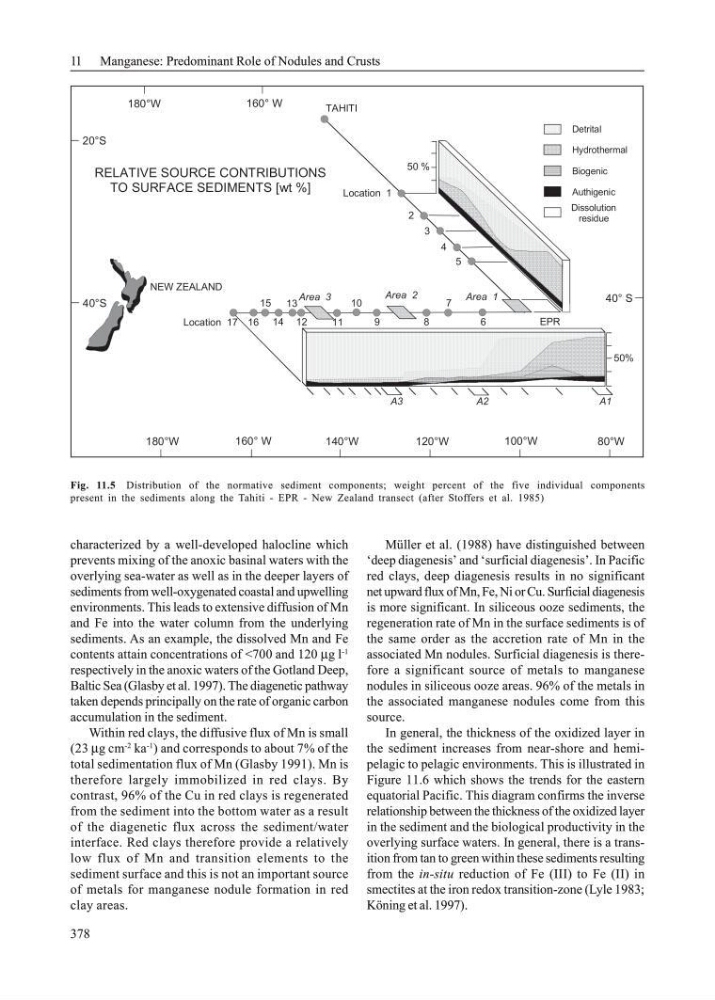
Fig. 11.5 Distribution of the normative sediment components; weight percent of the five individual components
present in the sediments along the Tahiti - EPR - New Zealand transect (after Stoffers et al. 1985)
11 Manganese: Predominant Role of Nodules and Crusts
characterized by a well-developed halocline which
prevents mixing of the anoxic basinal waters with the
overlying sea-water as well as in the deeper layers of
sediments from well-oxygenated coastal and upwelling
environments. This leads to extensive diffusion of Mn
and Fe into the water column from the underlying
sediments. As an example, the dissolved Mn and Fe
contents attain concentrations of <700 and 120 µg l
-1
respectively in the anoxic waters of the Gotland Deep,
Baltic Sea (Glasby et al. 1997). The diagenetic pathway
taken depends principally on the rate of organic carbon
accumulation in the sediment.
Within red clays, the diffusive flux of Mn is small
(23 µg cm
-2
ka
-1
) and corresponds to about 7% of the
total sedimentation flux of Mn (Glasby 1991). Mn is
therefore largely immobilized in red clays. By
contrast, 96% of the Cu in red clays is regenerated
from the sediment into the bottom water as a result
of the diagenetic flux across the sediment/water
interface. Red clays therefore provide a relatively
low flux of Mn and transition elements to the
sediment surface and this is not an important source
of metals for manganese nodule formation in red
clay areas.
Müller et al. (1988) have distinguished between
‘deep diagenesis’ and ‘surficial diagenesis’. In Pacific
red clays, deep diagenesis results in no significant
net upward flux of Mn, Fe, Ni or Cu. Surficial diagenesis
is more significant. In siliceous ooze sediments, the
regeneration rate of Mn in the surface sediments is of
the same order as the accretion rate of Mn in the
associated Mn nodules. Surficial diagenesis is therefore a significant source of metals to manganese
nodules in siliceous ooze areas. 96% of the metals in
the associated manganese nodules come from this
source.
In general, the thickness of the oxidized layer in
the sediment increases from near-shore and hemipelagic to pelagic environments. This is illustrated in
Figure 11.6 which shows the trends for the eastern
equatorial Pacific. This diagram confirms the inverse
relationship between the thickness of the oxidized layer
in the sediment and the biological productivity in the
overlying surface waters. In general, there is a transition from tan to green within these sediments resulting
from the in-situ reduction of Fe (III) to Fe (II) in
smectites at the iron redox transition-zone (Lyle 1983;
Köning et al. 1997).
Detrital
Hydrothermal
Biogenic
Authigenic
Dissolution
residue
RELATIVE SOURCE CONTRIBUTIONS
TO SURFACE SEDIMENTS [wt %]
NEW ZEALAND
40°S
20°S
180°W
160° W
140°W
120°W
100°W
80°W
40° S
160° W
180°W
TAHITI
50 %
Location 1
2
3
4
5
Area 1
6
7
8
9
Area 2
10
11
Area 3
12
13
14
15
16
Location 17
A3
A2
A1
50%
EPR
Fig. 11.5 Distribution of the normative sediment components; weight percent of the five individual components
present in the sediments along the Tahiti - EPR - New Zealand transect (after Stoffers et al. 1985)