

377
brown, increasing transition metal contents, increasing
oxidation state of iron, decreasing sedimentation rate
and increased abundance of deep-sea manganese
nodules with increasing distance from New Zealand.
The dusky brown sediments are rich in phillipsite and
manganese micronodules (Glasby et al. 1980). Several
of the changes along the transect were thought to
reflect an increase in the degree of oxidation of the
sediments with decreasing sediment accumulation rate
caused by a longer contact time of the sediment
surface with well-oxygenated ocean bottom water. On
a transect from the crest of the East Pacific Rise to
New Zealand at 42°S, Stoffers et al. (1985) found
similar increases in the contents of Mn, Fe, Co, Ni and
Cu in sediments with increasing distance from New
Zealand.
In a detailed comparison of sediments from the
equatorial North Pacific high productivity zone (Area
C) and the low productivity SW Pacific subtropical
anticyclonic gyre (Area K), Stoffers et al. (1981)
showed that the siliceous oozes from the equatorial
North Pacific have much higher contents of Mn, Ni,
Cu and Ba but lower contents of Fe and Co than the
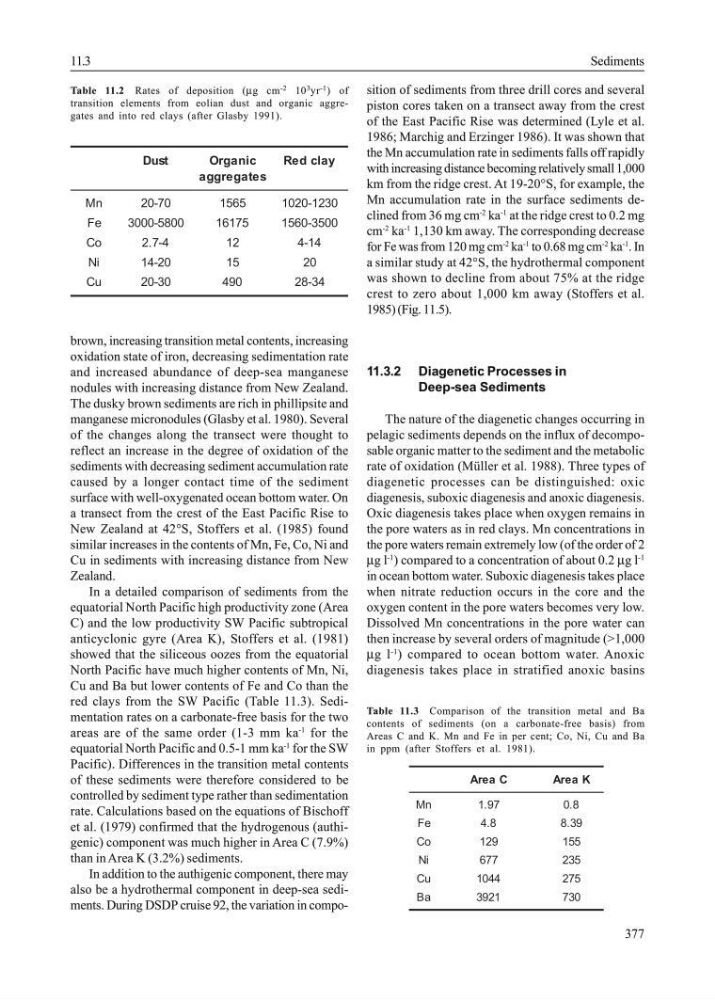
red clays from the SW Pacific (Table 11.3). Sedimentation rates on a carbonate-free basis for the two
areas are of the same order (1-3 mm ka
-1
for the
equatorial North Pacific and 0.5-1 mm ka
-1
for the SW
Pacific). Differences in the transition metal contents
of these sediments were therefore considered to be
controlled by sediment type rather than sedimentation
rate. Calculations based on the equations of Bischoff
et al. (1979) confirmed that the hydrogenous (authigenic) component was much higher in Area C (7.9%)
than in Area K (3.2%) sediments.
In addition to the authigenic component, there may
also be a hydrothermal component in deep-sea sediments. During DSDP cruise 92, the variation in composition of sediments from three drill cores and several
piston cores taken on a transect away from the crest
of the East Pacific Rise was determined (Lyle et al.
1986; Marchig and Erzinger 1986). It was shown that
the Mn accumulation rate in sediments falls off rapidly
with increasing distance becoming relatively small 1,000
km from the ridge crest. At 19-20°S, for example, the
Mn accumulation rate in the surface sediments declined from 36 mg cm
-2
ka
-1
at the ridge crest to 0.2 mg
cm
-2
ka
-1
1,130 km away. The corresponding decrease
for Fe was from 120 mg cm
-2
ka
-1
to 0.68 mg cm
-2
ka
-1
. In
a similar study at 42°S, the hydrothermal component
was shown to decline from about 75% at the ridge
crest to zero about 1,000 km away (Stoffers et al.
1985) (Fig. 11.5).
11.3.2 Diagenetic Processes in
Deep-sea Sediments
The nature of the diagenetic changes occurring in
pelagic sediments depends on the influx of decomposable organic matter to the sediment and the metabolic
rate of oxidation (Müller et al. 1988). Three types of
diagenetic processes can be distinguished: oxic
diagenesis, suboxic diagenesis and anoxic diagenesis.
Oxic diagenesis takes place when oxygen remains in
the pore waters as in red clays. Mn concentrations in
the pore waters remain extremely low (of the order of 2
µg l
-1
) compared to a concentration of about 0.2 µg l
-1
in ocean bottom water. Suboxic diagenesis takes place
when nitrate reduction occurs in the core and the
oxygen content in the pore waters becomes very low.
Dissolved Mn concentrations in the pore water can
then increase by several orders of magnitude (>1,000
µg l
-1
) compared to ocean bottom water. Anoxic
diagenesis takes place in stratified anoxic basins
Dust
Organic
Red clay
aggregates
Mn
20-70
1565
1020-1230
Fe
3000-5800
16175
1560-3500
Co
2.7-4
12
4-14
Ni
14-20
15
20
Cu
20-30
490
28-34
Table 11.2 Rates of deposition (µg cm -2 10 3 yr -1 ) of
transition elements from eolian dust and organic aggregates and into red clays (after Glasby 1991).
Area C
Area K
Mn
1.97
0.8
Fe
4.8
8.39
Co
129
155
Ni
677
235
Cu
1044
275
Ba
3921
730
Table 11.3 Comparison of the transition metal and Ba
contents of sediments (on a carbonate-free basis) from
Areas C and K. Mn and Fe in per cent; Co, Ni, Cu and Ba
in ppm (after Stoffers et al. 1981).
11.3
Sediments
brown, increasing transition metal contents, increasing
oxidation state of iron, decreasing sedimentation rate
and increased abundance of deep-sea manganese
nodules with increasing distance from New Zealand.
The dusky brown sediments are rich in phillipsite and
manganese micronodules (Glasby et al. 1980). Several
of the changes along the transect were thought to
reflect an increase in the degree of oxidation of the
sediments with decreasing sediment accumulation rate
caused by a longer contact time of the sediment
surface with well-oxygenated ocean bottom water. On
a transect from the crest of the East Pacific Rise to
New Zealand at 42°S, Stoffers et al. (1985) found
similar increases in the contents of Mn, Fe, Co, Ni and
Cu in sediments with increasing distance from New
Zealand.
In a detailed comparison of sediments from the
equatorial North Pacific high productivity zone (Area
C) and the low productivity SW Pacific subtropical
anticyclonic gyre (Area K), Stoffers et al. (1981)
showed that the siliceous oozes from the equatorial
North Pacific have much higher contents of Mn, Ni,
Cu and Ba but lower contents of Fe and Co than the
red clays from the SW Pacific (Table 11.3). Sedimentation rates on a carbonate-free basis for the two
areas are of the same order (1-3 mm ka
-1
for the
equatorial North Pacific and 0.5-1 mm ka
-1
for the SW
Pacific). Differences in the transition metal contents
of these sediments were therefore considered to be
controlled by sediment type rather than sedimentation
rate. Calculations based on the equations of Bischoff
et al. (1979) confirmed that the hydrogenous (authigenic) component was much higher in Area C (7.9%)
than in Area K (3.2%) sediments.
In addition to the authigenic component, there may
also be a hydrothermal component in deep-sea sediments. During DSDP cruise 92, the variation in composition of sediments from three drill cores and several
piston cores taken on a transect away from the crest
of the East Pacific Rise was determined (Lyle et al.
1986; Marchig and Erzinger 1986). It was shown that
the Mn accumulation rate in sediments falls off rapidly
with increasing distance becoming relatively small 1,000
km from the ridge crest. At 19-20°S, for example, the
Mn accumulation rate in the surface sediments declined from 36 mg cm
-2
ka
-1
at the ridge crest to 0.2 mg
cm
-2
ka
-1
1,130 km away. The corresponding decrease
for Fe was from 120 mg cm
-2
ka
-1
to 0.68 mg cm
-2
ka
-1
. In
a similar study at 42°S, the hydrothermal component
was shown to decline from about 75% at the ridge
crest to zero about 1,000 km away (Stoffers et al.
1985) (Fig. 11.5).
11.3.2 Diagenetic Processes in
Deep-sea Sediments
The nature of the diagenetic changes occurring in
pelagic sediments depends on the influx of decomposable organic matter to the sediment and the metabolic
rate of oxidation (Müller et al. 1988). Three types of
diagenetic processes can be distinguished: oxic
diagenesis, suboxic diagenesis and anoxic diagenesis.
Oxic diagenesis takes place when oxygen remains in
the pore waters as in red clays. Mn concentrations in
the pore waters remain extremely low (of the order of 2
µg l
-1
) compared to a concentration of about 0.2 µg l
-1
in ocean bottom water. Suboxic diagenesis takes place
when nitrate reduction occurs in the core and the
oxygen content in the pore waters becomes very low.
Dissolved Mn concentrations in the pore water can
then increase by several orders of magnitude (>1,000
µg l
-1
) compared to ocean bottom water. Anoxic
diagenesis takes place in stratified anoxic basins
Dust
Organic
Red clay
aggregates
Mn
20-70
1565
1020-1230
Fe
3000-5800
16175
1560-3500
Co
2.7-4
12
4-14
Ni
14-20
15
20
Cu
20-30
490
28-34
Table 11.2 Rates of deposition (µg cm -2 10 3 yr -1 ) of
transition elements from eolian dust and organic aggregates and into red clays (after Glasby 1991).
Area C
Area K
Mn
1.97
0.8
Fe
4.8
8.39
Co
129
155
Ni
677
235
Cu
1044
275
Ba
3921
730
Table 11.3 Comparison of the transition metal and Ba
contents of sediments (on a carbonate-free basis) from
Areas C and K. Mn and Fe in per cent; Co, Ni, Cu and Ba
in ppm (after Stoffers et al. 1981).
11.3
Sediments