

376
11 Manganese: Predominant Role of Nodules and Crusts
the deserts of central Asia explains the higher sedimentation rates of the noncarbonate fraction of sediments
from the North Pacific (0.5-6 mm ka
-1
) than those of
sediments from the South Pacific (0.4 mm ka
-1
). Because
of its composite origin, red clay has a similar
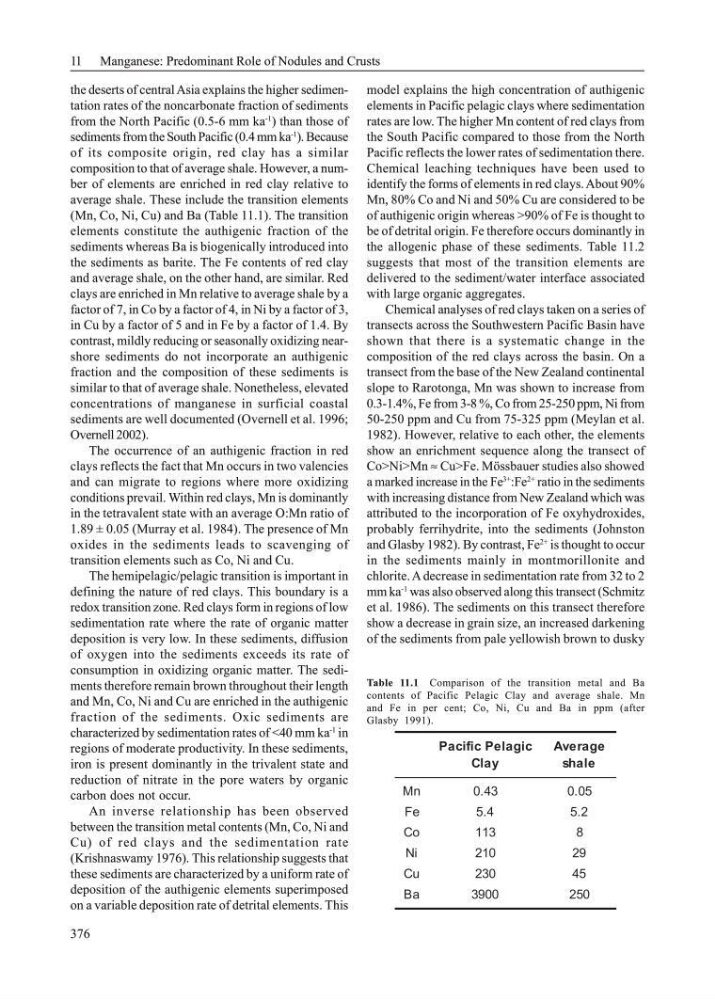
composition to that of average shale. However, a number of elements are enriched in red clay relative to
average shale. These include the transition elements
(Mn, Co, Ni, Cu) and Ba (Table 11.1). The transition
elements constitute the authigenic fraction of the
sediments whereas Ba is biogenically introduced into
the sediments as barite. The Fe contents of red clay
and average shale, on the other hand, are similar. Red
clays are enriched in Mn relative to average shale by a
factor of 7, in Co by a factor of 4, in Ni by a factor of 3,
in Cu by a factor of 5 and in Fe by a factor of 1.4. By
contrast, mildly reducing or seasonally oxidizing nearshore sediments do not incorporate an authigenic
fraction and the composition of these sediments is
similar to that of average shale. Nonetheless, elevated
concentrations of manganese in surficial coastal
sediments are well documented (Overnell et al. 1996;
Overnell 2002).
The occurrence of an authigenic fraction in red
clays reflects the fact that Mn occurs in two valencies
and can migrate to regions where more oxidizing
conditions prevail. Within red clays, Mn is dominantly
in the tetravalent state with an average O:Mn ratio of
1.89 ± 0.05 (Murray et al. 1984). The presence of Mn
oxides in the sediments leads to scavenging of
transition elements such as Co, Ni and Cu.
The hemipelagic/pelagic transition is important in
defining the nature of red clays. This boundary is a
redox transition zone. Red clays form in regions of low
sedimentation rate where the rate of organic matter
deposition is very low. In these sediments, diffusion
of oxygen into the sediments exceeds its rate of
consumption in oxidizing organic matter. The sediments therefore remain brown throughout their length
and Mn, Co, Ni and Cu are enriched in the authigenic
fraction of the sediments. Oxic sediments are
characterized by sedimentation rates of <40 mm ka
-1
in
regions of moderate productivity. In these sediments,
iron is present dominantly in the trivalent state and
reduction of nitrate in the pore waters by organic
carbon does not occur.
An inverse relationship has been observed
between the transition metal contents (Mn, Co, Ni and
Cu) of red clays and the sedimentation rate
(Krishnaswamy 1976). This relationship suggests that
these sediments are characterized by a uniform rate of
deposition of the authigenic elements superimposed
on a variable deposition rate of detrital elements. This
model explains the high concentration of authigenic
elements in Pacific pelagic clays where sedimentation
rates are low. The higher Mn content of red clays from
the South Pacific compared to those from the North
Pacific reflects the lower rates of sedimentation there.
Chemical leaching techniques have been used to
identify the forms of elements in red clays. About 90%
Mn, 80% Co and Ni and 50% Cu are considered to be
of authigenic origin whereas >90% of Fe is thought to
be of detrital origin. Fe therefore occurs dominantly in
the allogenic phase of these sediments. Table 11.2
suggests that most of the transition elements are
delivered to the sediment/water interface associated
with large organic aggregates.
Chemical analyses of red clays taken on a series of
transects across the Southwestern Pacific Basin have
shown that there is a systematic change in the
composition of the red clays across the basin. On a
transect from the base of the New Zealand continental
slope to Rarotonga, Mn was shown to increase from
0.3-1.4%, Fe from 3-8 %, Co from 25-250 ppm, Ni from
50-250 ppm and Cu from 75-325 ppm (Meylan et al.
1982). However, relative to each other, the elements
show an enrichment sequence along the transect of
Co>Ni>Mn ≈ Cu>Fe. Mössbauer studies also showed
a marked increase in the Fe
3+
:Fe
2+
ratio in the sediments
with increasing distance from New Zealand which was
attributed to the incorporation of Fe oxyhydroxides,
probably ferrihydrite, into the sediments (Johnston
and Glasby 1982). By contrast, Fe
2+
is thought to occur
in the sediments mainly in montmorillonite and
chlorite. A decrease in sedimentation rate from 32 to 2
mm ka
-1
was also observed along this transect (Schmitz
et al. 1986). The sediments on this transect therefore
show a decrease in grain size, an increased darkening
of the sediments from pale yellowish brown to dusky
Pacific Pelagic
Average
Clay
shale
Mn
0.43
0.05
Fe
5.4
5.2
Co
113
8
Ni
210
29
Cu
230
45
Ba
3900
250
Table 11.1 Comparison of the transition metal and Ba
contents of Pacific Pelagic Clay and average shale. Mn
and Fe in per cent; Co, Ni, Cu and Ba in ppm (after
Glasby 1991).
11 Manganese: Predominant Role of Nodules and Crusts
the deserts of central Asia explains the higher sedimentation rates of the noncarbonate fraction of sediments
from the North Pacific (0.5-6 mm ka
-1
) than those of
sediments from the South Pacific (0.4 mm ka
-1
). Because
of its composite origin, red clay has a similar
composition to that of average shale. However, a number of elements are enriched in red clay relative to
average shale. These include the transition elements
(Mn, Co, Ni, Cu) and Ba (Table 11.1). The transition
elements constitute the authigenic fraction of the
sediments whereas Ba is biogenically introduced into
the sediments as barite. The Fe contents of red clay
and average shale, on the other hand, are similar. Red
clays are enriched in Mn relative to average shale by a
factor of 7, in Co by a factor of 4, in Ni by a factor of 3,
in Cu by a factor of 5 and in Fe by a factor of 1.4. By
contrast, mildly reducing or seasonally oxidizing nearshore sediments do not incorporate an authigenic
fraction and the composition of these sediments is
similar to that of average shale. Nonetheless, elevated
concentrations of manganese in surficial coastal
sediments are well documented (Overnell et al. 1996;
Overnell 2002).
The occurrence of an authigenic fraction in red
clays reflects the fact that Mn occurs in two valencies
and can migrate to regions where more oxidizing
conditions prevail. Within red clays, Mn is dominantly
in the tetravalent state with an average O:Mn ratio of
1.89 ± 0.05 (Murray et al. 1984). The presence of Mn
oxides in the sediments leads to scavenging of
transition elements such as Co, Ni and Cu.
The hemipelagic/pelagic transition is important in
defining the nature of red clays. This boundary is a
redox transition zone. Red clays form in regions of low
sedimentation rate where the rate of organic matter
deposition is very low. In these sediments, diffusion
of oxygen into the sediments exceeds its rate of
consumption in oxidizing organic matter. The sediments therefore remain brown throughout their length
and Mn, Co, Ni and Cu are enriched in the authigenic
fraction of the sediments. Oxic sediments are
characterized by sedimentation rates of <40 mm ka
-1
in
regions of moderate productivity. In these sediments,
iron is present dominantly in the trivalent state and
reduction of nitrate in the pore waters by organic
carbon does not occur.
An inverse relationship has been observed
between the transition metal contents (Mn, Co, Ni and
Cu) of red clays and the sedimentation rate
(Krishnaswamy 1976). This relationship suggests that
these sediments are characterized by a uniform rate of
deposition of the authigenic elements superimposed
on a variable deposition rate of detrital elements. This
model explains the high concentration of authigenic
elements in Pacific pelagic clays where sedimentation
rates are low. The higher Mn content of red clays from
the South Pacific compared to those from the North
Pacific reflects the lower rates of sedimentation there.
Chemical leaching techniques have been used to
identify the forms of elements in red clays. About 90%
Mn, 80% Co and Ni and 50% Cu are considered to be
of authigenic origin whereas >90% of Fe is thought to
be of detrital origin. Fe therefore occurs dominantly in
the allogenic phase of these sediments. Table 11.2
suggests that most of the transition elements are
delivered to the sediment/water interface associated
with large organic aggregates.
Chemical analyses of red clays taken on a series of
transects across the Southwestern Pacific Basin have
shown that there is a systematic change in the
composition of the red clays across the basin. On a
transect from the base of the New Zealand continental
slope to Rarotonga, Mn was shown to increase from
0.3-1.4%, Fe from 3-8 %, Co from 25-250 ppm, Ni from
50-250 ppm and Cu from 75-325 ppm (Meylan et al.
1982). However, relative to each other, the elements
show an enrichment sequence along the transect of
Co>Ni>Mn ≈ Cu>Fe. Mössbauer studies also showed
a marked increase in the Fe
3+
:Fe
2+
ratio in the sediments
with increasing distance from New Zealand which was
attributed to the incorporation of Fe oxyhydroxides,
probably ferrihydrite, into the sediments (Johnston
and Glasby 1982). By contrast, Fe
2+
is thought to occur
in the sediments mainly in montmorillonite and
chlorite. A decrease in sedimentation rate from 32 to 2
mm ka
-1
was also observed along this transect (Schmitz
et al. 1986). The sediments on this transect therefore
show a decrease in grain size, an increased darkening
of the sediments from pale yellowish brown to dusky
Pacific Pelagic
Average
Clay
shale
Mn
0.43
0.05
Fe
5.4
5.2
Co
113
8
Ni
210
29
Cu
230
45
Ba
3900
250
Table 11.1 Comparison of the transition metal and Ba
contents of Pacific Pelagic Clay and average shale. Mn
and Fe in per cent; Co, Ni, Cu and Ba in ppm (after
Glasby 1991).