

375
and NiCl
+
, and displays a nutrient-type behavior in
seawater. Cu is present in deep ocean water at
concentrations of about 6 nmol kg
-1
, mainly as
CuCO 3 °, CuOH
+
and Cu
2+
, and has a distribution
intermediate between that of nutrient-type elements
and Mn. Zn is present in deep ocean water at
concentrations of about 8 nmol kg
-1
, mainly as Zn
2+
,
ZnOH
+
, ZnCO 3 °, and ZnCl
2+
, and displays a nutrienttype behavior in seawater.
Trace metals in seawater can be characterized as
scavenged-type or nutrient-type elements (Bruland
et al. 1994; Bruland and Lohan, 2004). On this basis,
Co is mainly a scavenged-type element, Ni and Zn
are nutrient-type elements, Fe displays an intermediate behavior and Mn is a scavenged-type
element strongly influenced by redox processes.
Nutrient-type elements have much longer deep-sea
residence times than scavenged-type elements. For
Zn, this has been estimated to be 22,000 - 45,000
years, for Fe 70 - 140 years and for Mn 20 - 40 years.
The residence times for Fe and Mn are short compared to the general oceanic turnover time of about
1,500 years (Bender et al. 1977). The rapid removal
of Mn from seawater accounts for its significant
fractionation between oceanic basins as well as the
widespread occurrence of manganese deposits on
the deep-sea floor.
11.3 Sediments
11.3.1 Manganese, Iron and Trace
Elements in Deep-Sea Sediments
The distribution of elements in deep-sea sediments
has been discussed by Bischoff et al. (1979), Stoffers
et al. (1981, 1985), Meylan et al. (1982), Aplin and
Cronan (1985), Baturin (1988), Chester (1990), Glasby
(1991) and Miller and Cronan (1994).
Deep-sea sediments cover more than 50% of the
earth’s surface and consist of carbonates, red clay
and siliceous ooze (cf. Chap. 1). On average, red clay
covers about 31% of the world’s ocean basins but its
abundance is much higher in the Pacific (49%) than
in the Atlantic (26%) and Indian (25%) Oceans
(Glasby 1991). Carbonates act as a diluent for the
transition elements in deep-sea sediments because
of the low contents of these elements in them and
the composition of deep-sea sediments is therefore
often presented on a carbonate-free basis.
Red clays are mainly allogenic in origin (Glasby
1991). In the Pacific, this allogenic component is
dominantly eolian dust. The high input of dust from
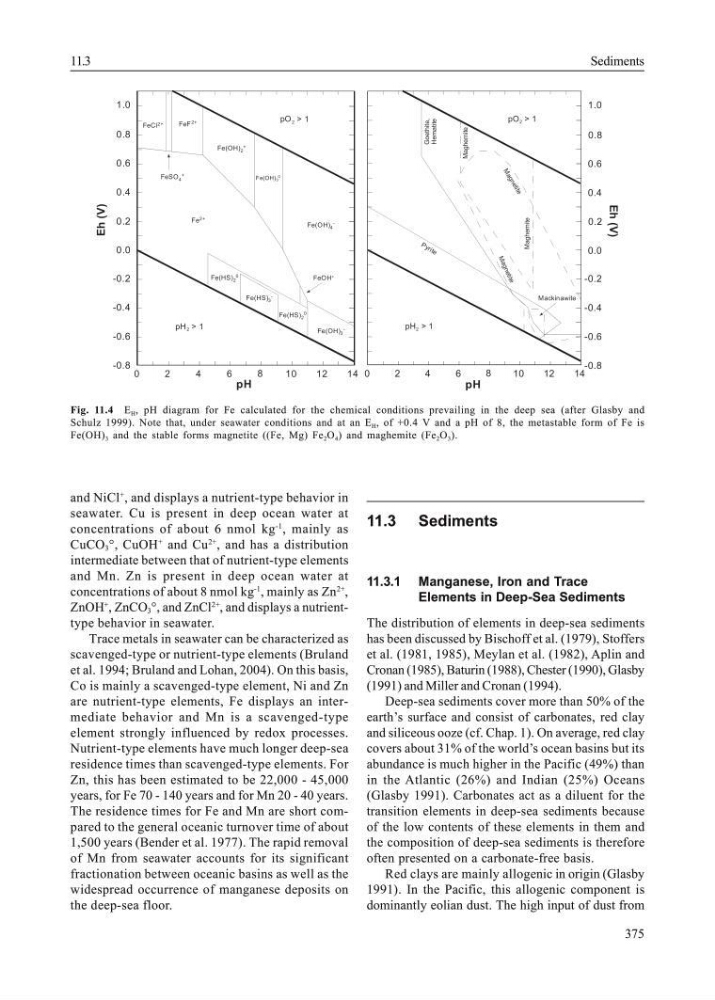
Fig. 11.4 E H , pH diagram for Fe calculated for the chemical conditions prevailing in the deep sea (after Glasby and
Schulz 1999). Note that, under seawater conditions and at an E H , of +0.4 V and a pH of 8, the metastable form of Fe is
Fe(OH) 3 and the stable forms magnetite ((Fe, Mg) Fe 2 O 4 ) and maghemite (Fe 2 O 3 ).
Goethite,
Hematite
Maghemite
P y ri te
Maghemite
M a g n e ti te
M a g n e ti te
Mackinawite
FeF
2+
FeCl 2+
FeSO 4
+
Fe(OH) 2
+
Fe(OH)3 0
Fe(OH) 4
-
Fe(HS) 2
0
Fe(HS) 3
-
Fe(HS) 2
0
FeOH +
Fe(OH) 3
-
Fe 2+
pH
0
2
4
6
8
10
12
14
1.0
0.8
0.6
0.4
0.2
0.0
-0.2
-0.4
-0.6
-0.8
Eh (V)
pH 2 > 1
pO 2 > 1
0
2
4
6
8
10
12
14
1.0
0.8
0.6
0.4
0.2
0.0
-0.2
-0.4
-0.6
-0.8
Eh (V)
pH 2 > 1
pO 2 > 1
pH
11.3
Sediments
and NiCl
+
, and displays a nutrient-type behavior in
seawater. Cu is present in deep ocean water at
concentrations of about 6 nmol kg
-1
, mainly as
CuCO 3 °, CuOH
+
and Cu
2+
, and has a distribution
intermediate between that of nutrient-type elements
and Mn. Zn is present in deep ocean water at
concentrations of about 8 nmol kg
-1
, mainly as Zn
2+
,
ZnOH
+
, ZnCO 3 °, and ZnCl
2+
, and displays a nutrienttype behavior in seawater.
Trace metals in seawater can be characterized as
scavenged-type or nutrient-type elements (Bruland
et al. 1994; Bruland and Lohan, 2004). On this basis,
Co is mainly a scavenged-type element, Ni and Zn
are nutrient-type elements, Fe displays an intermediate behavior and Mn is a scavenged-type
element strongly influenced by redox processes.
Nutrient-type elements have much longer deep-sea
residence times than scavenged-type elements. For
Zn, this has been estimated to be 22,000 - 45,000
years, for Fe 70 - 140 years and for Mn 20 - 40 years.
The residence times for Fe and Mn are short compared to the general oceanic turnover time of about
1,500 years (Bender et al. 1977). The rapid removal
of Mn from seawater accounts for its significant
fractionation between oceanic basins as well as the
widespread occurrence of manganese deposits on
the deep-sea floor.
11.3 Sediments
11.3.1 Manganese, Iron and Trace
Elements in Deep-Sea Sediments
The distribution of elements in deep-sea sediments
has been discussed by Bischoff et al. (1979), Stoffers
et al. (1981, 1985), Meylan et al. (1982), Aplin and
Cronan (1985), Baturin (1988), Chester (1990), Glasby
(1991) and Miller and Cronan (1994).
Deep-sea sediments cover more than 50% of the
earth’s surface and consist of carbonates, red clay
and siliceous ooze (cf. Chap. 1). On average, red clay
covers about 31% of the world’s ocean basins but its
abundance is much higher in the Pacific (49%) than
in the Atlantic (26%) and Indian (25%) Oceans
(Glasby 1991). Carbonates act as a diluent for the
transition elements in deep-sea sediments because
of the low contents of these elements in them and
the composition of deep-sea sediments is therefore
often presented on a carbonate-free basis.
Red clays are mainly allogenic in origin (Glasby
1991). In the Pacific, this allogenic component is
dominantly eolian dust. The high input of dust from
Fig. 11.4 E H , pH diagram for Fe calculated for the chemical conditions prevailing in the deep sea (after Glasby and
Schulz 1999). Note that, under seawater conditions and at an E H , of +0.4 V and a pH of 8, the metastable form of Fe is
Fe(OH) 3 and the stable forms magnetite ((Fe, Mg) Fe 2 O 4 ) and maghemite (Fe 2 O 3 ).
Goethite,
Hematite
Maghemite
P y ri te
Maghemite
M a g n e ti te
M a g n e ti te
Mackinawite
FeF
2+
FeCl 2+
FeSO 4
+
Fe(OH) 2
+
Fe(OH)3 0
Fe(OH) 4
-
Fe(HS) 2
0
Fe(HS) 3
-
Fe(HS) 2
0
FeOH +
Fe(OH) 3
-
Fe 2+
pH
0
2
4
6
8
10
12
14
1.0
0.8
0.6
0.4
0.2
0.0
-0.2
-0.4
-0.6
-0.8
Eh (V)
pH 2 > 1
pO 2 > 1
0
2
4
6
8
10
12
14
1.0
0.8
0.6
0.4
0.2
0.0
-0.2
-0.4
-0.6
-0.8
Eh (V)
pH 2 > 1
pO 2 > 1
pH
11.3
Sediments