

373
compares with the flux of Mn from the rivers of 0.27·10
9
kg yr
-1
(Elderfield and Schulz 1996) confirming the
original calculation of Glasby (1988).
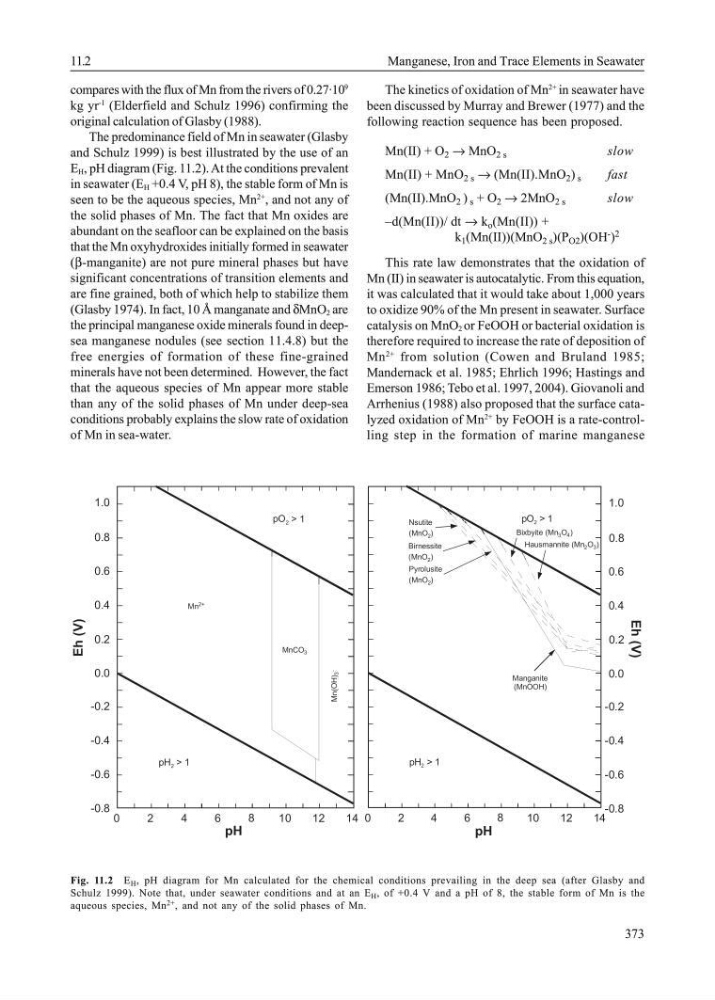
The predominance field of Mn in seawater (Glasby
and Schulz 1999) is best illustrated by the use of an
E H , pH diagram (Fig. 11.2). At the conditions prevalent
in seawater (E H +0.4 V, pH 8), the stable form of Mn is
seen to be the aqueous species, Mn
2+
, and not any of
the solid phases of Mn. The fact that Mn oxides are
abundant on the seafloor can be explained on the basis
that the Mn oxyhydroxides initially formed in seawater
(β-manganite) are not pure mineral phases but have
significant concentrations of transition elements and
are fine grained, both of which help to stabilize them
(Glasby 1974). In fact, 10 Å manganate and δMnO 2 are
the principal manganese oxide minerals found in deepsea manganese nodules (see section 11.4.8) but the
free energies of formation of these fine-grained
minerals have not been determined. However, the fact
that the aqueous species of Mn appear more stable
than any of the solid phases of Mn under deep-sea
conditions probably explains the slow rate of oxidation
of Mn in sea-water.
The kinetics of oxidation of Mn
2+
in seawater have
been discussed by Murray and Brewer (1977) and the
following reaction sequence has been proposed.
Mn(II) + O 2 → MnO 2 s
slow
Mn(II) + MnO 2 s → (Mn(II).MnO 2 ) s
fast
(Mn(II).MnO 2 ) s + O 2 → 2MnO 2 s
slow
–d(Mn(II))/ dt → k o (Mn(II)) +
k 1 (Mn(II))(MnO 2 s )(P O2 )(OH - ) 2
This rate law demonstrates that the oxidation of
Mn (II) in seawater is autocatalytic. From this equation,
it was calculated that it would take about 1,000 years
to oxidize 90% of the Mn present in seawater. Surface
catalysis on MnO 2 or FeOOH or bacterial oxidation is
therefore required to increase the rate of deposition of
Mn
2+
from solution (Cowen and Bruland 1985;
Mandernack et al. 1985; Ehrlich 1996; Hastings and
Emerson 1986; Tebo et al. 1997, 2004). Giovanoli and
Arrhenius (1988) also proposed that the surface catalyzed oxidation of Mn
2+
by FeOOH is a rate-controlling step in the formation of marine manganese
Fig. 11.2 E H , pH diagram for Mn calculated for the chemical conditions prevailing in the deep sea (after Glasby and
Schulz 1999). Note that, under seawater conditions and at an E H , of +0.4 V and a pH of 8, the stable form of Mn is the
aqueous species, Mn 2+ , and not any of the solid phases of Mn.
pH
0
2
4
6
8
10
12
14
1.0
0.8
0.6
0.4
0.2
0.0
-0.2
-0.4
-0.6
-0.8
Eh (V)
pH 2 > 1
pO 2 > 1
0
2
4
6
8
10
12
14
1.0
0.8
0.6
0.4
0.2
0.0
-0.2
-0.4
-0.6
-0.8
Eh (V)
pH 2 > 1
pO 2 > 1
pH
Mn(OH)
3
-
MnCO 3
Mn
2+
Nsutite
(MnO 2 )
Birnessite
(MnO 2 )
Pyrolusite
(MnO 2 )
Bixbyite (Mn 3 O 4 )
Hausmannite (Mn 2 O 3 )
Manganite
(MnOOH)
11.2
Manganese, Iron and Trace Elements in Seawater
compares with the flux of Mn from the rivers of 0.27·10
9
kg yr
-1
(Elderfield and Schulz 1996) confirming the
original calculation of Glasby (1988).
The predominance field of Mn in seawater (Glasby
and Schulz 1999) is best illustrated by the use of an
E H , pH diagram (Fig. 11.2). At the conditions prevalent
in seawater (E H +0.4 V, pH 8), the stable form of Mn is
seen to be the aqueous species, Mn
2+
, and not any of
the solid phases of Mn. The fact that Mn oxides are
abundant on the seafloor can be explained on the basis
that the Mn oxyhydroxides initially formed in seawater
(β-manganite) are not pure mineral phases but have
significant concentrations of transition elements and
are fine grained, both of which help to stabilize them
(Glasby 1974). In fact, 10 Å manganate and δMnO 2 are
the principal manganese oxide minerals found in deepsea manganese nodules (see section 11.4.8) but the
free energies of formation of these fine-grained
minerals have not been determined. However, the fact
that the aqueous species of Mn appear more stable
than any of the solid phases of Mn under deep-sea
conditions probably explains the slow rate of oxidation
of Mn in sea-water.
The kinetics of oxidation of Mn
2+
in seawater have
been discussed by Murray and Brewer (1977) and the
following reaction sequence has been proposed.
Mn(II) + O 2 → MnO 2 s
slow
Mn(II) + MnO 2 s → (Mn(II).MnO 2 ) s
fast
(Mn(II).MnO 2 ) s + O 2 → 2MnO 2 s
slow
–d(Mn(II))/ dt → k o (Mn(II)) +
k 1 (Mn(II))(MnO 2 s )(P O2 )(OH - ) 2
This rate law demonstrates that the oxidation of
Mn (II) in seawater is autocatalytic. From this equation,
it was calculated that it would take about 1,000 years
to oxidize 90% of the Mn present in seawater. Surface
catalysis on MnO 2 or FeOOH or bacterial oxidation is
therefore required to increase the rate of deposition of
Mn
2+
from solution (Cowen and Bruland 1985;
Mandernack et al. 1985; Ehrlich 1996; Hastings and
Emerson 1986; Tebo et al. 1997, 2004). Giovanoli and
Arrhenius (1988) also proposed that the surface catalyzed oxidation of Mn
2+
by FeOOH is a rate-controlling step in the formation of marine manganese
Fig. 11.2 E H , pH diagram for Mn calculated for the chemical conditions prevailing in the deep sea (after Glasby and
Schulz 1999). Note that, under seawater conditions and at an E H , of +0.4 V and a pH of 8, the stable form of Mn is the
aqueous species, Mn 2+ , and not any of the solid phases of Mn.
pH
0
2
4
6
8
10
12
14
1.0
0.8
0.6
0.4
0.2
0.0
-0.2
-0.4
-0.6
-0.8
Eh (V)
pH 2 > 1
pO 2 > 1
0
2
4
6
8
10
12
14
1.0
0.8
0.6
0.4
0.2
0.0
-0.2
-0.4
-0.6
-0.8
Eh (V)
pH 2 > 1
pO 2 > 1
pH
Mn(OH)
3
-
MnCO 3
Mn
2+
Nsutite
(MnO 2 )
Birnessite
(MnO 2 )
Pyrolusite
(MnO 2 )
Bixbyite (Mn 3 O 4 )
Hausmannite (Mn 2 O 3 )
Manganite
(MnOOH)
11.2
Manganese, Iron and Trace Elements in Seawater