

372
11 Manganese: Predominant Role of Nodules and Crusts
behaves in seawater as a scavenged-type metal.
Bacterial mediation plays a key role in the scavenging
and oxidation of dissolved Mn in intermediate and
deep water. The higher concentration of particulate
Mn in North Atlantic deep water (0.15 nmol kg
-1
) than
in central North Pacific deep water (0.05 nmol kg
-1
)
reflects the higher input of eolian material into the
Atlantic compared to the Pacific Ocean.
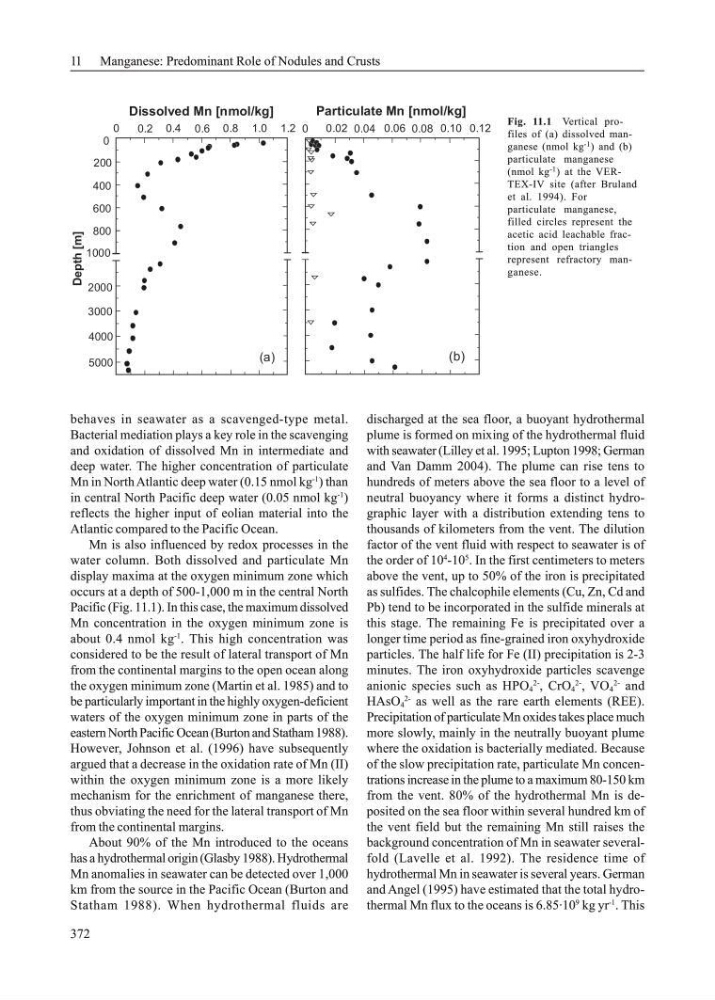
Mn is also influenced by redox processes in the
water column. Both dissolved and particulate Mn
display maxima at the oxygen minimum zone which
occurs at a depth of 500-1,000 m in the central North
Pacific (Fig. 11.1). In this case, the maximum dissolved
Mn concentration in the oxygen minimum zone is
about 0.4 nmol kg
-1
. This high concentration was
considered to be the result of lateral transport of Mn
from the continental margins to the open ocean along
the oxygen minimum zone (Martin et al. 1985) and to
be particularly important in the highly oxygen-deficient
waters of the oxygen minimum zone in parts of the
eastern North Pacific Ocean (Burton and Statham 1988).
However, Johnson et al. (1996) have subsequently
argued that a decrease in the oxidation rate of Mn (II)
within the oxygen minimum zone is a more likely
mechanism for the enrichment of manganese there,
thus obviating the need for the lateral transport of Mn
from the continental margins.
About 90% of the Mn introduced to the oceans
has a hydrothermal origin (Glasby 1988). Hydrothermal
Mn anomalies in seawater can be detected over 1,000
km from the source in the Pacific Ocean (Burton and
Statham 1988). When hydrothermal fluids are
discharged at the sea floor, a buoyant hydrothermal
plume is formed on mixing of the hydrothermal fluid
with seawater (Lilley et al. 1995; Lupton 1998; German
and Van Damm 2004). The plume can rise tens to
hundreds of meters above the sea floor to a level of
neutral buoyancy where it forms a distinct hydrographic layer with a distribution extending tens to
thousands of kilometers from the vent. The dilution
factor of the vent fluid with respect to seawater is of
the order of 10
4
-10
5
. In the first centimeters to meters
above the vent, up to 50% of the iron is precipitated
as sulfides. The chalcophile elements (Cu, Zn, Cd and
Pb) tend to be incorporated in the sulfide minerals at
this stage. The remaining Fe is precipitated over a
longer time period as fine-grained iron oxyhydroxide
particles. The half life for Fe (II) precipitation is 2-3
minutes. The iron oxyhydroxide particles scavenge
anionic species such as HPO 4
2, CrO 4
2, VO 4
2and
HAsO 4
2as well as the rare earth elements (REE).
Precipitation of particulate Mn oxides takes place much
more slowly, mainly in the neutrally buoyant plume
where the oxidation is bacterially mediated. Because
of the slow precipitation rate, particulate Mn concentrations increase in the plume to a maximum 80-150 km
from the vent. 80% of the hydrothermal Mn is deposited on the sea floor within several hundred km of
the vent field but the remaining Mn still raises the
background concentration of Mn in seawater severalfold (Lavelle et al. 1992). The residence time of
hydrothermal Mn in seawater is several years. German
and Angel (1995) have estimated that the total hydrothermal Mn flux to the oceans is 6.85·10
9
kg yr
-1
. This
Fig. 11.1 Vertical profiles of (a) dissolved manganese (nmol kg -1 ) and (b)
particulate manganese
(nmol kg -1 ) at the VERTEX-IV site (after Bruland
et al. 1994). For
particulate manganese,
filled circles represent the
acetic acid leachable fraction and open triangles
represent refractory manganese.
(b)
0
200
400
600
800
1000
2000
3000
4000
5000
(a)
Dissolved Mn [nmol/kg]
Depth [m]
0
0.2 0.4 0.6 0.8 1.0 1.2 0
0.02 0.04 0.06
0.12
Particulate Mn [nmol/kg]
0.08 0.10
11 Manganese: Predominant Role of Nodules and Crusts
behaves in seawater as a scavenged-type metal.
Bacterial mediation plays a key role in the scavenging
and oxidation of dissolved Mn in intermediate and
deep water. The higher concentration of particulate
Mn in North Atlantic deep water (0.15 nmol kg
-1
) than
in central North Pacific deep water (0.05 nmol kg
-1
)
reflects the higher input of eolian material into the
Atlantic compared to the Pacific Ocean.
Mn is also influenced by redox processes in the
water column. Both dissolved and particulate Mn
display maxima at the oxygen minimum zone which
occurs at a depth of 500-1,000 m in the central North
Pacific (Fig. 11.1). In this case, the maximum dissolved
Mn concentration in the oxygen minimum zone is
about 0.4 nmol kg
-1
. This high concentration was
considered to be the result of lateral transport of Mn
from the continental margins to the open ocean along
the oxygen minimum zone (Martin et al. 1985) and to
be particularly important in the highly oxygen-deficient
waters of the oxygen minimum zone in parts of the
eastern North Pacific Ocean (Burton and Statham 1988).
However, Johnson et al. (1996) have subsequently
argued that a decrease in the oxidation rate of Mn (II)
within the oxygen minimum zone is a more likely
mechanism for the enrichment of manganese there,
thus obviating the need for the lateral transport of Mn
from the continental margins.
About 90% of the Mn introduced to the oceans
has a hydrothermal origin (Glasby 1988). Hydrothermal
Mn anomalies in seawater can be detected over 1,000
km from the source in the Pacific Ocean (Burton and
Statham 1988). When hydrothermal fluids are
discharged at the sea floor, a buoyant hydrothermal
plume is formed on mixing of the hydrothermal fluid
with seawater (Lilley et al. 1995; Lupton 1998; German
and Van Damm 2004). The plume can rise tens to
hundreds of meters above the sea floor to a level of
neutral buoyancy where it forms a distinct hydrographic layer with a distribution extending tens to
thousands of kilometers from the vent. The dilution
factor of the vent fluid with respect to seawater is of
the order of 10
4
-10
5
. In the first centimeters to meters
above the vent, up to 50% of the iron is precipitated
as sulfides. The chalcophile elements (Cu, Zn, Cd and
Pb) tend to be incorporated in the sulfide minerals at
this stage. The remaining Fe is precipitated over a
longer time period as fine-grained iron oxyhydroxide
particles. The half life for Fe (II) precipitation is 2-3
minutes. The iron oxyhydroxide particles scavenge
anionic species such as HPO 4
2, CrO 4
2, VO 4
2and
HAsO 4
2as well as the rare earth elements (REE).
Precipitation of particulate Mn oxides takes place much
more slowly, mainly in the neutrally buoyant plume
where the oxidation is bacterially mediated. Because
of the slow precipitation rate, particulate Mn concentrations increase in the plume to a maximum 80-150 km
from the vent. 80% of the hydrothermal Mn is deposited on the sea floor within several hundred km of
the vent field but the remaining Mn still raises the
background concentration of Mn in seawater severalfold (Lavelle et al. 1992). The residence time of
hydrothermal Mn in seawater is several years. German
and Angel (1995) have estimated that the total hydrothermal Mn flux to the oceans is 6.85·10
9
kg yr
-1
. This
Fig. 11.1 Vertical profiles of (a) dissolved manganese (nmol kg -1 ) and (b)
particulate manganese
(nmol kg -1 ) at the VERTEX-IV site (after Bruland
et al. 1994). For
particulate manganese,
filled circles represent the
acetic acid leachable fraction and open triangles
represent refractory manganese.
(b)
0
200
400
600
800
1000
2000
3000
4000
5000
(a)
Dissolved Mn [nmol/kg]
Depth [m]
0
0.2 0.4 0.6 0.8 1.0 1.2 0
0.02 0.04 0.06
0.12
Particulate Mn [nmol/kg]
0.08 0.10