

10 Influence of Geochemical Processes on Stable Isotope Distribution in Marine Sediments
362
Although still limited in their spatial coverage, the
studies cited above provide strong support for
using the boron isotope pH proxy to evaluate the
role of different ocean parts to estimate past
sources and sinks of CO 2 to the atmosphere.
However, the application of the boron isotope
proxy in mixed benthic foraminifera species for
deep ocean pH reconstruction led to some doubt,
because it suggested a 0.3 units higher glacial pH
(i.e., +2.5‰ in δ
11
B) compared to modern deep
water pH (Sanyal et al. 1995), which is not corroborated by sedimentary records of glacial calcite preservation suggesting no significant change in deep
ocean carbonate ion concentration and pH. But this
too large increase in pH was most probably due to
the use of mixed benthic species instead of a single
species, only (B. Hoenisch, pers. comm.).
Pearson and Palmer (2000) extended the δ
11
B
application to the Paleogene and estimated a pH of
7.4 and corresponding pCO 2 values higher than 2000
ppmv for the early Eocene time period. However,
several uncertainties may limit the confidence in
their interpretation, because of the residence time of
boron in the ocean of only 3-5 million years
(Lemarchand et al. 2000) and the use of extinct
foraminifer species without a significant crosscalibration against modern species. So far, such records
need to be interpreted with caution, and considerable efforts will have to be made to improve confidence in pre-Quaternary reconstructions.
Acknowledgements
This is contribution No 0335 of the Research Center
Ocean Margins (RCOM) which is financed by the
Deutsche Forschungsgemeinschaft (DFG) at Bremen
University, Germany.
10.8 Problems
Problem 1
Antarctic and Greenland ice sheets store today
about 2 % of the ocean water mass with an
average δ
18
O value of -45‰. What would be the
δ
18
O w value of an ice-free world?
Problem 2
A number of authors have proposed that the
0.3‰ lower δ
13
C mean ocean value during the
last glacial maximum (about 21000 years ago)
resulted from an increased erosion of organic
carbon from terrigenous soils and shelf sediments during a drop in sea-level as a result of
continental glaciation. Assuming an oceanic
carbon mass of 38,000 Gt and an average δ
13
C
value of terrestrial organic carbon of -25‰,
calculate the transfer of organic carbon from the
terrestrial to the oceanic reservoir necessary to
explain the carbon isotope shift. Is the result
realistic? What other explanations would be
reasonable?
Problem 3
Given the range of b-values (equation 10.9)
between 80 and 160 ‰µM as derived from
South Atlantic core tops (Schulte et al. 2003),
what would be its effect on atmospheric pCO 2
assuming an ε p of 12‰, an enzymatic fractionation ε f of 25‰, and a solubility coefficent
α = 0.032 at 20°C?
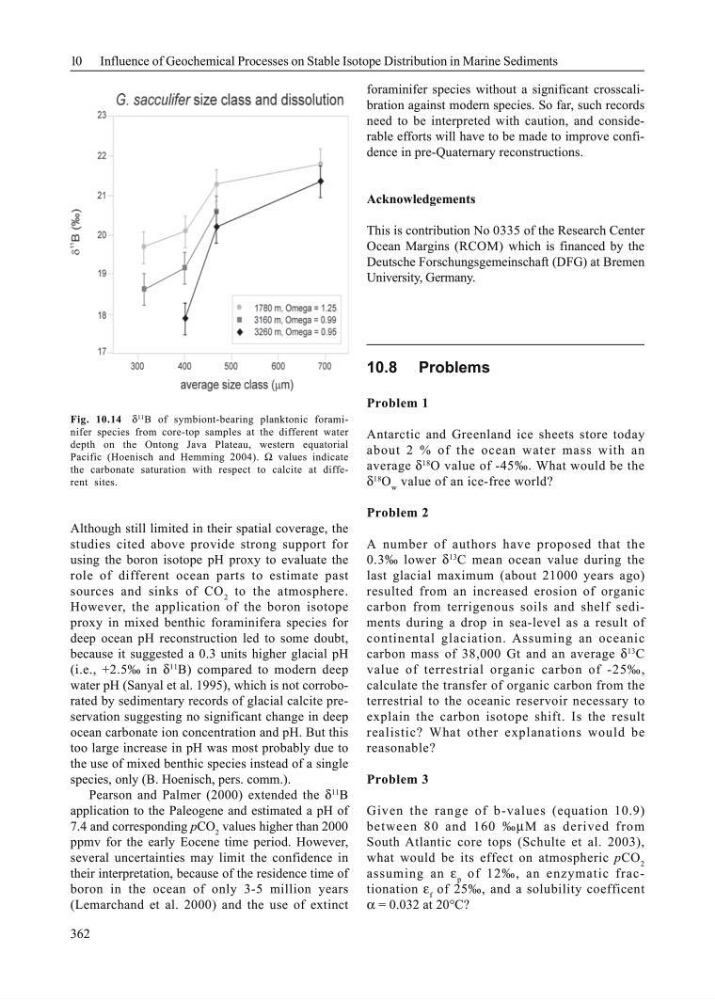
Fig. 10.14 δ
11 B of symbiont-bearing planktonic foraminifer species from core-top samples at the different water
depth on the Ontong Java Plateau, western equatorial
Pacific (Hoenisch and Hemming 2004). Ω values indicate
the carbonate saturation with respect to calcite at different sites.
362
Although still limited in their spatial coverage, the
studies cited above provide strong support for
using the boron isotope pH proxy to evaluate the
role of different ocean parts to estimate past
sources and sinks of CO 2 to the atmosphere.
However, the application of the boron isotope
proxy in mixed benthic foraminifera species for
deep ocean pH reconstruction led to some doubt,
because it suggested a 0.3 units higher glacial pH
(i.e., +2.5‰ in δ
11
B) compared to modern deep
water pH (Sanyal et al. 1995), which is not corroborated by sedimentary records of glacial calcite preservation suggesting no significant change in deep
ocean carbonate ion concentration and pH. But this
too large increase in pH was most probably due to
the use of mixed benthic species instead of a single
species, only (B. Hoenisch, pers. comm.).
Pearson and Palmer (2000) extended the δ
11
B
application to the Paleogene and estimated a pH of
7.4 and corresponding pCO 2 values higher than 2000
ppmv for the early Eocene time period. However,
several uncertainties may limit the confidence in
their interpretation, because of the residence time of
boron in the ocean of only 3-5 million years
(Lemarchand et al. 2000) and the use of extinct
foraminifer species without a significant crosscalibration against modern species. So far, such records
need to be interpreted with caution, and considerable efforts will have to be made to improve confidence in pre-Quaternary reconstructions.
Acknowledgements
This is contribution No 0335 of the Research Center
Ocean Margins (RCOM) which is financed by the
Deutsche Forschungsgemeinschaft (DFG) at Bremen
University, Germany.
10.8 Problems
Problem 1
Antarctic and Greenland ice sheets store today
about 2 % of the ocean water mass with an
average δ
18
O value of -45‰. What would be the
δ
18
O w value of an ice-free world?
Problem 2
A number of authors have proposed that the
0.3‰ lower δ
13
C mean ocean value during the
last glacial maximum (about 21000 years ago)
resulted from an increased erosion of organic
carbon from terrigenous soils and shelf sediments during a drop in sea-level as a result of
continental glaciation. Assuming an oceanic
carbon mass of 38,000 Gt and an average δ
13
C
value of terrestrial organic carbon of -25‰,
calculate the transfer of organic carbon from the
terrestrial to the oceanic reservoir necessary to
explain the carbon isotope shift. Is the result
realistic? What other explanations would be
reasonable?
Problem 3
Given the range of b-values (equation 10.9)
between 80 and 160 ‰µM as derived from
South Atlantic core tops (Schulte et al. 2003),
what would be its effect on atmospheric pCO 2
assuming an ε p of 12‰, an enzymatic fractionation ε f of 25‰, and a solubility coefficent
α = 0.032 at 20°C?
Fig. 10.14 δ
11 B of symbiont-bearing planktonic foraminifer species from core-top samples at the different water
depth on the Ontong Java Plateau, western equatorial
Pacific (Hoenisch and Hemming 2004). Ω values indicate
the carbonate saturation with respect to calcite at different sites.