

361
10.7.2 δ
δ δ
δ δ 11 B in Marine Carbonates
Principles of Fractionation
Diverse biogenic and inorganic marine
carbonates record boron isotopic compositions
close to the boron isotopic composition of
B(OH) 4
-
at modern seawater pH. Therefore,
Hemming and Hanson (1992) suggested that it is
the charged borate species that is preferably
incorporated into marine carbonates. This
interpretation has been confirmed by a number of
empirical calibration studies on inorganic calcium
carbonates (Hemming et al. 1995; Sanyal et al.
2000), corals (Hönisch et al. 2004; Reynaud et al.
2004), and planktonic foraminifers (Sanyal et al.
1996; Sanyal et al. 2001) over a wide range of
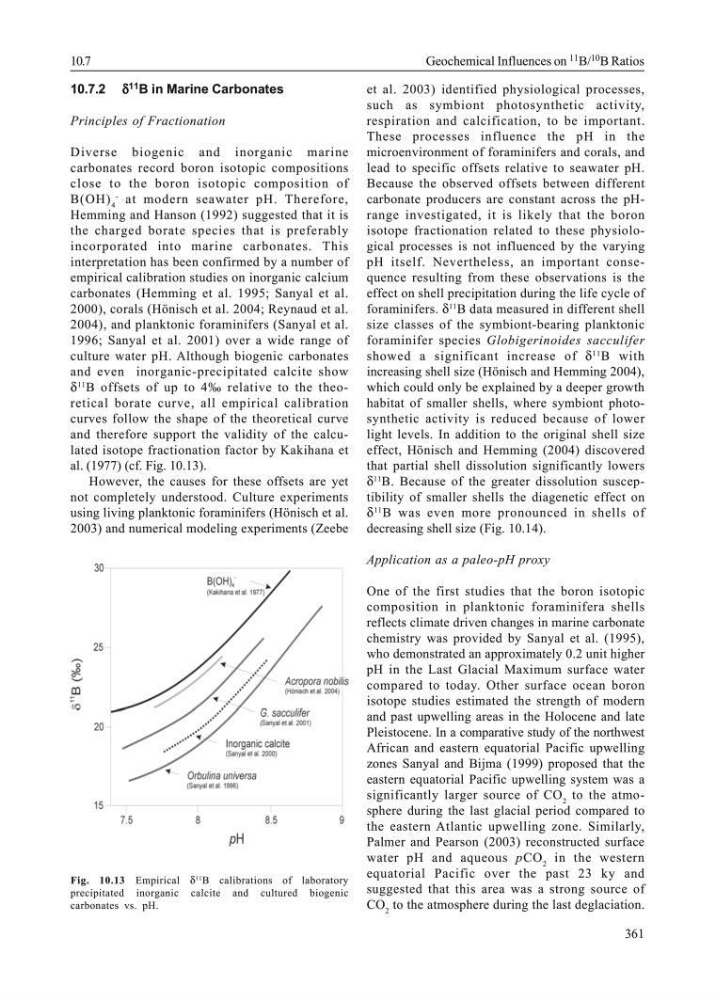
culture water pH. Although biogenic carbonates
and even inorganic-precipitated calcite show
δ
11
B offsets of up to 4‰ relative to the theoretical borate curve, all empirical calibration
curves follow the shape of the theoretical curve
and therefore support the validity of the calculated isotope fractionation factor by Kakihana et
al. (1977) (cf. Fig. 10.13).
However, the causes for these offsets are yet
not completely understood. Culture experiments
using living planktonic foraminifers (Hönisch et al.
2003) and numerical modeling experiments (Zeebe
et al. 2003) identified physiological processes,
such as symbiont photosynthetic activity,
respiration and calcification, to be important.
These processes influence the pH in the
microenvironment of foraminifers and corals, and
lead to specific offsets relative to seawater pH.
Because the observed offsets between different
carbonate producers are constant across the pHrange investigated, it is likely that the boron
isotope fractionation related to these physiological processes is not influenced by the varying
pH itself. Nevertheless, an important consequence resulting from these observations is the
effect on shell precipitation during the life cycle of
foraminifers. δ
11
B data measured in different shell
size classes of the symbiont-bearing planktonic
foraminifer species Globigerinoides sacculifer
showed a significant increase of δ
11
B with
increasing shell size (Hönisch and Hemming 2004),
which could only be explained by a deeper growth
habitat of smaller shells, where symbiont photosynthetic activity is reduced because of lower
light levels. In addition to the original shell size
effect, Hönisch and Hemming (2004) discovered
that partial shell dissolution significantly lowers
δ
11
B. Because of the greater dissolution susceptibility of smaller shells the diagenetic effect on
δ
11
B was even more pronounced in shells of
decreasing shell size (Fig. 10.14).
Application as a paleo-pH proxy
One of the first studies that the boron isotopic
composition in planktonic foraminifera shells
reflects climate driven changes in marine carbonate
chemistry was provided by Sanyal et al. (1995),
who demonstrated an approximately 0.2 unit higher
pH in the Last Glacial Maximum surface water
compared to today. Other surface ocean boron
isotope studies estimated the strength of modern
and past upwelling areas in the Holocene and late
Pleistocene. In a comparative study of the northwest
African and eastern equatorial Pacific upwelling
zones Sanyal and Bijma (1999) proposed that the
eastern equatorial Pacific upwelling system was a
significantly larger source of CO 2 to the atmosphere during the last glacial period compared to
the eastern Atlantic upwelling zone. Similarly,
Palmer and Pearson (2003) reconstructed surface
water pH and aqueous pCO 2 in the western
equatorial Pacific over the past 23 ky and
suggested that this area was a strong source of
CO 2 to the atmosphere during the last deglaciation.
Fig. 10.13 Empirical δ
11 B calibrations of laboratory
precipitated inorganic calcite and cultured biogenic
carbonates vs. pH.
10.7
Geochemical Influences on 11 B/ 10 B Ratios
10.7.2 δ
δ δ
δ δ 11 B in Marine Carbonates
Principles of Fractionation
Diverse biogenic and inorganic marine
carbonates record boron isotopic compositions
close to the boron isotopic composition of
B(OH) 4
-
at modern seawater pH. Therefore,
Hemming and Hanson (1992) suggested that it is
the charged borate species that is preferably
incorporated into marine carbonates. This
interpretation has been confirmed by a number of
empirical calibration studies on inorganic calcium
carbonates (Hemming et al. 1995; Sanyal et al.
2000), corals (Hönisch et al. 2004; Reynaud et al.
2004), and planktonic foraminifers (Sanyal et al.
1996; Sanyal et al. 2001) over a wide range of
culture water pH. Although biogenic carbonates
and even inorganic-precipitated calcite show
δ
11
B offsets of up to 4‰ relative to the theoretical borate curve, all empirical calibration
curves follow the shape of the theoretical curve
and therefore support the validity of the calculated isotope fractionation factor by Kakihana et
al. (1977) (cf. Fig. 10.13).
However, the causes for these offsets are yet
not completely understood. Culture experiments
using living planktonic foraminifers (Hönisch et al.
2003) and numerical modeling experiments (Zeebe
et al. 2003) identified physiological processes,
such as symbiont photosynthetic activity,
respiration and calcification, to be important.
These processes influence the pH in the
microenvironment of foraminifers and corals, and
lead to specific offsets relative to seawater pH.
Because the observed offsets between different
carbonate producers are constant across the pHrange investigated, it is likely that the boron
isotope fractionation related to these physiological processes is not influenced by the varying
pH itself. Nevertheless, an important consequence resulting from these observations is the
effect on shell precipitation during the life cycle of
foraminifers. δ
11
B data measured in different shell
size classes of the symbiont-bearing planktonic
foraminifer species Globigerinoides sacculifer
showed a significant increase of δ
11
B with
increasing shell size (Hönisch and Hemming 2004),
which could only be explained by a deeper growth
habitat of smaller shells, where symbiont photosynthetic activity is reduced because of lower
light levels. In addition to the original shell size
effect, Hönisch and Hemming (2004) discovered
that partial shell dissolution significantly lowers
δ
11
B. Because of the greater dissolution susceptibility of smaller shells the diagenetic effect on
δ
11
B was even more pronounced in shells of
decreasing shell size (Fig. 10.14).
Application as a paleo-pH proxy
One of the first studies that the boron isotopic
composition in planktonic foraminifera shells
reflects climate driven changes in marine carbonate
chemistry was provided by Sanyal et al. (1995),
who demonstrated an approximately 0.2 unit higher
pH in the Last Glacial Maximum surface water
compared to today. Other surface ocean boron
isotope studies estimated the strength of modern
and past upwelling areas in the Holocene and late
Pleistocene. In a comparative study of the northwest
African and eastern equatorial Pacific upwelling
zones Sanyal and Bijma (1999) proposed that the
eastern equatorial Pacific upwelling system was a
significantly larger source of CO 2 to the atmosphere during the last glacial period compared to
the eastern Atlantic upwelling zone. Similarly,
Palmer and Pearson (2003) reconstructed surface
water pH and aqueous pCO 2 in the western
equatorial Pacific over the past 23 ky and
suggested that this area was a strong source of
CO 2 to the atmosphere during the last deglaciation.
Fig. 10.13 Empirical δ
11 B calibrations of laboratory
precipitated inorganic calcite and cultured biogenic
carbonates vs. pH.
10.7
Geochemical Influences on 11 B/ 10 B Ratios