

10 Influence of Geochemical Processes on Stable Isotope Distribution in Marine Sediments
360
In that case, some H 2 S diffuses back to the sediment surface, where it is reoxidized, whereas some
H 2 S undergoes further reactions. All these
processes are associated with different fractionation effects on the sulfur isotopic composition
of sulfides.
In addition to these primary, syngenetic
effects, the isotope variability may reflect the
diagenetic history of the sediments with a
progressive evolution from early to late diagenetic sulfides (i.e. framboids to concretions
or overgrowth). In summary, due to the large
number of processes that might affect the isotopic composition of sulfides, their potential
for interpreting features of the Phanerozoic
sulfur cycle appears to be rather limited
(Strauss 1997).
10.7 Geochemical Influences on
11
B /
10
B Ratios
10.7.1 δ
δ δ
δ δ 11 B of Seawater and Pore Waters
Principles of Fractionation
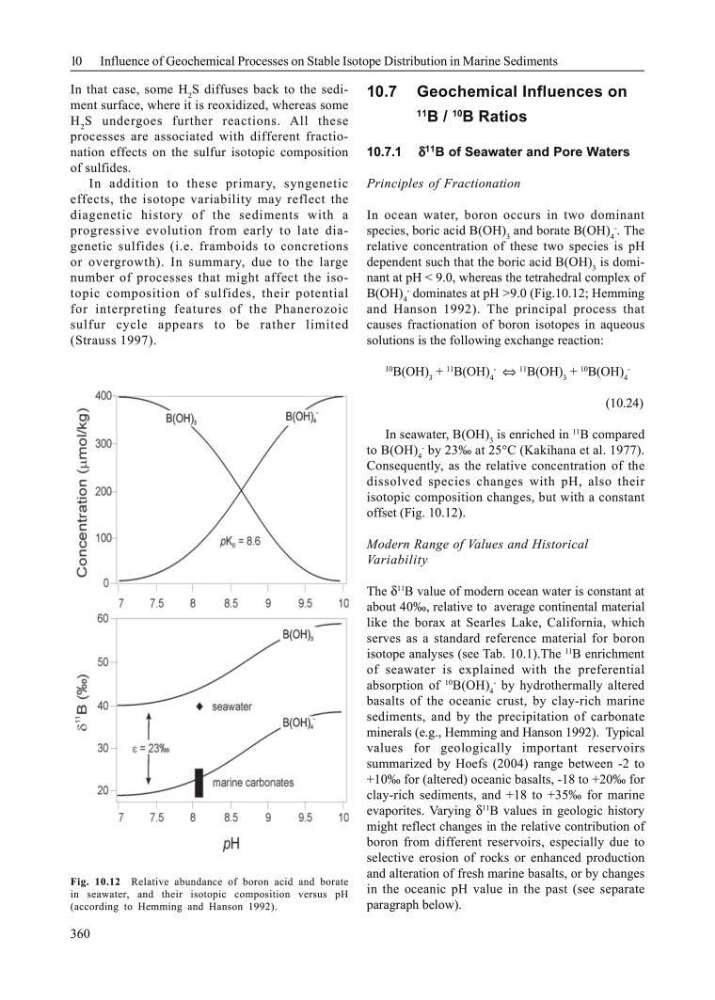
In ocean water, boron occurs in two dominant
species, boric acid B(OH) 3 and borate B(OH) 4
-
. The
relative concentration of these two species is pH
dependent such that the boric acid B(OH) 3 is dominant at pH < 9.0, whereas the tetrahedral complex of
B(OH) 4
-
dominates at pH >9.0 (Fig.10.12; Hemming
and Hanson 1992). The principal process that
causes fractionation of boron isotopes in aqueous
solutions is the following exchange reaction:
10
B(OH) 3 +
11
B(OH) 4
-
⇔
11
B(OH) 3 +
10
B(OH) 4
-
(10.24)
In seawater, B(OH) 3 is enriched in
11
B compared
to B(OH) 4
-
by 23‰ at 25°C (Kakihana et al. 1977).
Consequently, as the relative concentration of the
dissolved species changes with pH, also their
isotopic composition changes, but with a constant
offset (Fig. 10.12).
Modern Range of Values and Historical
Variability
The δ
11
B value of modern ocean water is constant at
about 40‰, relative to average continental material
like the borax at Searles Lake, California, which
serves as a standard reference material for boron
isotope analyses (see Tab. 10.1).The
11
B enrichment
of seawater is explained with the preferential
absorption of
10
B(OH) 4
-
by hydrothermally altered
basalts of the oceanic crust, by clay-rich marine
sediments, and by the precipitation of carbonate
minerals (e.g., Hemming and Hanson 1992). Typical
values for geologically important reservoirs
summarized by Hoefs (2004) range between -2 to
+10‰ for (altered) oceanic basalts, -18 to +20‰ for
clay-rich sediments, and +18 to +35‰ for marine
evaporites. Varying δ
11
B values in geologic history
might reflect changes in the relative contribution of
boron from different reservoirs, especially due to
selective erosion of rocks or enhanced production
and alteration of fresh marine basalts, or by changes
in the oceanic pH value in the past (see separate
paragraph below).
Fig. 10.12 Relative abundance of boron acid and borate
in seawater, and their isotopic composition versus pH
(according to Hemming and Hanson 1992).
360
In that case, some H 2 S diffuses back to the sediment surface, where it is reoxidized, whereas some
H 2 S undergoes further reactions. All these
processes are associated with different fractionation effects on the sulfur isotopic composition
of sulfides.
In addition to these primary, syngenetic
effects, the isotope variability may reflect the
diagenetic history of the sediments with a
progressive evolution from early to late diagenetic sulfides (i.e. framboids to concretions
or overgrowth). In summary, due to the large
number of processes that might affect the isotopic composition of sulfides, their potential
for interpreting features of the Phanerozoic
sulfur cycle appears to be rather limited
(Strauss 1997).
10.7 Geochemical Influences on
11
B /
10
B Ratios
10.7.1 δ
δ δ
δ δ 11 B of Seawater and Pore Waters
Principles of Fractionation
In ocean water, boron occurs in two dominant
species, boric acid B(OH) 3 and borate B(OH) 4
-
. The
relative concentration of these two species is pH
dependent such that the boric acid B(OH) 3 is dominant at pH < 9.0, whereas the tetrahedral complex of
B(OH) 4
-
dominates at pH >9.0 (Fig.10.12; Hemming
and Hanson 1992). The principal process that
causes fractionation of boron isotopes in aqueous
solutions is the following exchange reaction:
10
B(OH) 3 +
11
B(OH) 4
-
⇔
11
B(OH) 3 +
10
B(OH) 4
-
(10.24)
In seawater, B(OH) 3 is enriched in
11
B compared
to B(OH) 4
-
by 23‰ at 25°C (Kakihana et al. 1977).
Consequently, as the relative concentration of the
dissolved species changes with pH, also their
isotopic composition changes, but with a constant
offset (Fig. 10.12).
Modern Range of Values and Historical
Variability
The δ
11
B value of modern ocean water is constant at
about 40‰, relative to average continental material
like the borax at Searles Lake, California, which
serves as a standard reference material for boron
isotope analyses (see Tab. 10.1).The
11
B enrichment
of seawater is explained with the preferential
absorption of
10
B(OH) 4
-
by hydrothermally altered
basalts of the oceanic crust, by clay-rich marine
sediments, and by the precipitation of carbonate
minerals (e.g., Hemming and Hanson 1992). Typical
values for geologically important reservoirs
summarized by Hoefs (2004) range between -2 to
+10‰ for (altered) oceanic basalts, -18 to +20‰ for
clay-rich sediments, and +18 to +35‰ for marine
evaporites. Varying δ
11
B values in geologic history
might reflect changes in the relative contribution of
boron from different reservoirs, especially due to
selective erosion of rocks or enhanced production
and alteration of fresh marine basalts, or by changes
in the oceanic pH value in the past (see separate
paragraph below).
Fig. 10.12 Relative abundance of boron acid and borate
in seawater, and their isotopic composition versus pH
(according to Hemming and Hanson 1992).