

8
Sulfur Cycling and Methane Oxidation
292
reduction - and a subsequent drastic drop during
the glacial/Holocene transition (Fig. 8.12). Similar
to the conditions on the Amazon Fan the strong
decrease in sedimentation rate encountered during
the last climatic transition induced a fixation of the
SMT and an enhanced overprint of rock magnetic
and mineralogical properties at this particular
sediment layer. To obtain the observed geochemical and magnetic patterns, the SMT must have
remained at a fixed position for about 9000 years –
a time span which closely corresponds to the time
since the Pleistocene/Holocene transition.
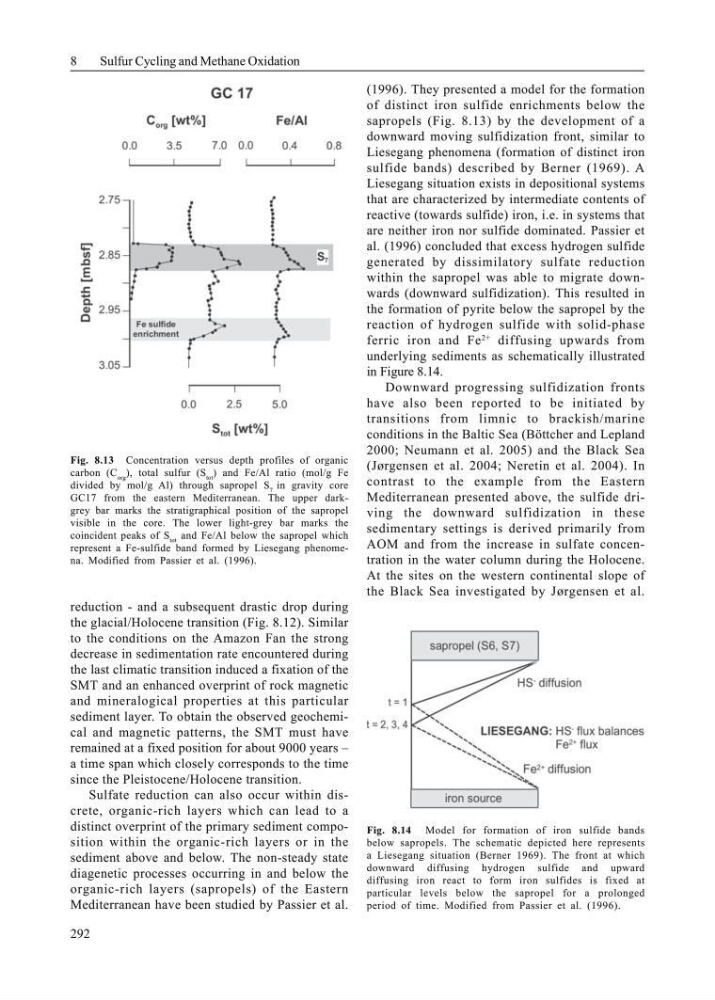
Sulfate reduction can also occur within discrete, organic-rich layers which can lead to a
distinct overprint of the primary sediment composition within the organic-rich layers or in the
sediment above and below. The non-steady state
diagenetic processes occurring in and below the
organic-rich layers (sapropels) of the Eastern
Mediterranean have been studied by Passier et al.
(1996). They presented a model for the formation
of distinct iron sulfide enrichments below the
sapropels (Fig. 8.13) by the development of a
downward moving sulfidization front, similar to
Liesegang phenomena (formation of distinct iron
sulfide bands) described by Berner (1969). A
Liesegang situation exists in depositional systems
that are characterized by intermediate contents of
reactive (towards sulfide) iron, i.e. in systems that
are neither iron nor sulfide dominated. Passier et
al. (1996) concluded that excess hydrogen sulfide
generated by dissimilatory sulfate reduction
within the sapropel was able to migrate downwards (downward sulfidization). This resulted in
the formation of pyrite below the sapropel by the
reaction of hydrogen sulfide with solid-phase
ferric iron and Fe
2+
diffusing upwards from
underlying sediments as schematically illustrated
in Figure 8.14.
Downward progressing sulfidization fronts
have also been reported to be initiated by
transitions from limnic to brackish/marine
conditions in the Baltic Sea (Böttcher and Lepland
2000; Neumann et al. 2005) and the Black Sea
(Jørgensen et al. 2004; Neretin et al. 2004). In
contrast to the example from the Eastern
Mediterranean presented above, the sulfide driving the downward sulfidization in these
sedimentary settings is derived primarily from
AOM and from the increase in sulfate concentration in the water column during the Holocene.
At the sites on the western continental slope of
the Black Sea investigated by Jørgensen et al.
Fig. 8.13 Concentration versus depth profiles of organic
carbon (C org ), total sulfur (S tot ) and Fe/Al ratio (mol/g Fe
divided by mol/g Al) through sapropel S 7 in gravity core
GC17 from the eastern Mediterranean. The upper darkgrey bar marks the stratigraphical position of the sapropel
visible in the core. The lower light-grey bar marks the
coincident peaks of S tot and Fe/Al below the sapropel which
represent a Fe-sulfide band formed by Liesegang phenomena. Modified from Passier et al. (1996).
Fig. 8.14 Model for formation of iron sulfide bands
below sapropels. The schematic depicted here represents
a Liesegang situation (Berner 1969). The front at which
downward diffusing hydrogen sulfide and upward
diffusing iron react to form iron sulfides is fixed at
particular levels below the sapropel for a prolonged
period of time. Modified from Passier et al. (1996).
Sulfur Cycling and Methane Oxidation
292
reduction - and a subsequent drastic drop during
the glacial/Holocene transition (Fig. 8.12). Similar
to the conditions on the Amazon Fan the strong
decrease in sedimentation rate encountered during
the last climatic transition induced a fixation of the
SMT and an enhanced overprint of rock magnetic
and mineralogical properties at this particular
sediment layer. To obtain the observed geochemical and magnetic patterns, the SMT must have
remained at a fixed position for about 9000 years –
a time span which closely corresponds to the time
since the Pleistocene/Holocene transition.
Sulfate reduction can also occur within discrete, organic-rich layers which can lead to a
distinct overprint of the primary sediment composition within the organic-rich layers or in the
sediment above and below. The non-steady state
diagenetic processes occurring in and below the
organic-rich layers (sapropels) of the Eastern
Mediterranean have been studied by Passier et al.
(1996). They presented a model for the formation
of distinct iron sulfide enrichments below the
sapropels (Fig. 8.13) by the development of a
downward moving sulfidization front, similar to
Liesegang phenomena (formation of distinct iron
sulfide bands) described by Berner (1969). A
Liesegang situation exists in depositional systems
that are characterized by intermediate contents of
reactive (towards sulfide) iron, i.e. in systems that
are neither iron nor sulfide dominated. Passier et
al. (1996) concluded that excess hydrogen sulfide
generated by dissimilatory sulfate reduction
within the sapropel was able to migrate downwards (downward sulfidization). This resulted in
the formation of pyrite below the sapropel by the
reaction of hydrogen sulfide with solid-phase
ferric iron and Fe
2+
diffusing upwards from
underlying sediments as schematically illustrated
in Figure 8.14.
Downward progressing sulfidization fronts
have also been reported to be initiated by
transitions from limnic to brackish/marine
conditions in the Baltic Sea (Böttcher and Lepland
2000; Neumann et al. 2005) and the Black Sea
(Jørgensen et al. 2004; Neretin et al. 2004). In
contrast to the example from the Eastern
Mediterranean presented above, the sulfide driving the downward sulfidization in these
sedimentary settings is derived primarily from
AOM and from the increase in sulfate concentration in the water column during the Holocene.
At the sites on the western continental slope of
the Black Sea investigated by Jørgensen et al.
Fig. 8.13 Concentration versus depth profiles of organic
carbon (C org ), total sulfur (S tot ) and Fe/Al ratio (mol/g Fe
divided by mol/g Al) through sapropel S 7 in gravity core
GC17 from the eastern Mediterranean. The upper darkgrey bar marks the stratigraphical position of the sapropel
visible in the core. The lower light-grey bar marks the
coincident peaks of S tot and Fe/Al below the sapropel which
represent a Fe-sulfide band formed by Liesegang phenomena. Modified from Passier et al. (1996).
Fig. 8.14 Model for formation of iron sulfide bands
below sapropels. The schematic depicted here represents
a Liesegang situation (Berner 1969). The front at which
downward diffusing hydrogen sulfide and upward
diffusing iron react to form iron sulfides is fixed at
particular levels below the sapropel for a prolonged
period of time. Modified from Passier et al. (1996).