

293
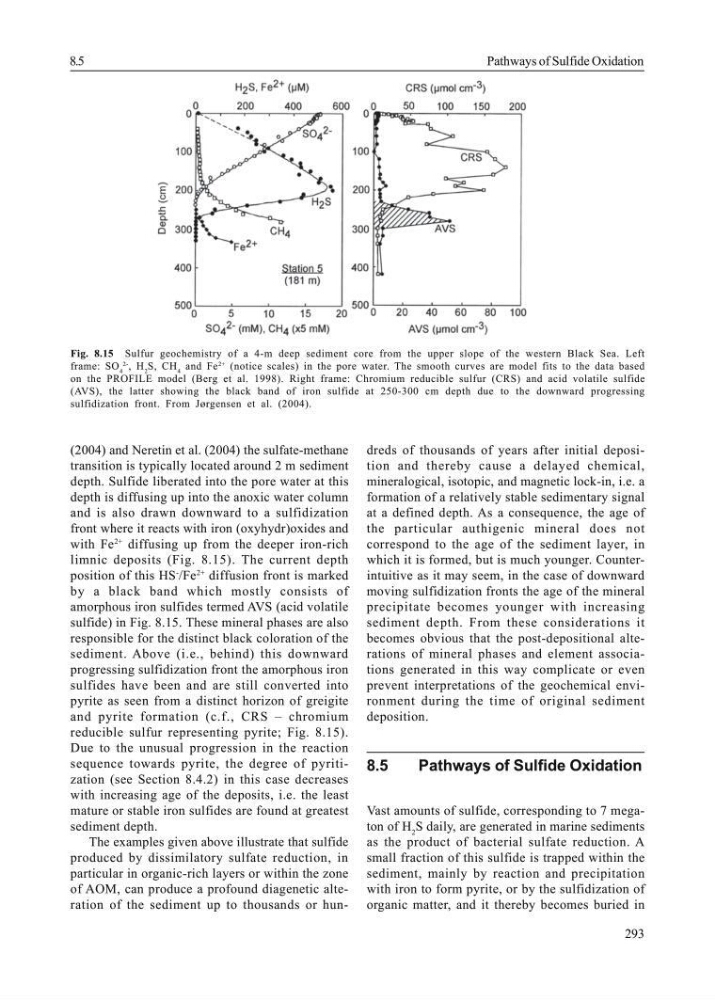
(2004) and Neretin et al. (2004) the sulfate-methane
transition is typically located around 2 m sediment
depth. Sulfide liberated into the pore water at this
depth is diffusing up into the anoxic water column
and is also drawn downward to a sulfidization
front where it reacts with iron (oxyhydr)oxides and
with Fe
2+
diffusing up from the deeper iron-rich
limnic deposits (Fig. 8.15). The current depth
position of this HS
-
/Fe
2+
diffusion front is marked
by a black band which mostly consists of
amorphous iron sulfides termed AVS (acid volatile
sulfide) in Fig. 8.15. These mineral phases are also
responsible for the distinct black coloration of the
sediment. Above (i.e., behind) this downward
progressing sulfidization front the amorphous iron
sulfides have been and are still converted into
pyrite as seen from a distinct horizon of greigite
and pyrite formation (c.f., CRS – chromium
reducible sulfur representing pyrite; Fig. 8.15).
Due to the unusual progression in the reaction
sequence towards pyrite, the degree of pyritization (see Section 8.4.2) in this case decreases
with increasing age of the deposits, i.e. the least
mature or stable iron sulfides are found at greatest
sediment depth.
The examples given above illustrate that sulfide
produced by dissimilatory sulfate reduction, in
particular in organic-rich layers or within the zone
of AOM, can produce a profound diagenetic alteration of the sediment up to thousands or hundreds of thousands of years after initial deposition and thereby cause a delayed chemical,
mineralogical, isotopic, and magnetic lock-in, i.e. a
formation of a relatively stable sedimentary signal
at a defined depth. As a consequence, the age of
the particular authigenic mineral does not
correspond to the age of the sediment layer, in
which it is formed, but is much younger. Counterintuitive as it may seem, in the case of downward
moving sulfidization fronts the age of the mineral
precipitate becomes younger with increasing
sediment depth. From these considerations it
becomes obvious that the post-depositional alterations of mineral phases and element associations generated in this way complicate or even
prevent interpretations of the geochemical environment during the time of original sediment
deposition.
8.5
Pathways of Sulfide Oxidation
Vast amounts of sulfide, corresponding to 7 megaton of H 2 S daily, are generated in marine sediments
as the product of bacterial sulfate reduction. A
small fraction of this sulfide is trapped within the
sediment, mainly by reaction and precipitation
with iron to form pyrite, or by the sulfidization of
organic matter, and it thereby becomes buried in
Fig. 8.15 Sulfur geochemistry of a 4-m deep sediment core from the upper slope of the western Black Sea. Left
frame: SO 4
2- , H 2 S, CH 4 and Fe
2+ (notice scales) in the pore water. The smooth curves are model fits to the data based
on the PROFILE model (Berg et al. 1998). Right frame: Chromium reducible sulfur (CRS) and acid volatile sulfide
(AVS), the latter showing the black band of iron sulfide at 250-300 cm depth due to the downward progressing
sulfidization front. From Jørgensen et al. (2004).
8.5
Pathways of Sulfide Oxidation
(2004) and Neretin et al. (2004) the sulfate-methane
transition is typically located around 2 m sediment
depth. Sulfide liberated into the pore water at this
depth is diffusing up into the anoxic water column
and is also drawn downward to a sulfidization
front where it reacts with iron (oxyhydr)oxides and
with Fe
2+
diffusing up from the deeper iron-rich
limnic deposits (Fig. 8.15). The current depth
position of this HS
-
/Fe
2+
diffusion front is marked
by a black band which mostly consists of
amorphous iron sulfides termed AVS (acid volatile
sulfide) in Fig. 8.15. These mineral phases are also
responsible for the distinct black coloration of the
sediment. Above (i.e., behind) this downward
progressing sulfidization front the amorphous iron
sulfides have been and are still converted into
pyrite as seen from a distinct horizon of greigite
and pyrite formation (c.f., CRS – chromium
reducible sulfur representing pyrite; Fig. 8.15).
Due to the unusual progression in the reaction
sequence towards pyrite, the degree of pyritization (see Section 8.4.2) in this case decreases
with increasing age of the deposits, i.e. the least
mature or stable iron sulfides are found at greatest
sediment depth.
The examples given above illustrate that sulfide
produced by dissimilatory sulfate reduction, in
particular in organic-rich layers or within the zone
of AOM, can produce a profound diagenetic alteration of the sediment up to thousands or hundreds of thousands of years after initial deposition and thereby cause a delayed chemical,
mineralogical, isotopic, and magnetic lock-in, i.e. a
formation of a relatively stable sedimentary signal
at a defined depth. As a consequence, the age of
the particular authigenic mineral does not
correspond to the age of the sediment layer, in
which it is formed, but is much younger. Counterintuitive as it may seem, in the case of downward
moving sulfidization fronts the age of the mineral
precipitate becomes younger with increasing
sediment depth. From these considerations it
becomes obvious that the post-depositional alterations of mineral phases and element associations generated in this way complicate or even
prevent interpretations of the geochemical environment during the time of original sediment
deposition.
8.5
Pathways of Sulfide Oxidation
Vast amounts of sulfide, corresponding to 7 megaton of H 2 S daily, are generated in marine sediments
as the product of bacterial sulfate reduction. A
small fraction of this sulfide is trapped within the
sediment, mainly by reaction and precipitation
with iron to form pyrite, or by the sulfidization of
organic matter, and it thereby becomes buried in
Fig. 8.15 Sulfur geochemistry of a 4-m deep sediment core from the upper slope of the western Black Sea. Left
frame: SO 4
2- , H 2 S, CH 4 and Fe
2+ (notice scales) in the pore water. The smooth curves are model fits to the data based
on the PROFILE model (Berg et al. 1998). Right frame: Chromium reducible sulfur (CRS) and acid volatile sulfide
(AVS), the latter showing the black band of iron sulfide at 250-300 cm depth due to the downward progressing
sulfidization front. From Jørgensen et al. (2004).
8.5
Pathways of Sulfide Oxidation