

291
greigite (Fe 3 S 4 ). These findings demonstrate that
non-steady-state diagenesis does not only lead to
a modification of the bulk sediment composition,
but can also generate distinct magnetic signals of
post-depositional origin within the sedimentary
record.
The continental margin off Argentina and
Uruguay is a highly dynamic sedimentary setting
characterized by gravity driven mass-flow
deposits and is therefore ideally suited to study
diagenetic processes under shifting depositional
conditions. As a typical feature of the deposits in
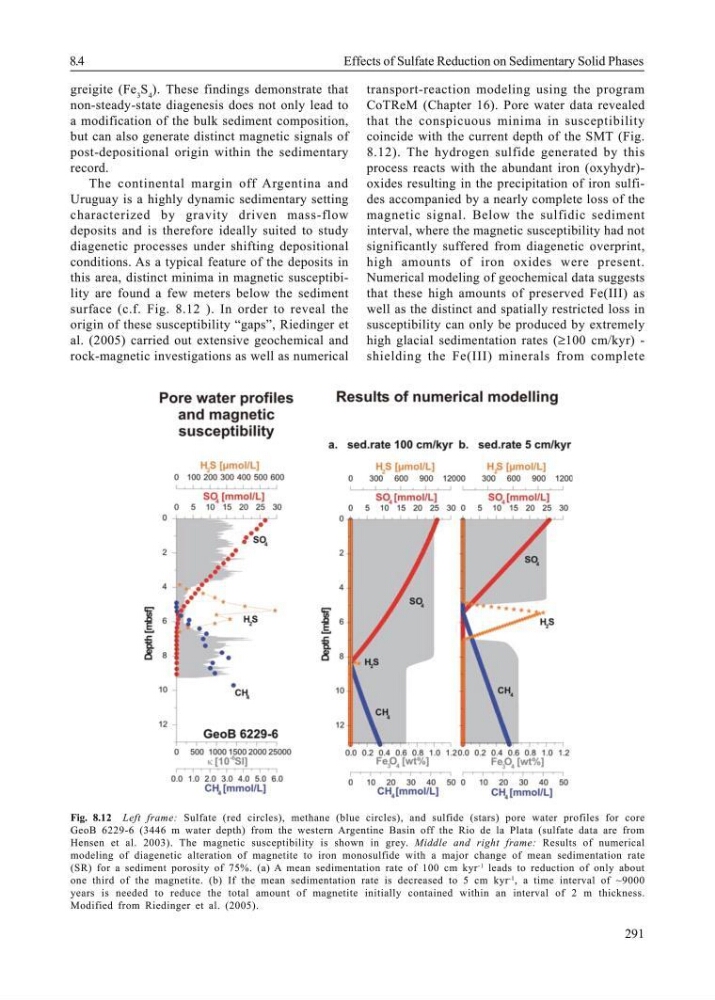
this area, distinct minima in magnetic susceptibility are found a few meters below the sediment
surface (c.f. Fig. 8.12 ). In order to reveal the
origin of these susceptibility “gaps”, Riedinger et
al. (2005) carried out extensive geochemical and
rock-magnetic investigations as well as numerical
transport-reaction modeling using the program
CoTReM (Chapter 16). Pore water data revealed
that the conspicuous minima in susceptibility
coincide with the current depth of the SMT (Fig.
8.12). The hydrogen sulfide generated by this
process reacts with the abundant iron (oxyhydr)oxides resulting in the precipitation of iron sulfides accompanied by a nearly complete loss of the
magnetic signal. Below the sulfidic sediment
interval, where the magnetic susceptibility had not
significantly suffered from diagenetic overprint,
high amounts of iron oxides were present.
Numerical modeling of geochemical data suggests
that these high amounts of preserved Fe(III) as
well as the distinct and spatially restricted loss in
susceptibility can only be produced by extremely
high glacial sedimentation rates (≥100 cm/kyr) -
shielding the Fe(III) minerals from complete
Fig. 8.12 Left frame: Sulfate (red circles), methane (blue circles), and sulfide (stars) pore water profiles for core
GeoB 6229-6 (3446 m water depth) from the western Argentine Basin off the Rio de la Plata (sulfate data are from
Hensen et al. 2003). The magnetic susceptibility is shown in grey. Middle and right frame: Results of numerical
modeling of diagenetic alteration of magnetite to iron monosulfide with a major change of mean sedimentation rate
(SR) for a sediment porosity of 75%. (a) A mean sedimentation rate of 100 cm kyr
-1 leads to reduction of only about
one third of the magnetite. (b) If the mean sedimentation rate is decreased to 5 cm kyr
-1 , a time interval of ~9000
years is needed to reduce the total amount of magnetite initially contained within an interval of 2 m thickness.
Modified from Riedinger et al. (2005).
8.4
Effects of Sulfate Reduction on Sedimentary Solid Phases
greigite (Fe 3 S 4 ). These findings demonstrate that
non-steady-state diagenesis does not only lead to
a modification of the bulk sediment composition,
but can also generate distinct magnetic signals of
post-depositional origin within the sedimentary
record.
The continental margin off Argentina and
Uruguay is a highly dynamic sedimentary setting
characterized by gravity driven mass-flow
deposits and is therefore ideally suited to study
diagenetic processes under shifting depositional
conditions. As a typical feature of the deposits in
this area, distinct minima in magnetic susceptibility are found a few meters below the sediment
surface (c.f. Fig. 8.12 ). In order to reveal the
origin of these susceptibility “gaps”, Riedinger et
al. (2005) carried out extensive geochemical and
rock-magnetic investigations as well as numerical
transport-reaction modeling using the program
CoTReM (Chapter 16). Pore water data revealed
that the conspicuous minima in susceptibility
coincide with the current depth of the SMT (Fig.
8.12). The hydrogen sulfide generated by this
process reacts with the abundant iron (oxyhydr)oxides resulting in the precipitation of iron sulfides accompanied by a nearly complete loss of the
magnetic signal. Below the sulfidic sediment
interval, where the magnetic susceptibility had not
significantly suffered from diagenetic overprint,
high amounts of iron oxides were present.
Numerical modeling of geochemical data suggests
that these high amounts of preserved Fe(III) as
well as the distinct and spatially restricted loss in
susceptibility can only be produced by extremely
high glacial sedimentation rates (≥100 cm/kyr) -
shielding the Fe(III) minerals from complete
Fig. 8.12 Left frame: Sulfate (red circles), methane (blue circles), and sulfide (stars) pore water profiles for core
GeoB 6229-6 (3446 m water depth) from the western Argentine Basin off the Rio de la Plata (sulfate data are from
Hensen et al. 2003). The magnetic susceptibility is shown in grey. Middle and right frame: Results of numerical
modeling of diagenetic alteration of magnetite to iron monosulfide with a major change of mean sedimentation rate
(SR) for a sediment porosity of 75%. (a) A mean sedimentation rate of 100 cm kyr
-1 leads to reduction of only about
one third of the magnetite. (b) If the mean sedimentation rate is decreased to 5 cm kyr
-1 , a time interval of ~9000
years is needed to reduce the total amount of magnetite initially contained within an interval of 2 m thickness.
Modified from Riedinger et al. (2005).
8.4
Effects of Sulfate Reduction on Sedimentary Solid Phases