

8
Sulfur Cycling and Methane Oxidation
290
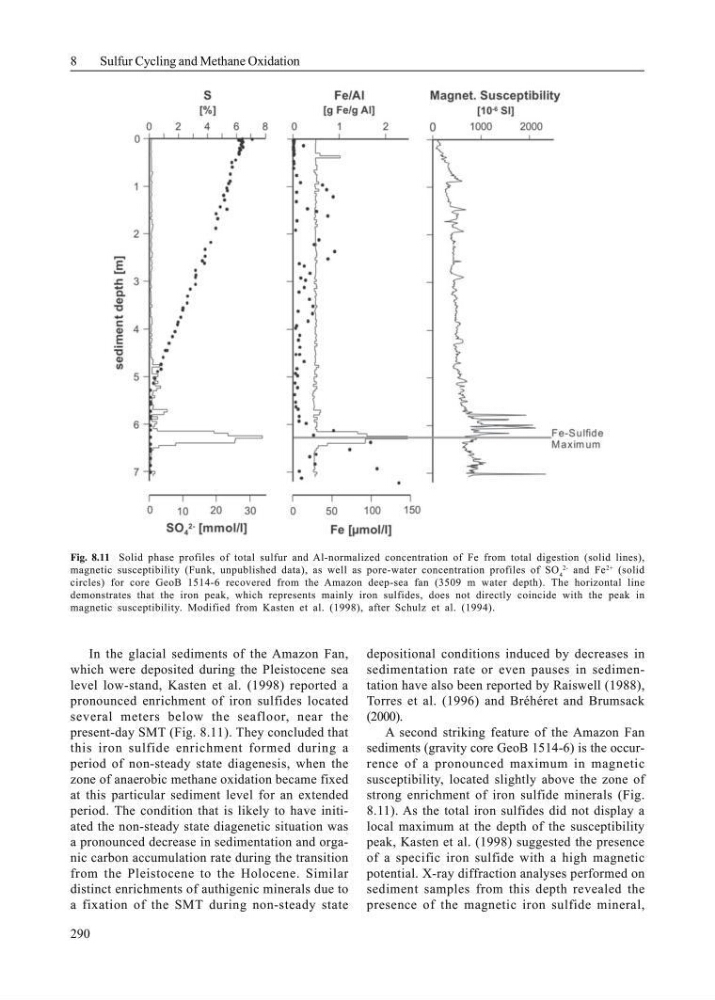
In the glacial sediments of the Amazon Fan,
which were deposited during the Pleistocene sea
level low-stand, Kasten et al. (1998) reported a
pronounced enrichment of iron sulfides located
several meters below the seafloor, near the
present-day SMT (Fig. 8.11). They concluded that
this iron sulfide enrichment formed during a
period of non-steady state diagenesis, when the
zone of anaerobic methane oxidation became fixed
at this particular sediment level for an extended
period. The condition that is likely to have initiated the non-steady state diagenetic situation was
a pronounced decrease in sedimentation and organic carbon accumulation rate during the transition
from the Pleistocene to the Holocene. Similar
distinct enrichments of authigenic minerals due to
a fixation of the SMT during non-steady state
depositional conditions induced by decreases in
sedimentation rate or even pauses in sedimentation have also been reported by Raiswell (1988),
Torres et al. (1996) and Bréhéret and Brumsack
(2000).
A second striking feature of the Amazon Fan
sediments (gravity core GeoB 1514-6) is the occurrence of a pronounced maximum in magnetic
susceptibility, located slightly above the zone of
strong enrichment of iron sulfide minerals (Fig.
8.11). As the total iron sulfides did not display a
local maximum at the depth of the susceptibility
peak, Kasten et al. (1998) suggested the presence
of a specific iron sulfide with a high magnetic
potential. X-ray diffraction analyses performed on
sediment samples from this depth revealed the
presence of the magnetic iron sulfide mineral,
Fig. 8.11 Solid phase profiles of total sulfur and Al-normalized concentration of Fe from total digestion (solid lines),
magnetic susceptibility (Funk, unpublished data), as well as pore-water concentration profiles of SO 4
2- and Fe
2+ (solid
circles) for core GeoB 1514-6 recovered from the Amazon deep-sea fan (3509 m water depth). The horizontal line
demonstrates that the iron peak, which represents mainly iron sulfides, does not directly coincide with the peak in
magnetic susceptibility. Modified from Kasten et al. (1998), after Schulz et al. (1994).
Sulfur Cycling and Methane Oxidation
290
In the glacial sediments of the Amazon Fan,
which were deposited during the Pleistocene sea
level low-stand, Kasten et al. (1998) reported a
pronounced enrichment of iron sulfides located
several meters below the seafloor, near the
present-day SMT (Fig. 8.11). They concluded that
this iron sulfide enrichment formed during a
period of non-steady state diagenesis, when the
zone of anaerobic methane oxidation became fixed
at this particular sediment level for an extended
period. The condition that is likely to have initiated the non-steady state diagenetic situation was
a pronounced decrease in sedimentation and organic carbon accumulation rate during the transition
from the Pleistocene to the Holocene. Similar
distinct enrichments of authigenic minerals due to
a fixation of the SMT during non-steady state
depositional conditions induced by decreases in
sedimentation rate or even pauses in sedimentation have also been reported by Raiswell (1988),
Torres et al. (1996) and Bréhéret and Brumsack
(2000).
A second striking feature of the Amazon Fan
sediments (gravity core GeoB 1514-6) is the occurrence of a pronounced maximum in magnetic
susceptibility, located slightly above the zone of
strong enrichment of iron sulfide minerals (Fig.
8.11). As the total iron sulfides did not display a
local maximum at the depth of the susceptibility
peak, Kasten et al. (1998) suggested the presence
of a specific iron sulfide with a high magnetic
potential. X-ray diffraction analyses performed on
sediment samples from this depth revealed the
presence of the magnetic iron sulfide mineral,
Fig. 8.11 Solid phase profiles of total sulfur and Al-normalized concentration of Fe from total digestion (solid lines),
magnetic susceptibility (Funk, unpublished data), as well as pore-water concentration profiles of SO 4
2- and Fe
2+ (solid
circles) for core GeoB 1514-6 recovered from the Amazon deep-sea fan (3509 m water depth). The horizontal line
demonstrates that the iron peak, which represents mainly iron sulfides, does not directly coincide with the peak in
magnetic susceptibility. Modified from Kasten et al. (1998), after Schulz et al. (1994).