

287
the anoxic sediments of Kau Bay, Indonesia,
(Middelburg 1990) or the Amazon Fan (Kasten et
al. 1998), can be due to a shortage of zero-valent
sulfur during pyrite formation. Zero-valent sulfur
may form as a result of the incomplete oxidation of
H 2 S or FeS by oxidants such as O 2 , NO 3
-
, MnO 2 or
FeOOH. A limited transformation of FeS to pyrite
can therefore be due to either (a) a limited amount
of sulfide available to be oxidized to zero-valent
sulfur or (b) a shortage in the amount of oxidants
supplied by diffusion, bioturbation or burial.
Direct precipitation of pyrite without intermediate iron sulfide precursors was reported for salt
marsh sediments, where pore waters were undersaturated with respect to amorphous FeS but
oversaturated with respect to pyrite (Howarth
1979; Giblin and Howarth 1984). In these sediments, the oxidizing activity of the roots favored
the formation of elemental sulfur and polysulfides
which were thought to react directly with Fe
2+
.
The direct reaction pathway may proceed within
hours, resulting in the formation of single small,
euhedral pyrite crystals (Rickard 1975; Luther et
al. 1982). Framboidal pyrite, apart from that formed
by the mechanism presented by Rickard (1997), is
formed slowly (over years) via intermediate iron
sulfides (Sweeney and Kaplan 1973; Raiswell
1982).
Irrespective of the pyrite forming pathway the
conversion of FeS into pyrite via intermediate iron
sulfides goes along with a pronounced change in
the rock magnetic properties of the particular iron
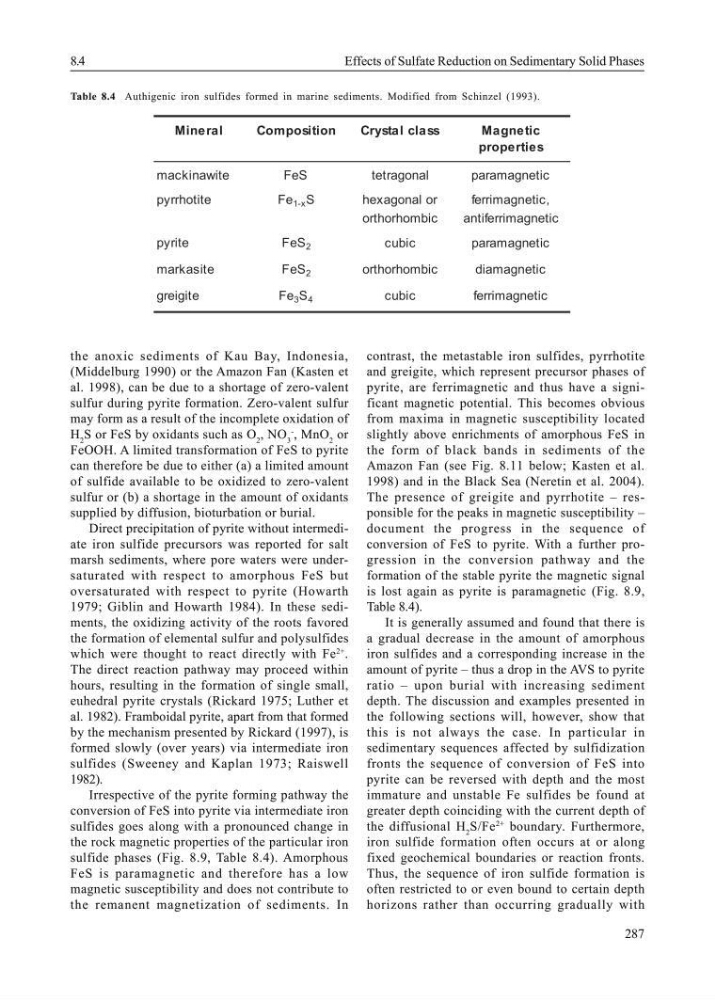
sulfide phases (Fig. 8.9, Table 8.4). Amorphous
FeS is paramagnetic and therefore has a low
magnetic susceptibility and does not contribute to
the remanent magnetization of sediments. In
contrast, the metastable iron sulfides, pyrrhotite
and greigite, which represent precursor phases of
pyrite, are ferrimagnetic and thus have a significant magnetic potential. This becomes obvious
from maxima in magnetic susceptibility located
slightly above enrichments of amorphous FeS in
the form of black bands in sediments of the
Amazon Fan (see Fig. 8.11 below; Kasten et al.
1998) and in the Black Sea (Neretin et al. 2004).
The presence of greigite and pyrrhotite – responsible for the peaks in magnetic susceptibility –
document the progress in the sequence of
conversion of FeS to pyrite. With a further progression in the conversion pathway and the
formation of the stable pyrite the magnetic signal
is lost again as pyrite is paramagnetic (Fig. 8.9,
Table 8.4).
It is generally assumed and found that there is
a gradual decrease in the amount of amorphous
iron sulfides and a corresponding increase in the
amount of pyrite – thus a drop in the AVS to pyrite
ratio – upon burial with increasing sediment
depth. The discussion and examples presented in
the following sections will, however, show that
this is not always the case. In particular in
sedimentary sequences affected by sulfidization
fronts the sequence of conversion of FeS into
pyrite can be reversed with depth and the most
immature and unstable Fe sulfides be found at
greater depth coinciding with the current depth of
the diffusional H 2 S/Fe
2+
boundary. Furthermore,
iron sulfide formation often occurs at or along
fixed geochemical boundaries or reaction fronts.
Thus, the sequence of iron sulfide formation is
often restricted to or even bound to certain depth
horizons rather than occurring gradually with
Table 8.4 Authigenic iron sulfides formed in marine sediments. Modified from Schinzel (1993).
Mineral
Composition
Crystal class
Magnetic
properties
mackinawite
FeS
tetragonal
paramagnetic
pyrrhotite
Fe 1-x S
hexagonal or
ferrimagnetic,
orthorhombic
antiferrimagnetic
pyrite
FeS 2
cubic
paramagnetic
markasite
FeS 2
orthorhombic
diamagnetic
greigite
Fe 3 S 4
cubic
ferrimagnetic
8.4
Effects of Sulfate Reduction on Sedimentary Solid Phases
the anoxic sediments of Kau Bay, Indonesia,
(Middelburg 1990) or the Amazon Fan (Kasten et
al. 1998), can be due to a shortage of zero-valent
sulfur during pyrite formation. Zero-valent sulfur
may form as a result of the incomplete oxidation of
H 2 S or FeS by oxidants such as O 2 , NO 3
-
, MnO 2 or
FeOOH. A limited transformation of FeS to pyrite
can therefore be due to either (a) a limited amount
of sulfide available to be oxidized to zero-valent
sulfur or (b) a shortage in the amount of oxidants
supplied by diffusion, bioturbation or burial.
Direct precipitation of pyrite without intermediate iron sulfide precursors was reported for salt
marsh sediments, where pore waters were undersaturated with respect to amorphous FeS but
oversaturated with respect to pyrite (Howarth
1979; Giblin and Howarth 1984). In these sediments, the oxidizing activity of the roots favored
the formation of elemental sulfur and polysulfides
which were thought to react directly with Fe
2+
.
The direct reaction pathway may proceed within
hours, resulting in the formation of single small,
euhedral pyrite crystals (Rickard 1975; Luther et
al. 1982). Framboidal pyrite, apart from that formed
by the mechanism presented by Rickard (1997), is
formed slowly (over years) via intermediate iron
sulfides (Sweeney and Kaplan 1973; Raiswell
1982).
Irrespective of the pyrite forming pathway the
conversion of FeS into pyrite via intermediate iron
sulfides goes along with a pronounced change in
the rock magnetic properties of the particular iron
sulfide phases (Fig. 8.9, Table 8.4). Amorphous
FeS is paramagnetic and therefore has a low
magnetic susceptibility and does not contribute to
the remanent magnetization of sediments. In
contrast, the metastable iron sulfides, pyrrhotite
and greigite, which represent precursor phases of
pyrite, are ferrimagnetic and thus have a significant magnetic potential. This becomes obvious
from maxima in magnetic susceptibility located
slightly above enrichments of amorphous FeS in
the form of black bands in sediments of the
Amazon Fan (see Fig. 8.11 below; Kasten et al.
1998) and in the Black Sea (Neretin et al. 2004).
The presence of greigite and pyrrhotite – responsible for the peaks in magnetic susceptibility –
document the progress in the sequence of
conversion of FeS to pyrite. With a further progression in the conversion pathway and the
formation of the stable pyrite the magnetic signal
is lost again as pyrite is paramagnetic (Fig. 8.9,
Table 8.4).
It is generally assumed and found that there is
a gradual decrease in the amount of amorphous
iron sulfides and a corresponding increase in the
amount of pyrite – thus a drop in the AVS to pyrite
ratio – upon burial with increasing sediment
depth. The discussion and examples presented in
the following sections will, however, show that
this is not always the case. In particular in
sedimentary sequences affected by sulfidization
fronts the sequence of conversion of FeS into
pyrite can be reversed with depth and the most
immature and unstable Fe sulfides be found at
greater depth coinciding with the current depth of
the diffusional H 2 S/Fe
2+
boundary. Furthermore,
iron sulfide formation often occurs at or along
fixed geochemical boundaries or reaction fronts.
Thus, the sequence of iron sulfide formation is
often restricted to or even bound to certain depth
horizons rather than occurring gradually with
Table 8.4 Authigenic iron sulfides formed in marine sediments. Modified from Schinzel (1993).
Mineral
Composition
Crystal class
Magnetic
properties
mackinawite
FeS
tetragonal
paramagnetic
pyrrhotite
Fe 1-x S
hexagonal or
ferrimagnetic,
orthorhombic
antiferrimagnetic
pyrite
FeS 2
cubic
paramagnetic
markasite
FeS 2
orthorhombic
diamagnetic
greigite
Fe 3 S 4
cubic
ferrimagnetic
8.4
Effects of Sulfate Reduction on Sedimentary Solid Phases