

8
Sulfur Cycling and Methane Oxidation
286
both in the field and in the laboratory – have been
performed to elucidate the mechanisms of pyrite
formation and in particular to understand the main
factors which control the formation of pyrite in
natural environments. Although these studies
have provided significant new insights, fundamental questions remain with respect to (a) the
different reaction rates obtained on the basis of
field studies and laboratory experiments, (b) the
role of FeS surface reactions and the electron
acceptor involved in the conversion to pyrite, and
(c) the role of sulfate-reducing bacteria – in particular their cell walls - in directing and promoting
the pyrite precipitation process. A comprehensive
review of pyrite formation in sedimentary environments by Rickard et al. (1995) was recently
updated by Schoonen (2004). Besides the detailed
description of the different pathways and mechanisms of sedimentary pyrite formation, the review
by Schoonen (2004) also discusses the synthesis
of nanoscale pyrite, trace element incorporation,
and the formation of electronic defects during the
formation process.
All pyrite forming pathways identified so far
involve several reaction steps. First, hydrogen
sulfide, produced during sulfate reduction (Eq.
8.1, 8.2 and 8.8), reacts with dissolved iron or
reactive (towards sulfide) iron minerals to form
amorphous iron sulfides, such as mackinawite
(FeS). The precipitated amorphous iron sulfide is
highly unstable and rapidly transforms to metastable
iron sulfide phases such as pyrrhotite (Fe x-1 S) or
greigite (Fe 3 S 4 ), both of which represent intermediates in the reaction pathways to pyrite (FeS 2 ).
The conversion of amorphous FeS to pyrite
requires an electron acceptor and a change in the
molar Fe:S ratio from about 1:1 to 1:2. The electron
acceptor is needed to oxidize the S(-II) component
in FeS to the mean oxidation state of –I in FeS 2 .
Concurrently, the Fe:S ratio has to decrease either
via the addition of sulfur or the loss of iron. Three
general pathways have been reported to convert
FeS to pyrite:
(1) Addition of sulfur with the sulfur species
acting as electron acceptor (Berner 1970; Berner
1984; Luther 1991). This pathway has been termed
the “polysulfide pathway”.
FeS + S
0
→ FeS 2
(8.13)
(2) Reaction with hydrogen sulfide, i.e.
addition of sulfur with a non-sulfur electron acceptor (Rickard and Luther 1997). This conversion mechanism is known as the “H 2 S pathway”.
FeS + H 2 S → FeS 2 + H 2
(8.14)
(3) Loss of iron, combined with an (additional)
electron acceptor (Wilkin and Barnes 1996), known
as the “iron-loss pathway”.
2FeS + 2H
+
→ FeS 2 + Fe
2+
+ H 2
(8.15)
As reviewed in detail by Schoonen (2004)
these different conversion mechanisms – and in
particular the H 2 S pathway – have received
controversial discussion. However, field studies
have shown that hydrogen sulfide can indeed
sulfidize amorphous FeS and form pyrite. Rickard
(1997) found that the H 2 S process is by far the
most rapid of the pyrite-forming reactions hitherto
identified and suggested that it represents the
dominant pyrite forming pathway in strictly anoxic
systems. In addition, Morse (2002) discussed that
the oxidation of FeS by hydrogen sulfide is the
faster process compared with the oxidation by
elemental sulfur. Berner (1970) suggested that, in
the presence of zero-valent sulfur, a complete
transformation of FeS to pyrite should be possible
on a time scale of years. An incomplete conversion of FeS to pyrite, as often observed, e.g. in
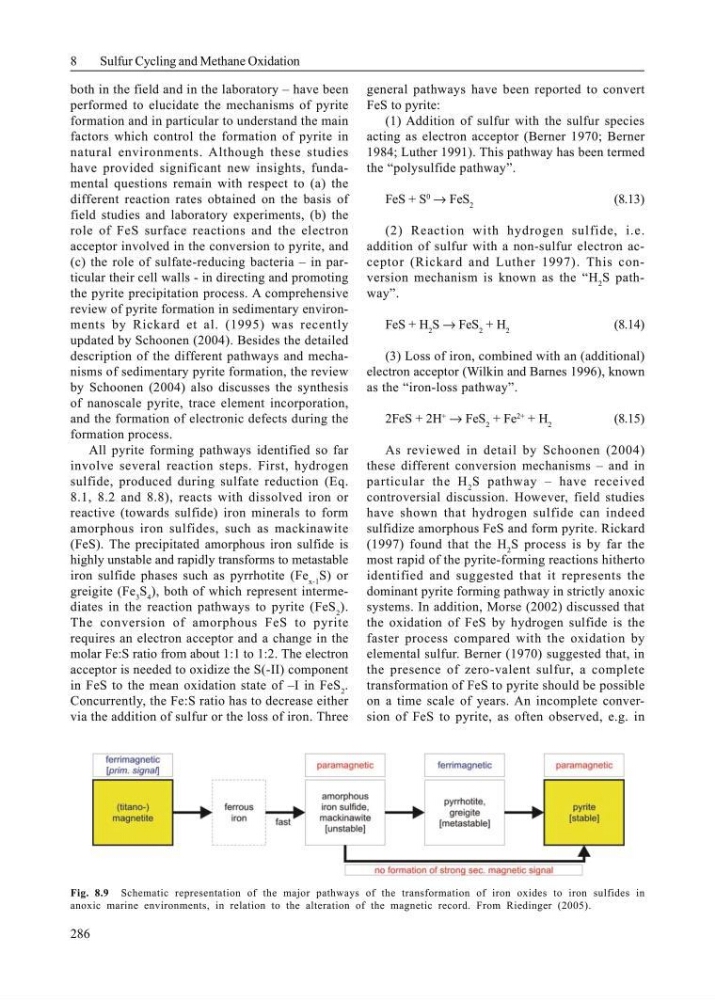
Fig. 8.9 Schematic representation of the major pathways of the transformation of iron oxides to iron sulfides in
anoxic marine environments, in relation to the alteration of the magnetic record. From Riedinger (2005).
Sulfur Cycling and Methane Oxidation
286
both in the field and in the laboratory – have been
performed to elucidate the mechanisms of pyrite
formation and in particular to understand the main
factors which control the formation of pyrite in
natural environments. Although these studies
have provided significant new insights, fundamental questions remain with respect to (a) the
different reaction rates obtained on the basis of
field studies and laboratory experiments, (b) the
role of FeS surface reactions and the electron
acceptor involved in the conversion to pyrite, and
(c) the role of sulfate-reducing bacteria – in particular their cell walls - in directing and promoting
the pyrite precipitation process. A comprehensive
review of pyrite formation in sedimentary environments by Rickard et al. (1995) was recently
updated by Schoonen (2004). Besides the detailed
description of the different pathways and mechanisms of sedimentary pyrite formation, the review
by Schoonen (2004) also discusses the synthesis
of nanoscale pyrite, trace element incorporation,
and the formation of electronic defects during the
formation process.
All pyrite forming pathways identified so far
involve several reaction steps. First, hydrogen
sulfide, produced during sulfate reduction (Eq.
8.1, 8.2 and 8.8), reacts with dissolved iron or
reactive (towards sulfide) iron minerals to form
amorphous iron sulfides, such as mackinawite
(FeS). The precipitated amorphous iron sulfide is
highly unstable and rapidly transforms to metastable
iron sulfide phases such as pyrrhotite (Fe x-1 S) or
greigite (Fe 3 S 4 ), both of which represent intermediates in the reaction pathways to pyrite (FeS 2 ).
The conversion of amorphous FeS to pyrite
requires an electron acceptor and a change in the
molar Fe:S ratio from about 1:1 to 1:2. The electron
acceptor is needed to oxidize the S(-II) component
in FeS to the mean oxidation state of –I in FeS 2 .
Concurrently, the Fe:S ratio has to decrease either
via the addition of sulfur or the loss of iron. Three
general pathways have been reported to convert
FeS to pyrite:
(1) Addition of sulfur with the sulfur species
acting as electron acceptor (Berner 1970; Berner
1984; Luther 1991). This pathway has been termed
the “polysulfide pathway”.
FeS + S
0
→ FeS 2
(8.13)
(2) Reaction with hydrogen sulfide, i.e.
addition of sulfur with a non-sulfur electron acceptor (Rickard and Luther 1997). This conversion mechanism is known as the “H 2 S pathway”.
FeS + H 2 S → FeS 2 + H 2
(8.14)
(3) Loss of iron, combined with an (additional)
electron acceptor (Wilkin and Barnes 1996), known
as the “iron-loss pathway”.
2FeS + 2H
+
→ FeS 2 + Fe
2+
+ H 2
(8.15)
As reviewed in detail by Schoonen (2004)
these different conversion mechanisms – and in
particular the H 2 S pathway – have received
controversial discussion. However, field studies
have shown that hydrogen sulfide can indeed
sulfidize amorphous FeS and form pyrite. Rickard
(1997) found that the H 2 S process is by far the
most rapid of the pyrite-forming reactions hitherto
identified and suggested that it represents the
dominant pyrite forming pathway in strictly anoxic
systems. In addition, Morse (2002) discussed that
the oxidation of FeS by hydrogen sulfide is the
faster process compared with the oxidation by
elemental sulfur. Berner (1970) suggested that, in
the presence of zero-valent sulfur, a complete
transformation of FeS to pyrite should be possible
on a time scale of years. An incomplete conversion of FeS to pyrite, as often observed, e.g. in
Fig. 8.9 Schematic representation of the major pathways of the transformation of iron oxides to iron sulfides in
anoxic marine environments, in relation to the alteration of the magnetic record. From Riedinger (2005).