

285
8.4
Effects of Sulfate Reduction on Sedimentary Solid Phases
a significant impact on the total methane budget.
Therefore, a more extensive mapping of seepage
areas, as well as a broader data base on diffusive
methane fluxes, is needed for more accurate
calculations of the methane cycling in the global
sea bed (see also Chapter 14).
8.4
Effects of Sulfate Reduction
on Sedimentary Solid Phases
Sulfate reduction, occurring either due to the
oxidation of methane or the mineralization of
organic material, can lead to a pronounced
overprint or modification of the primary sediment
composition by dissolution/reduction of minerals
and precipitation of authigenic mineral phases.
Since most of the minerals affected are also
commonly used for paleoceanographic and paleoclimatologic reconstructions it is crucial to consider and assess the extent of diagenetic alteration
of the sedimentary record driven by sulfate
reduction.
8.4.1
Reactions with iron
Iron sulfides represent the most important
minerals that form in association with both
organoclastic and methanotrophic sulfate reduction, or - more precisely - as a result of the hydrogen sulfide produced by these processes. The
different pathways of pyrite formation via
intermediate iron sulfides will be described in more
detail in Section 8.4.2. The first step in all pyrite
forming sequences involves a reaction of
hydrogen sulfide with either dissolved Fe
2+
or
solid-state iron (oxyhydr)oxides. The reactivity of
oxidized iron minerals towards sulfide varies
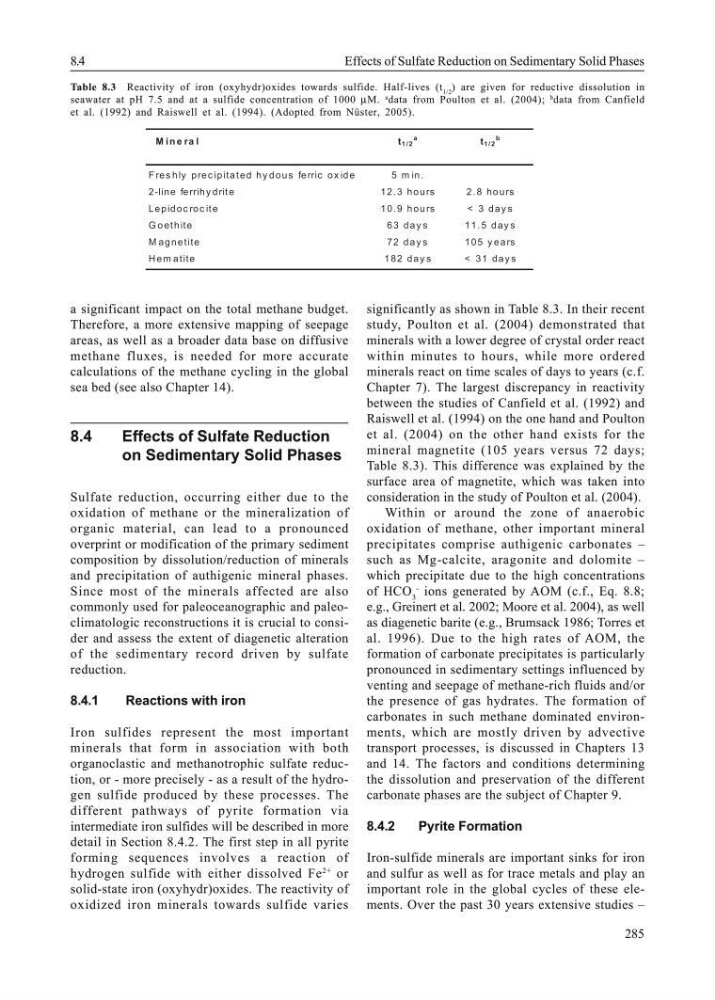
significantly as shown in Table 8.3. In their recent
study, Poulton et al. (2004) demonstrated that
minerals with a lower degree of crystal order react
within minutes to hours, while more ordered
minerals react on time scales of days to years (c.f.
Chapter 7). The largest discrepancy in reactivity
between the studies of Canfield et al. (1992) and
Raiswell et al. (1994) on the one hand and Poulton
et al. (2004) on the other hand exists for the
mineral magnetite (105 years versus 72 days;
Table 8.3). This difference was explained by the
surface area of magnetite, which was taken into
consideration in the study of Poulton et al. (2004).
Within or around the zone of anaerobic
oxidation of methane, other important mineral
precipitates comprise authigenic carbonates –
such as Mg-calcite, aragonite and dolomite –
which precipitate due to the high concentrations
of HCO 3
-
ions generated by AOM (c.f., Eq. 8.8;
e.g., Greinert et al. 2002; Moore et al. 2004), as well
as diagenetic barite (e.g., Brumsack 1986; Torres et
al. 1996). Due to the high rates of AOM, the
formation of carbonate precipitates is particularly
pronounced in sedimentary settings influenced by
venting and seepage of methane-rich fluids and/or
the presence of gas hydrates. The formation of
carbonates in such methane dominated environments, which are mostly driven by advective
transport processes, is discussed in Chapters 13
and 14. The factors and conditions determining
the dissolution and preservation of the different
carbonate phases are the subject of Chapter 9.
8.4.2
Pyrite Formation
Iron-sulfide minerals are important sinks for iron
and sulfur as well as for trace metals and play an
important role in the global cycles of these elements. Over the past 30 years extensive studies –
Table 8.3 Reactivity of iron (oxyhydr)oxides towards sulfide. Half-lives (t 1/2 ) are given for reductive dissolution in
seawater at pH 7.5 and at a sulfide concentration of 1000 µM.
a data from Poulton et al. (2004);
b data from Canfield
et al. (1992) and Raiswell et al. (1994). (Adopted from Nüster, 2005).
M i n e ra l
t 1 /2
a
t 1 / 2
b
F re s h ly prec ip ita t ed h y d o u s fe rric o x id e
5 m in .
2-line fe rrih y drit e
1 2 .3 h o u rs
2 . 8 ho u rs
Le p id o c ro c it e
1 0 .9 h o u rs
< 3 d a y s
G o et h ite
6 3 d a y s
1 1. 5 d ay s
M ag n e tite
7 2 d a y s
1 05 y e a rs
H e m a tite
1 82 d a y s
< 3 1 da y s
8.4
Effects of Sulfate Reduction on Sedimentary Solid Phases
a significant impact on the total methane budget.
Therefore, a more extensive mapping of seepage
areas, as well as a broader data base on diffusive
methane fluxes, is needed for more accurate
calculations of the methane cycling in the global
sea bed (see also Chapter 14).
8.4
Effects of Sulfate Reduction
on Sedimentary Solid Phases
Sulfate reduction, occurring either due to the
oxidation of methane or the mineralization of
organic material, can lead to a pronounced
overprint or modification of the primary sediment
composition by dissolution/reduction of minerals
and precipitation of authigenic mineral phases.
Since most of the minerals affected are also
commonly used for paleoceanographic and paleoclimatologic reconstructions it is crucial to consider and assess the extent of diagenetic alteration
of the sedimentary record driven by sulfate
reduction.
8.4.1
Reactions with iron
Iron sulfides represent the most important
minerals that form in association with both
organoclastic and methanotrophic sulfate reduction, or - more precisely - as a result of the hydrogen sulfide produced by these processes. The
different pathways of pyrite formation via
intermediate iron sulfides will be described in more
detail in Section 8.4.2. The first step in all pyrite
forming sequences involves a reaction of
hydrogen sulfide with either dissolved Fe
2+
or
solid-state iron (oxyhydr)oxides. The reactivity of
oxidized iron minerals towards sulfide varies
significantly as shown in Table 8.3. In their recent
study, Poulton et al. (2004) demonstrated that
minerals with a lower degree of crystal order react
within minutes to hours, while more ordered
minerals react on time scales of days to years (c.f.
Chapter 7). The largest discrepancy in reactivity
between the studies of Canfield et al. (1992) and
Raiswell et al. (1994) on the one hand and Poulton
et al. (2004) on the other hand exists for the
mineral magnetite (105 years versus 72 days;
Table 8.3). This difference was explained by the
surface area of magnetite, which was taken into
consideration in the study of Poulton et al. (2004).
Within or around the zone of anaerobic
oxidation of methane, other important mineral
precipitates comprise authigenic carbonates –
such as Mg-calcite, aragonite and dolomite –
which precipitate due to the high concentrations
of HCO 3
-
ions generated by AOM (c.f., Eq. 8.8;
e.g., Greinert et al. 2002; Moore et al. 2004), as well
as diagenetic barite (e.g., Brumsack 1986; Torres et
al. 1996). Due to the high rates of AOM, the
formation of carbonate precipitates is particularly
pronounced in sedimentary settings influenced by
venting and seepage of methane-rich fluids and/or
the presence of gas hydrates. The formation of
carbonates in such methane dominated environments, which are mostly driven by advective
transport processes, is discussed in Chapters 13
and 14. The factors and conditions determining
the dissolution and preservation of the different
carbonate phases are the subject of Chapter 9.
8.4.2
Pyrite Formation
Iron-sulfide minerals are important sinks for iron
and sulfur as well as for trace metals and play an
important role in the global cycles of these elements. Over the past 30 years extensive studies –
Table 8.3 Reactivity of iron (oxyhydr)oxides towards sulfide. Half-lives (t 1/2 ) are given for reductive dissolution in
seawater at pH 7.5 and at a sulfide concentration of 1000 µM.
a data from Poulton et al. (2004);
b data from Canfield
et al. (1992) and Raiswell et al. (1994). (Adopted from Nüster, 2005).
M i n e ra l
t 1 /2
a
t 1 / 2
b
F re s h ly prec ip ita t ed h y d o u s fe rric o x id e
5 m in .
2-line fe rrih y drit e
1 2 .3 h o u rs
2 . 8 ho u rs
Le p id o c ro c it e
1 0 .9 h o u rs
< 3 d a y s
G o et h ite
6 3 d a y s
1 1. 5 d ay s
M ag n e tite
7 2 d a y s
1 05 y e a rs
H e m a tite
1 82 d a y s
< 3 1 da y s