

277
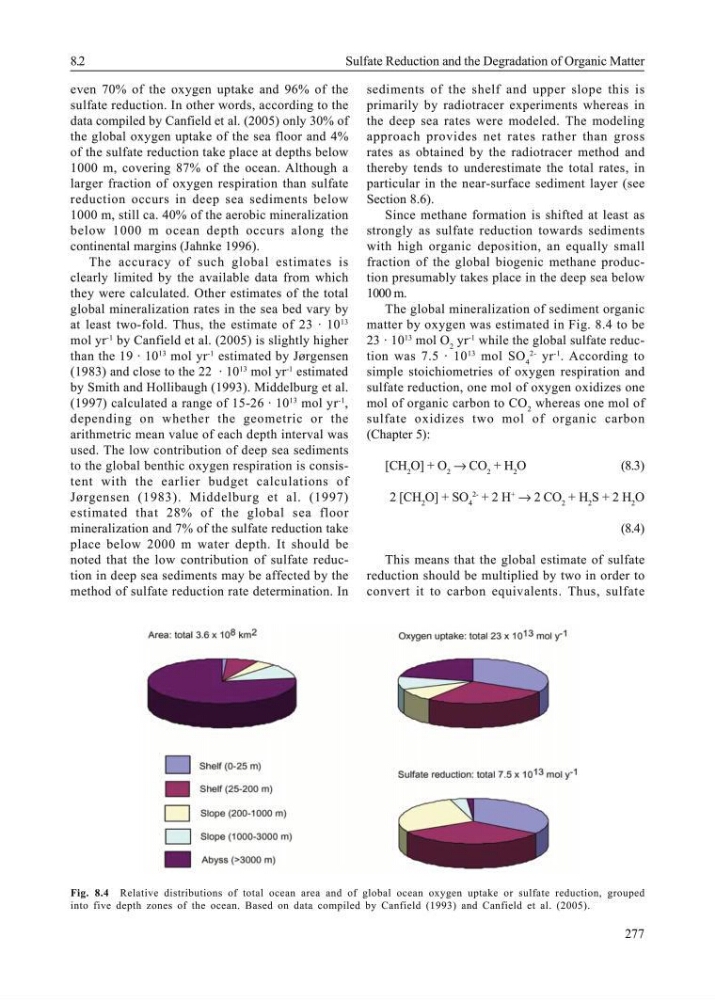
even 70% of the oxygen uptake and 96% of the
sulfate reduction. In other words, according to the
data compiled by Canfield et al. (2005) only 30% of
the global oxygen uptake of the sea floor and 4%
of the sulfate reduction take place at depths below
1000 m, covering 87% of the ocean. Although a
larger fraction of oxygen respiration than sulfate
reduction occurs in deep sea sediments below
1000 m, still ca. 40% of the aerobic mineralization
below 1000 m ocean depth occurs along the
continental margins (Jahnke 1996).
The accuracy of such global estimates is
clearly limited by the available data from which
they were calculated. Other estimates of the total
global mineralization rates in the sea bed vary by
at least two-fold. Thus, the estimate of 23 · 10
13
mol yr
-1
by Canfield et al. (2005) is slightly higher
than the 19 · 10
13
mol yr
-1
estimated by Jørgensen
(1983) and close to the 22 · 10
13
mol yr
-1
estimated
by Smith and Hollibaugh (1993). Middelburg et al.
(1997) calculated a range of 15-26 · 10
13
mol yr
-1
,
depending on whether the geometric or the
arithmetric mean value of each depth interval was
used. The low contribution of deep sea sediments
to the global benthic oxygen respiration is consistent with the earlier budget calculations of
Jørgensen (1983). Middelburg et al. (1997)
estimated that 28% of the global sea floor
mineralization and 7% of the sulfate reduction take
place below 2000 m water depth. It should be
noted that the low contribution of sulfate reduction in deep sea sediments may be affected by the
method of sulfate reduction rate determination. In
sediments of the shelf and upper slope this is
primarily by radiotracer experiments whereas in
the deep sea rates were modeled. The modeling
approach provides net rates rather than gross
rates as obtained by the radiotracer method and
thereby tends to underestimate the total rates, in
particular in the near-surface sediment layer (see
Section 8.6).
Since methane formation is shifted at least as
strongly as sulfate reduction towards sediments
with high organic deposition, an equally small
fraction of the global biogenic methane production presumably takes place in the deep sea below
1000 m.
The global mineralization of sediment organic
matter by oxygen was estimated in Fig. 8.4 to be
23 · 10
13
mol O 2 yr
-1
while the global sulfate reduction was 7.5 · 10
13
mol SO 4
2yr
-1
. According to
simple stoichiometries of oxygen respiration and
sulfate reduction, one mol of oxygen oxidizes one
mol of organic carbon to CO 2 whereas one mol of
sulfate oxidizes two mol of organic carbon
(Chapter 5):
[CH 2 O] + O 2 → CO 2 + H 2 O
(8.3)
2 [CH 2 O] + SO 4
2+ 2 H
+
→ 2 CO 2 + H 2 S + 2 H 2 O
(8.4)
This means that the global estimate of sulfate
reduction should be multiplied by two in order to
convert it to carbon equivalents. Thus, sulfate
Fig. 8.4 Relative distributions of total ocean area and of global ocean oxygen uptake or sulfate reduction, grouped
into five depth zones of the ocean. Based on data compiled by Canfield (1993) and Canfield et al. (2005).
8.2
Sulfate Reduction and the Degradation of Organic Matter
even 70% of the oxygen uptake and 96% of the
sulfate reduction. In other words, according to the
data compiled by Canfield et al. (2005) only 30% of
the global oxygen uptake of the sea floor and 4%
of the sulfate reduction take place at depths below
1000 m, covering 87% of the ocean. Although a
larger fraction of oxygen respiration than sulfate
reduction occurs in deep sea sediments below
1000 m, still ca. 40% of the aerobic mineralization
below 1000 m ocean depth occurs along the
continental margins (Jahnke 1996).
The accuracy of such global estimates is
clearly limited by the available data from which
they were calculated. Other estimates of the total
global mineralization rates in the sea bed vary by
at least two-fold. Thus, the estimate of 23 · 10
13
mol yr
-1
by Canfield et al. (2005) is slightly higher
than the 19 · 10
13
mol yr
-1
estimated by Jørgensen
(1983) and close to the 22 · 10
13
mol yr
-1
estimated
by Smith and Hollibaugh (1993). Middelburg et al.
(1997) calculated a range of 15-26 · 10
13
mol yr
-1
,
depending on whether the geometric or the
arithmetric mean value of each depth interval was
used. The low contribution of deep sea sediments
to the global benthic oxygen respiration is consistent with the earlier budget calculations of
Jørgensen (1983). Middelburg et al. (1997)
estimated that 28% of the global sea floor
mineralization and 7% of the sulfate reduction take
place below 2000 m water depth. It should be
noted that the low contribution of sulfate reduction in deep sea sediments may be affected by the
method of sulfate reduction rate determination. In
sediments of the shelf and upper slope this is
primarily by radiotracer experiments whereas in
the deep sea rates were modeled. The modeling
approach provides net rates rather than gross
rates as obtained by the radiotracer method and
thereby tends to underestimate the total rates, in
particular in the near-surface sediment layer (see
Section 8.6).
Since methane formation is shifted at least as
strongly as sulfate reduction towards sediments
with high organic deposition, an equally small
fraction of the global biogenic methane production presumably takes place in the deep sea below
1000 m.
The global mineralization of sediment organic
matter by oxygen was estimated in Fig. 8.4 to be
23 · 10
13
mol O 2 yr
-1
while the global sulfate reduction was 7.5 · 10
13
mol SO 4
2yr
-1
. According to
simple stoichiometries of oxygen respiration and
sulfate reduction, one mol of oxygen oxidizes one
mol of organic carbon to CO 2 whereas one mol of
sulfate oxidizes two mol of organic carbon
(Chapter 5):
[CH 2 O] + O 2 → CO 2 + H 2 O
(8.3)
2 [CH 2 O] + SO 4
2+ 2 H
+
→ 2 CO 2 + H 2 S + 2 H 2 O
(8.4)
This means that the global estimate of sulfate
reduction should be multiplied by two in order to
convert it to carbon equivalents. Thus, sulfate
Fig. 8.4 Relative distributions of total ocean area and of global ocean oxygen uptake or sulfate reduction, grouped
into five depth zones of the ocean. Based on data compiled by Canfield (1993) and Canfield et al. (2005).
8.2
Sulfate Reduction and the Degradation of Organic Matter