

8
Sulfur Cycling and Methane Oxidation
276
is insignificant in vast regions of the deep sea.
The additional source of H 2 S from the anaerobic
degradation of organic sulfur plays a minor role
relative to this dissimilatory sulfate reduction.
Radiotracer measurements of sulfate reduction
rates have mainly been carried out in shallower
waters, so that the data base for sediments below
500 m water depth is very limited. A detailed study
was done by Ferdelman et al. (1999) between 855
and 4766 m water depth on the continental margin
of southwest Africa. This area forms part of the
Benguela upwelling system. The authors demonstrated that the depth-integrated sulfate reduction
rates over the upper 20 cm of the sediment
strongly correlated with the concentrations of
organic carbon in the surface sediments. They
further estimated that sulfate reduction at for
example 3700 m water depth accounts for 3 to 16 %
(Table 8.1) of total oxygen consumption. Thus,
even on the lower continental slope in this region,
a small but significant fraction of organic matter is
degraded anaerobically through sulfate reduction.
Canfield (1993) and Canfield et al. (2005) have
compiled published data on oxygen uptake and
sulfate reduction in marine sediments and grouped
these into different coastal types and into different depth regions of the ocean. Based on their
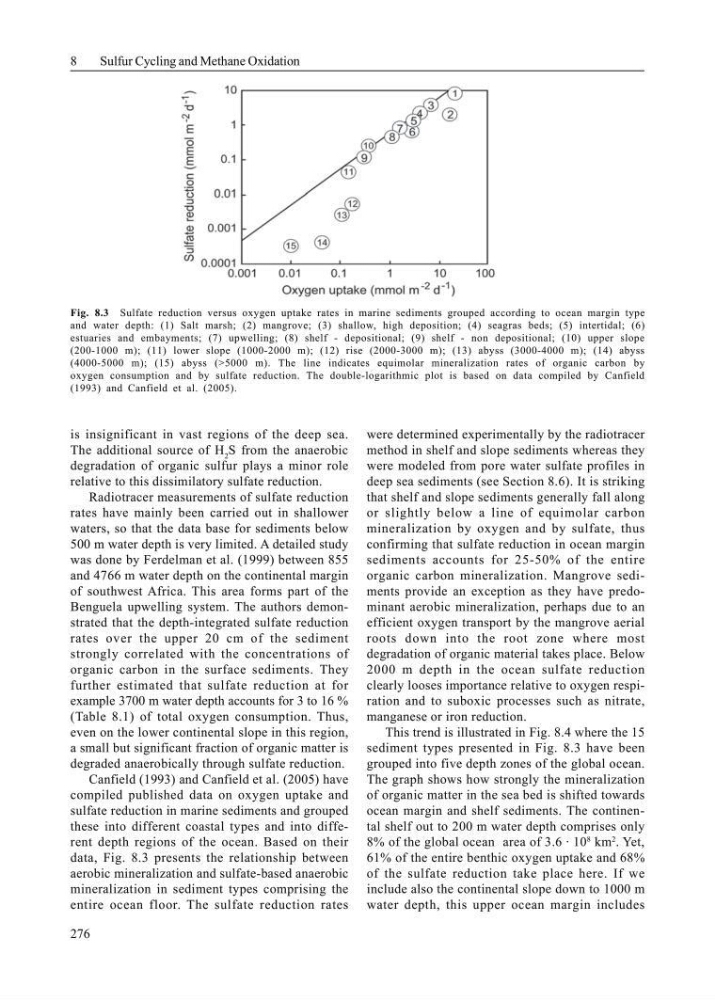
data, Fig. 8.3 presents the relationship between
aerobic mineralization and sulfate-based anaerobic
mineralization in sediment types comprising the
entire ocean floor. The sulfate reduction rates
were determined experimentally by the radiotracer
method in shelf and slope sediments whereas they
were modeled from pore water sulfate profiles in
deep sea sediments (see Section 8.6). It is striking
that shelf and slope sediments generally fall along
or slightly below a line of equimolar carbon
mineralization by oxygen and by sulfate, thus
confirming that sulfate reduction in ocean margin
sediments accounts for 25-50% of the entire
organic carbon mineralization. Mangrove sediments provide an exception as they have predominant aerobic mineralization, perhaps due to an
efficient oxygen transport by the mangrove aerial
roots down into the root zone where most
degradation of organic material takes place. Below
2000 m depth in the ocean sulfate reduction
clearly looses importance relative to oxygen respiration and to suboxic processes such as nitrate,
manganese or iron reduction.
This trend is illustrated in Fig. 8.4 where the 15
sediment types presented in Fig. 8.3 have been
grouped into five depth zones of the global ocean.
The graph shows how strongly the mineralization
of organic matter in the sea bed is shifted towards
ocean margin and shelf sediments. The continental shelf out to 200 m water depth comprises only
8% of the global ocean area of 3.6 · 10
8
km
2
. Yet,
61% of the entire benthic oxygen uptake and 68%
of the sulfate reduction take place here. If we
include also the continental slope down to 1000 m
water depth, this upper ocean margin includes
Fig. 8.3 Sulfate reduction versus oxygen uptake rates in marine sediments grouped according to ocean margin type
and water depth: (1) Salt marsh; (2) mangrove; (3) shallow, high deposition; (4) seagras beds; (5) intertidal; (6)
estuaries and embayments; (7) upwelling; (8) shelf - depositional; (9) shelf - non depositional; (10) upper slope
(200-1000 m); (11) lower slope (1000-2000 m); (12) rise (2000-3000 m); (13) abyss (3000-4000 m); (14) abyss
(4000-5000 m); (15) abyss (>5000 m). The line indicates equimolar mineralization rates of organic carbon by
oxygen consumption and by sulfate reduction. The double-logarithmic plot is based on data compiled by Canfield
(1993) and Canfield et al. (2005).
Sulfur Cycling and Methane Oxidation
276
is insignificant in vast regions of the deep sea.
The additional source of H 2 S from the anaerobic
degradation of organic sulfur plays a minor role
relative to this dissimilatory sulfate reduction.
Radiotracer measurements of sulfate reduction
rates have mainly been carried out in shallower
waters, so that the data base for sediments below
500 m water depth is very limited. A detailed study
was done by Ferdelman et al. (1999) between 855
and 4766 m water depth on the continental margin
of southwest Africa. This area forms part of the
Benguela upwelling system. The authors demonstrated that the depth-integrated sulfate reduction
rates over the upper 20 cm of the sediment
strongly correlated with the concentrations of
organic carbon in the surface sediments. They
further estimated that sulfate reduction at for
example 3700 m water depth accounts for 3 to 16 %
(Table 8.1) of total oxygen consumption. Thus,
even on the lower continental slope in this region,
a small but significant fraction of organic matter is
degraded anaerobically through sulfate reduction.
Canfield (1993) and Canfield et al. (2005) have
compiled published data on oxygen uptake and
sulfate reduction in marine sediments and grouped
these into different coastal types and into different depth regions of the ocean. Based on their
data, Fig. 8.3 presents the relationship between
aerobic mineralization and sulfate-based anaerobic
mineralization in sediment types comprising the
entire ocean floor. The sulfate reduction rates
were determined experimentally by the radiotracer
method in shelf and slope sediments whereas they
were modeled from pore water sulfate profiles in
deep sea sediments (see Section 8.6). It is striking
that shelf and slope sediments generally fall along
or slightly below a line of equimolar carbon
mineralization by oxygen and by sulfate, thus
confirming that sulfate reduction in ocean margin
sediments accounts for 25-50% of the entire
organic carbon mineralization. Mangrove sediments provide an exception as they have predominant aerobic mineralization, perhaps due to an
efficient oxygen transport by the mangrove aerial
roots down into the root zone where most
degradation of organic material takes place. Below
2000 m depth in the ocean sulfate reduction
clearly looses importance relative to oxygen respiration and to suboxic processes such as nitrate,
manganese or iron reduction.
This trend is illustrated in Fig. 8.4 where the 15
sediment types presented in Fig. 8.3 have been
grouped into five depth zones of the global ocean.
The graph shows how strongly the mineralization
of organic matter in the sea bed is shifted towards
ocean margin and shelf sediments. The continental shelf out to 200 m water depth comprises only
8% of the global ocean area of 3.6 · 10
8
km
2
. Yet,
61% of the entire benthic oxygen uptake and 68%
of the sulfate reduction take place here. If we
include also the continental slope down to 1000 m
water depth, this upper ocean margin includes
Fig. 8.3 Sulfate reduction versus oxygen uptake rates in marine sediments grouped according to ocean margin type
and water depth: (1) Salt marsh; (2) mangrove; (3) shallow, high deposition; (4) seagras beds; (5) intertidal; (6)
estuaries and embayments; (7) upwelling; (8) shelf - depositional; (9) shelf - non depositional; (10) upper slope
(200-1000 m); (11) lower slope (1000-2000 m); (12) rise (2000-3000 m); (13) abyss (3000-4000 m); (14) abyss
(4000-5000 m); (15) abyss (>5000 m). The line indicates equimolar mineralization rates of organic carbon by
oxygen consumption and by sulfate reduction. The double-logarithmic plot is based on data compiled by Canfield
(1993) and Canfield et al. (2005).