

275
8.2
Sulfate Reduction and the Degradation of Organic Matter
common sulfate-reducing bacteria in marine
sediments we refer to Widdel (1988). Besides
sulfate there are also other oxidized sulfur
compounds, e.g. thiosulfate (S 2 O 3
2) and elemental
sulfur (S
0
), that can serve as the terminal electron
acceptor (Ehrlich 1996). They are, however, not of
similar quantitative importance as sulfate.
Dissimilatory sulfate reduction can be described by the following net equation:
2 [CH 2 O] + SO 4
2→ 2 HCO 3
-
+ H 2 S
(8.1)
where [CH 2 O] simply represents organic material.
When the sulfate reducing bacteria are growing, a
part of the [CH 2 O] will be assimilated to produce
cell material. Hydrogen, in contrast, is used only
as an energy source and the cell assimilates CO 2
or an organic subtrate:
4 H 2 + SO 4
2+ 2 H
+
→ 4 H 2 O + H 2 S
(8.2)
8.2.3
Sulfate Reduction and
Organic Carbon Mineralization
Continental margin sediments play a major role for
the overall budget of the global carbon cycle in
the modern ocean. Most burial of organic carbon
takes place on the continental shelf, in particular
in deltaic and other coastal sediments (Berner
1982; Hedges and Keil 1995). Thus, 82% of the
buried organic carbon is stored in shelf sediments
and 16% in continental slope sediments (Wollast
1998). Only 2% of the marine organic carbon burial
takes place in deep sea sediments. It is important
to note, however, that during glaciations the sea
level has in the past dropped by more than 100 m
and thereby exposed vast shelf areas to erosion
and transport of stored material into deeper water.
The current burial of organic material in shelf
sediments is, therefore, in a geological perspective
a transient state that may undergo major reallocation during a future glaciation. On the other
hand, in case of a long-term global warming the
sea level would rise and the area and sediment
accumulation on the continental shelves would
increase.
The aerobic and anaerobic mineralization of
organic material is also strongly focused towards
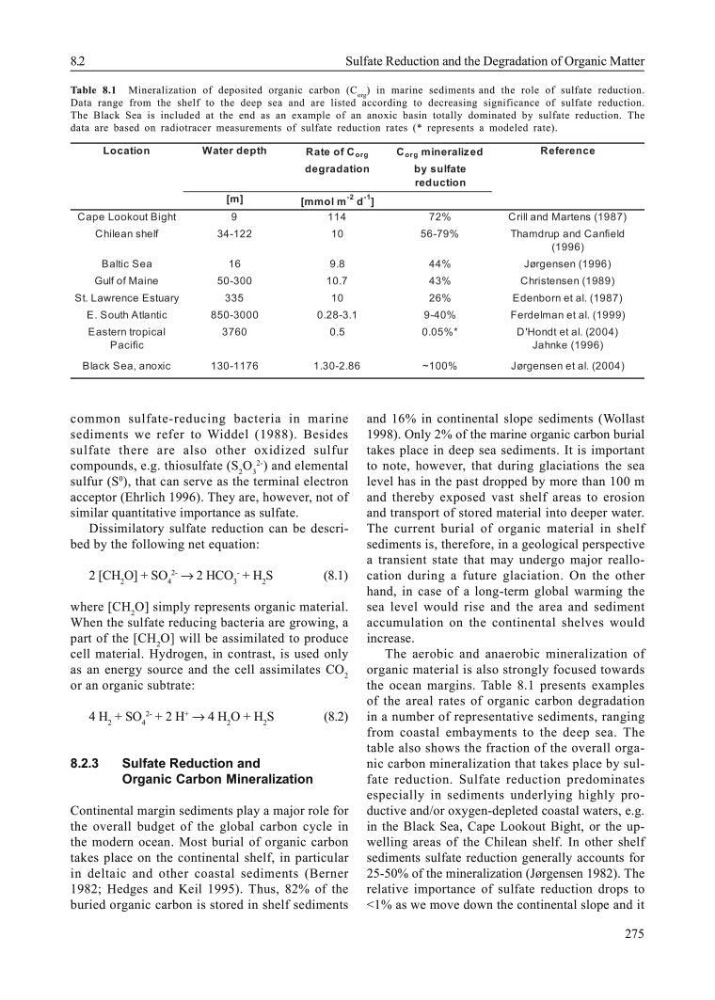
the ocean margins. Table 8.1 presents examples
of the areal rates of organic carbon degradation
in a number of representative sediments, ranging
from coastal embayments to the deep sea. The
table also shows the fraction of the overall organic carbon mineralization that takes place by sulfate reduction. Sulfate reduction predominates
especially in sediments underlying highly productive and/or oxygen-depleted coastal waters, e.g.
in the Black Sea, Cape Lookout Bight, or the upwelling areas of the Chilean shelf. In other shelf
sediments sulfate reduction generally accounts for
25-50% of the mineralization (Jørgensen 1982). The
relative importance of sulfate reduction drops to
<1% as we move down the continental slope and it
Table 8.1 Mineralization of deposited organic carbon (C org ) in marine sediments and the role of sulfate reduction.
Data range from the shelf to the deep sea and are listed according to decreasing significance of sulfate reduction.
The Black Sea is included at the end as an example of an anoxic basin totally dominated by sulfate reduction. The
data are based on radiotracer measurements of sulfate reduction rates (* represents a modeled rate).
Water depth
Rate of C org
C org mineraliz ed
degradation
by sulfate
reduction
[m]
[mmol m
-2 d
-1 ]
Cape Lookout Bight
9
114
72%
Crill and Martens (1987)
Chilean shelf
34-122
10
56-79%
Thamdrup and Canfield
(1996)
Baltic Sea
16
9.8
44%
Jørgensen (1996)
Gulf of Maine
50-300
10.7
43%
Christensen (1989)
St. Lawrence Estuary
335
10
26%
Edenborn et al. (1987)
E. South Atlantic
850-3000
0.28-3.1
9-40%
Ferdelman et al. (1999)
Black Sea, anoxic
130-1176
1.30-2.86
~100%
Jørgensen et al. (2004)
Location
Reference
Eastern tropical
Pacific
3760
0.5
0.05%*
D'Hondt et al. (2004)
Jahnke (1996)
8.2
Sulfate Reduction and the Degradation of Organic Matter
common sulfate-reducing bacteria in marine
sediments we refer to Widdel (1988). Besides
sulfate there are also other oxidized sulfur
compounds, e.g. thiosulfate (S 2 O 3
2) and elemental
sulfur (S
0
), that can serve as the terminal electron
acceptor (Ehrlich 1996). They are, however, not of
similar quantitative importance as sulfate.
Dissimilatory sulfate reduction can be described by the following net equation:
2 [CH 2 O] + SO 4
2→ 2 HCO 3
-
+ H 2 S
(8.1)
where [CH 2 O] simply represents organic material.
When the sulfate reducing bacteria are growing, a
part of the [CH 2 O] will be assimilated to produce
cell material. Hydrogen, in contrast, is used only
as an energy source and the cell assimilates CO 2
or an organic subtrate:
4 H 2 + SO 4
2+ 2 H
+
→ 4 H 2 O + H 2 S
(8.2)
8.2.3
Sulfate Reduction and
Organic Carbon Mineralization
Continental margin sediments play a major role for
the overall budget of the global carbon cycle in
the modern ocean. Most burial of organic carbon
takes place on the continental shelf, in particular
in deltaic and other coastal sediments (Berner
1982; Hedges and Keil 1995). Thus, 82% of the
buried organic carbon is stored in shelf sediments
and 16% in continental slope sediments (Wollast
1998). Only 2% of the marine organic carbon burial
takes place in deep sea sediments. It is important
to note, however, that during glaciations the sea
level has in the past dropped by more than 100 m
and thereby exposed vast shelf areas to erosion
and transport of stored material into deeper water.
The current burial of organic material in shelf
sediments is, therefore, in a geological perspective
a transient state that may undergo major reallocation during a future glaciation. On the other
hand, in case of a long-term global warming the
sea level would rise and the area and sediment
accumulation on the continental shelves would
increase.
The aerobic and anaerobic mineralization of
organic material is also strongly focused towards
the ocean margins. Table 8.1 presents examples
of the areal rates of organic carbon degradation
in a number of representative sediments, ranging
from coastal embayments to the deep sea. The
table also shows the fraction of the overall organic carbon mineralization that takes place by sulfate reduction. Sulfate reduction predominates
especially in sediments underlying highly productive and/or oxygen-depleted coastal waters, e.g.
in the Black Sea, Cape Lookout Bight, or the upwelling areas of the Chilean shelf. In other shelf
sediments sulfate reduction generally accounts for
25-50% of the mineralization (Jørgensen 1982). The
relative importance of sulfate reduction drops to
<1% as we move down the continental slope and it
Table 8.1 Mineralization of deposited organic carbon (C org ) in marine sediments and the role of sulfate reduction.
Data range from the shelf to the deep sea and are listed according to decreasing significance of sulfate reduction.
The Black Sea is included at the end as an example of an anoxic basin totally dominated by sulfate reduction. The
data are based on radiotracer measurements of sulfate reduction rates (* represents a modeled rate).
Water depth
Rate of C org
C org mineraliz ed
degradation
by sulfate
reduction
[m]
[mmol m
-2 d
-1 ]
Cape Lookout Bight
9
114
72%
Crill and Martens (1987)
Chilean shelf
34-122
10
56-79%
Thamdrup and Canfield
(1996)
Baltic Sea
16
9.8
44%
Jørgensen (1996)
Gulf of Maine
50-300
10.7
43%
Christensen (1989)
St. Lawrence Estuary
335
10
26%
Edenborn et al. (1987)
E. South Atlantic
850-3000
0.28-3.1
9-40%
Ferdelman et al. (1999)
Black Sea, anoxic
130-1176
1.30-2.86
~100%
Jørgensen et al. (2004)
Location
Reference
Eastern tropical
Pacific
3760
0.5
0.05%*
D'Hondt et al. (2004)
Jahnke (1996)