

8
Sulfur Cycling and Methane Oxidation
274
the organic sedimentation is so scanty that sulfate
reduction is hardly detectable throughout the
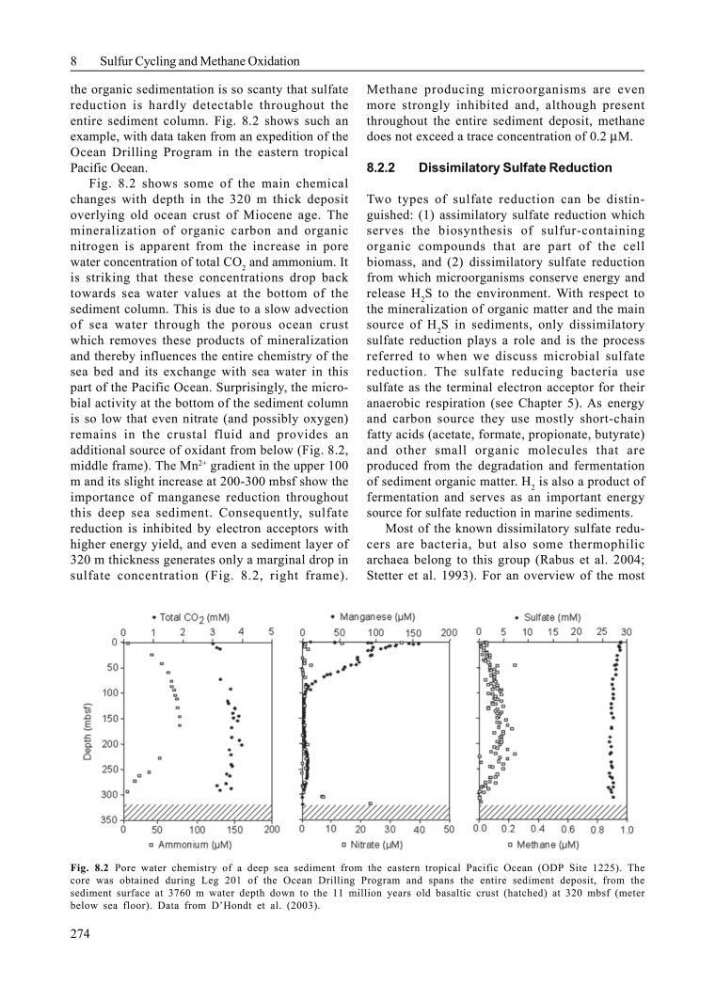
entire sediment column. Fig. 8.2 shows such an
example, with data taken from an expedition of the
Ocean Drilling Program in the eastern tropical
Pacific Ocean.
Fig. 8.2 shows some of the main chemical
changes with depth in the 320 m thick deposit
overlying old ocean crust of Miocene age. The
mineralization of organic carbon and organic
nitrogen is apparent from the increase in pore
water concentration of total CO 2 and ammonium. It
is striking that these concentrations drop back
towards sea water values at the bottom of the
sediment column. This is due to a slow advection
of sea water through the porous ocean crust
which removes these products of mineralization
and thereby influences the entire chemistry of the
sea bed and its exchange with sea water in this
part of the Pacific Ocean. Surprisingly, the microbial activity at the bottom of the sediment column
is so low that even nitrate (and possibly oxygen)
remains in the crustal fluid and provides an
additional source of oxidant from below (Fig. 8.2,
middle frame). The Mn
2+
gradient in the upper 100
m and its slight increase at 200-300 mbsf show the
importance of manganese reduction throughout
this deep sea sediment. Consequently, sulfate
reduction is inhibited by electron acceptors with
higher energy yield, and even a sediment layer of
320 m thickness generates only a marginal drop in
sulfate concentration (Fig. 8.2, right frame).
Methane producing microorganisms are even
more strongly inhibited and, although present
throughout the entire sediment deposit, methane
does not exceed a trace concentration of 0.2 µM.
8.2.2
Dissimilatory Sulfate Reduction
Two types of sulfate reduction can be distinguished: (1) assimilatory sulfate reduction which
serves the biosynthesis of sulfur-containing
organic compounds that are part of the cell
biomass, and (2) dissimilatory sulfate reduction
from which microorganisms conserve energy and
release H 2 S to the environment. With respect to
the mineralization of organic matter and the main
source of H 2 S in sediments, only dissimilatory
sulfate reduction plays a role and is the process
referred to when we discuss microbial sulfate
reduction. The sulfate reducing bacteria use
sulfate as the terminal electron acceptor for their
anaerobic respiration (see Chapter 5). As energy
and carbon source they use mostly short-chain
fatty acids (acetate, formate, propionate, butyrate)
and other small organic molecules that are
produced from the degradation and fermentation
of sediment organic matter. H 2 is also a product of
fermentation and serves as an important energy
source for sulfate reduction in marine sediments.
Most of the known dissimilatory sulfate reducers are bacteria, but also some thermophilic
archaea belong to this group (Rabus et al. 2004;
Stetter et al. 1993). For an overview of the most
Fig. 8.2 Pore water chemistry of a deep sea sediment from the eastern tropical Pacific Ocean (ODP Site 1225). The
core was obtained during Leg 201 of the Ocean Drilling Program and spans the entire sediment deposit, from the
sediment surface at 3760 m water depth down to the 11 million years old basaltic crust (hatched) at 320 mbsf (meter
below sea floor). Data from D’Hondt et al. (2003).
Sulfur Cycling and Methane Oxidation
274
the organic sedimentation is so scanty that sulfate
reduction is hardly detectable throughout the
entire sediment column. Fig. 8.2 shows such an
example, with data taken from an expedition of the
Ocean Drilling Program in the eastern tropical
Pacific Ocean.
Fig. 8.2 shows some of the main chemical
changes with depth in the 320 m thick deposit
overlying old ocean crust of Miocene age. The
mineralization of organic carbon and organic
nitrogen is apparent from the increase in pore
water concentration of total CO 2 and ammonium. It
is striking that these concentrations drop back
towards sea water values at the bottom of the
sediment column. This is due to a slow advection
of sea water through the porous ocean crust
which removes these products of mineralization
and thereby influences the entire chemistry of the
sea bed and its exchange with sea water in this
part of the Pacific Ocean. Surprisingly, the microbial activity at the bottom of the sediment column
is so low that even nitrate (and possibly oxygen)
remains in the crustal fluid and provides an
additional source of oxidant from below (Fig. 8.2,
middle frame). The Mn
2+
gradient in the upper 100
m and its slight increase at 200-300 mbsf show the
importance of manganese reduction throughout
this deep sea sediment. Consequently, sulfate
reduction is inhibited by electron acceptors with
higher energy yield, and even a sediment layer of
320 m thickness generates only a marginal drop in
sulfate concentration (Fig. 8.2, right frame).
Methane producing microorganisms are even
more strongly inhibited and, although present
throughout the entire sediment deposit, methane
does not exceed a trace concentration of 0.2 µM.
8.2.2
Dissimilatory Sulfate Reduction
Two types of sulfate reduction can be distinguished: (1) assimilatory sulfate reduction which
serves the biosynthesis of sulfur-containing
organic compounds that are part of the cell
biomass, and (2) dissimilatory sulfate reduction
from which microorganisms conserve energy and
release H 2 S to the environment. With respect to
the mineralization of organic matter and the main
source of H 2 S in sediments, only dissimilatory
sulfate reduction plays a role and is the process
referred to when we discuss microbial sulfate
reduction. The sulfate reducing bacteria use
sulfate as the terminal electron acceptor for their
anaerobic respiration (see Chapter 5). As energy
and carbon source they use mostly short-chain
fatty acids (acetate, formate, propionate, butyrate)
and other small organic molecules that are
produced from the degradation and fermentation
of sediment organic matter. H 2 is also a product of
fermentation and serves as an important energy
source for sulfate reduction in marine sediments.
Most of the known dissimilatory sulfate reducers are bacteria, but also some thermophilic
archaea belong to this group (Rabus et al. 2004;
Stetter et al. 1993). For an overview of the most
Fig. 8.2 Pore water chemistry of a deep sea sediment from the eastern tropical Pacific Ocean (ODP Site 1225). The
core was obtained during Leg 201 of the Ocean Drilling Program and spans the entire sediment deposit, from the
sediment surface at 3760 m water depth down to the 11 million years old basaltic crust (hatched) at 320 mbsf (meter
below sea floor). Data from D’Hondt et al. (2003).