

8
Sulfur Cycling and Methane Oxidation
278
oxidizes 15 · 10
13
mol organic carbon per year. This
is equivalent to 65% of the global sediment oxygen uptake. The major part of the sulfide produced from sulfate reduction, around 90% in many
shelf sediments, does not become buried in the
sediment but is directly or indirectly reoxidized
back to sulfate (see Section 8.5). The complex
process of sulfide oxidation will thereby ultimately
consume oxygen corresponding to the net
equation:
H 2 S + 2 O 2 → SO 4
2+ 2 H
+
(8.5)
It is a striking consequence of these simple
calculations that about half of the entire oxygen
uptake in shelf sediments, where most sulfate
reduction takes place, is used for the reoxidation
of sulfide or of reduced metals originally reduced
by reaction with sulfide (cf. Jørgensen 1977).
Thus, if 90 % of 15 · 10
13
mol O 2 yr
-1
is consumed in
this process, it means that 13 out of 23 mol O 2 yr
-1
or 56% of the oxygen is somehow involved in the
reoxidation of sulfide (see Section 8.5). Only the
remaining half of the oxygen is therefore available
for all the animals and heterotrophic microorganisms that oxidize organic matter directly through
their aerobic respiration.
8.3
Anaerobic Oxidation of
Methane (AOM)
Below the sulfate zone, methanogenesis is the
main terminal pathway of organic carbon mineralization. Methane is produced exclusively by
anaerobic archaea that utilize a narrow spectrum
of substrates for the process (Whitman et al.
1999). Methanogenic bacteria or eukaryotes are
not known to exist. The primary sources of
methane formation in marine sediments are from
the splitting of acetate (CH 3 COO
-
) and from the
reduction of CO 2 by hydrogen (Eq. 8.6 and 8.7):
CH 3 COO
-
+ H
+
+ → CH 4 + CO 2
(8.6)
CO 2 + 4 H 2 → CH 4 + 2 H 2 O
(8.7)
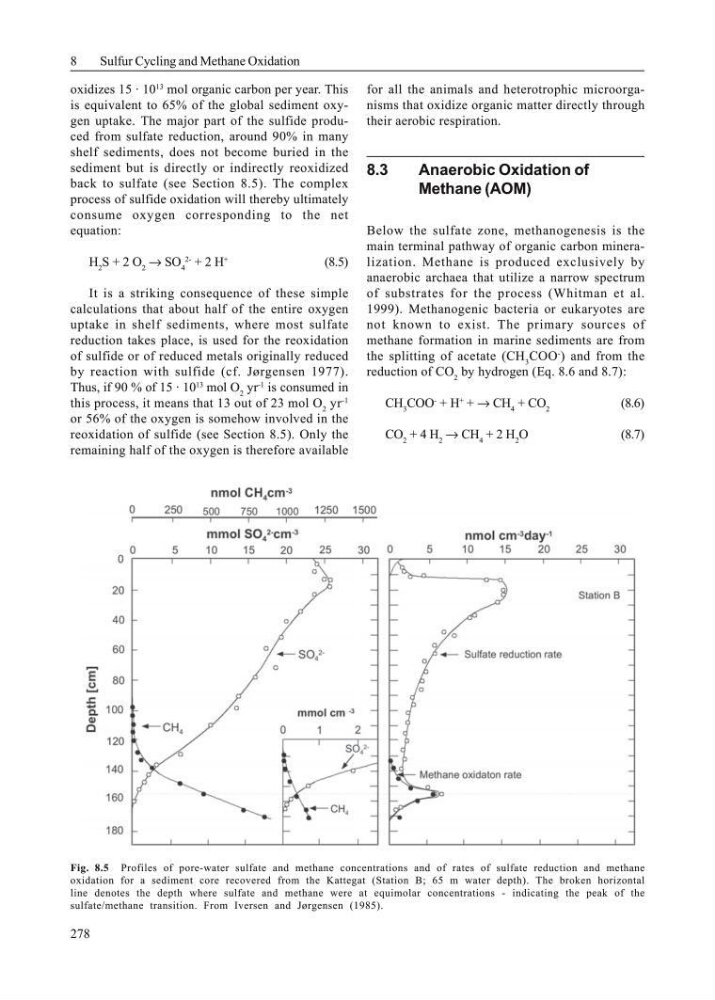
Fig. 8.5 Profiles of pore-water sulfate and methane concentrations and of rates of sulfate reduction and methane
oxidation for a sediment core recovered from the Kattegat (Station B; 65 m water depth). The broken horizontal
line denotes the depth where sulfate and methane were at equimolar concentrations - indicating the peak of the
sulfate/methane transition. From Iversen and Jørgensen (1985).
Sulfur Cycling and Methane Oxidation
278
oxidizes 15 · 10
13
mol organic carbon per year. This
is equivalent to 65% of the global sediment oxygen uptake. The major part of the sulfide produced from sulfate reduction, around 90% in many
shelf sediments, does not become buried in the
sediment but is directly or indirectly reoxidized
back to sulfate (see Section 8.5). The complex
process of sulfide oxidation will thereby ultimately
consume oxygen corresponding to the net
equation:
H 2 S + 2 O 2 → SO 4
2+ 2 H
+
(8.5)
It is a striking consequence of these simple
calculations that about half of the entire oxygen
uptake in shelf sediments, where most sulfate
reduction takes place, is used for the reoxidation
of sulfide or of reduced metals originally reduced
by reaction with sulfide (cf. Jørgensen 1977).
Thus, if 90 % of 15 · 10
13
mol O 2 yr
-1
is consumed in
this process, it means that 13 out of 23 mol O 2 yr
-1
or 56% of the oxygen is somehow involved in the
reoxidation of sulfide (see Section 8.5). Only the
remaining half of the oxygen is therefore available
for all the animals and heterotrophic microorganisms that oxidize organic matter directly through
their aerobic respiration.
8.3
Anaerobic Oxidation of
Methane (AOM)
Below the sulfate zone, methanogenesis is the
main terminal pathway of organic carbon mineralization. Methane is produced exclusively by
anaerobic archaea that utilize a narrow spectrum
of substrates for the process (Whitman et al.
1999). Methanogenic bacteria or eukaryotes are
not known to exist. The primary sources of
methane formation in marine sediments are from
the splitting of acetate (CH 3 COO
-
) and from the
reduction of CO 2 by hydrogen (Eq. 8.6 and 8.7):
CH 3 COO
-
+ H
+
+ → CH 4 + CO 2
(8.6)
CO 2 + 4 H 2 → CH 4 + 2 H 2 O
(8.7)
Fig. 8.5 Profiles of pore-water sulfate and methane concentrations and of rates of sulfate reduction and methane
oxidation for a sediment core recovered from the Kattegat (Station B; 65 m water depth). The broken horizontal
line denotes the depth where sulfate and methane were at equimolar concentrations - indicating the peak of the
sulfate/methane transition. From Iversen and Jørgensen (1985).