

1
The Solid Phase of Marine Sediments
12
deep sea and the shelf seas, and (iii) “pelagic deposits in deep water removed from land”. This
scheme is very much appropriate to provide the basic framework for a simple classification scheme on
the basis of terrigenous sediments, inclusive of the
“shallow-water deposits” in the sense of Murray
and Renard (1891), and the deep-sea sediments.
The latter usually are subdivided into hemipelagic
sediments and pelagic sediments.
1.3.1
Terrigenous Sediments
Terrigenous sediments, i.e. clastics consisting of
material eroded from the land surface, are not only
understood as nearshore shallow-water deposits
on the shelf seas, but also comprise the deltaic
foreset beds of continental margins, slump deposits at continental slopes produced by gravity
transport, and the terrigenous-detrital shelf sediments redistributed into the deep sea by the activity of debris flows and turbidity currents.
The sand, silt, and clay containing shelf sediments primarily consist of terrigenous siliciclastic
components transported downstream by rivers;
they also contain various amounts of autochthonous biogenic shell material. Depending on the
availability of terrigenous discharge, biogenic carbonate sedimentation might predominate in broad
shelf regions. A great variety of grain sizes is
typical for the sediments on the continental shelf,
with very coarse sand or gravel accumulating in
high-energy environments and very fine-grained
material accumulating in low-energy environments. Coarse material in the terrigenous sediments of the deep sea is restricted to debris flow
deposits on and near the continental margins and
the proximal depocenters of episodic turbidites.
The development and the hydrodynamic history of terrigenous sediments is described in its
essentials by the grain-size distribution and the
derived sediment characteristics. Therefore, a
classification on the basis of textural features appears suitable to describe the terrigenous sediments. The subdivision of sedimentary particles
according the Udden-Wentworth scale encompasses four major categories: gravel (> 2 mm),
sand (2 - 0.0625 mm), silt (0.0625 - 0.0039 mm) and
clay (< 0.0039 mm), each further divided into a
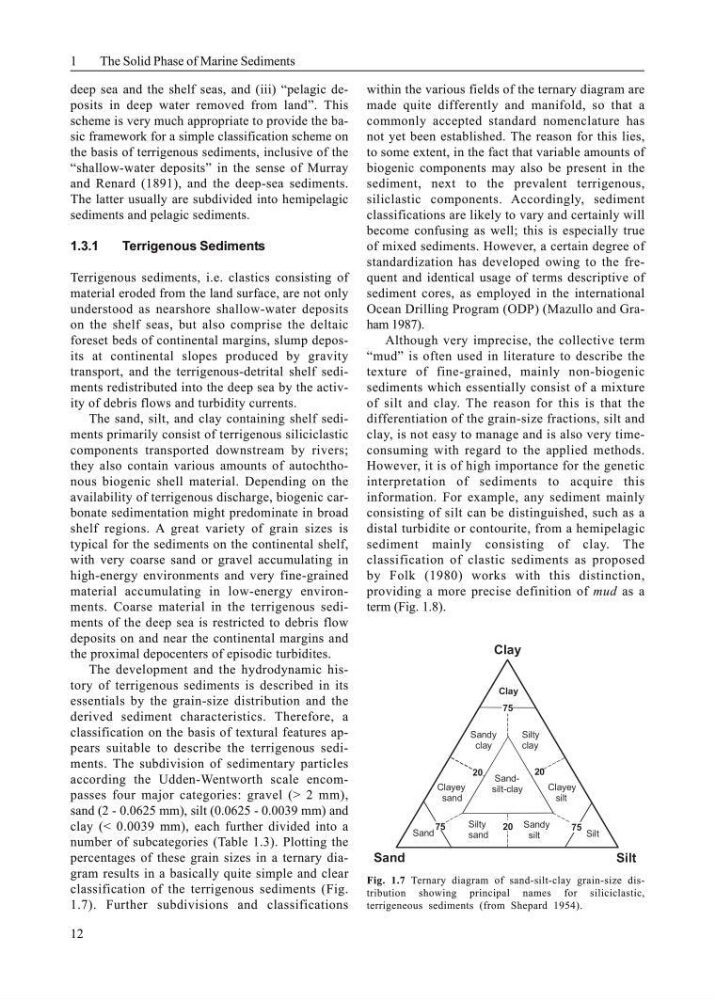
number of subcategories (Table 1.3). Plotting the
percentages of these grain sizes in a ternary diagram results in a basically quite simple and clear
classification of the terrigenous sediments (Fig.
1.7). Further subdivisions and classifications
within the various fields of the ternary diagram are
made quite differently and manifold, so that a
commonly accepted standard nomenclature has
not yet been established. The reason for this lies,
to some extent, in the fact that variable amounts of
biogenic components may also be present in the
sediment, next to the prevalent terrigenous,
siliclastic components. Accordingly, sediment
classifications are likely to vary and certainly will
become confusing as well; this is especially true
of mixed sediments. However, a certain degree of
standardization has developed owing to the frequent and identical usage of terms descriptive of
sediment cores, as employed in the international
Ocean Drilling Program (ODP) (Mazullo and Graham 1987).
Although very imprecise, the collective term
“mud” is often used in literature to describe the
texture of fine-grained, mainly non-biogenic
sediments which essentially consist of a mixture
of silt and clay. The reason for this is that the
differentiation of the grain-size fractions, silt and
clay, is not easy to manage and is also very timeconsuming with regard to the applied methods.
However, it is of high importance for the genetic
interpretation of sediments to acquire this
information. For example, any sediment mainly
consisting of silt can be distinguished, such as a
distal turbidite or contourite, from a hemipelagic
sediment mainly consisting of clay. The
classification of clastic sediments as proposed
by Folk (1980) works with this distinction,
providing a more precise definition of mud as a
term (Fig. 1.8).
Clay
Clay
Silty
clay
Sandy
clay
Sand
Silt
Clayey
silt
Clayey
sand
Silty
sand
Sandy
silt
Sandsilt-clay
Sand
Silt
75
20
20
20
75
75
Fig. 1.7 Ternary diagram of sand-silt-clay grain-size distribution showing principal names for siliciclastic,
terrigeneous sediments (from Shepard 1954).
The Solid Phase of Marine Sediments
12
deep sea and the shelf seas, and (iii) “pelagic deposits in deep water removed from land”. This
scheme is very much appropriate to provide the basic framework for a simple classification scheme on
the basis of terrigenous sediments, inclusive of the
“shallow-water deposits” in the sense of Murray
and Renard (1891), and the deep-sea sediments.
The latter usually are subdivided into hemipelagic
sediments and pelagic sediments.
1.3.1
Terrigenous Sediments
Terrigenous sediments, i.e. clastics consisting of
material eroded from the land surface, are not only
understood as nearshore shallow-water deposits
on the shelf seas, but also comprise the deltaic
foreset beds of continental margins, slump deposits at continental slopes produced by gravity
transport, and the terrigenous-detrital shelf sediments redistributed into the deep sea by the activity of debris flows and turbidity currents.
The sand, silt, and clay containing shelf sediments primarily consist of terrigenous siliciclastic
components transported downstream by rivers;
they also contain various amounts of autochthonous biogenic shell material. Depending on the
availability of terrigenous discharge, biogenic carbonate sedimentation might predominate in broad
shelf regions. A great variety of grain sizes is
typical for the sediments on the continental shelf,
with very coarse sand or gravel accumulating in
high-energy environments and very fine-grained
material accumulating in low-energy environments. Coarse material in the terrigenous sediments of the deep sea is restricted to debris flow
deposits on and near the continental margins and
the proximal depocenters of episodic turbidites.
The development and the hydrodynamic history of terrigenous sediments is described in its
essentials by the grain-size distribution and the
derived sediment characteristics. Therefore, a
classification on the basis of textural features appears suitable to describe the terrigenous sediments. The subdivision of sedimentary particles
according the Udden-Wentworth scale encompasses four major categories: gravel (> 2 mm),
sand (2 - 0.0625 mm), silt (0.0625 - 0.0039 mm) and
clay (< 0.0039 mm), each further divided into a
number of subcategories (Table 1.3). Plotting the
percentages of these grain sizes in a ternary diagram results in a basically quite simple and clear
classification of the terrigenous sediments (Fig.
1.7). Further subdivisions and classifications
within the various fields of the ternary diagram are
made quite differently and manifold, so that a
commonly accepted standard nomenclature has
not yet been established. The reason for this lies,
to some extent, in the fact that variable amounts of
biogenic components may also be present in the
sediment, next to the prevalent terrigenous,
siliclastic components. Accordingly, sediment
classifications are likely to vary and certainly will
become confusing as well; this is especially true
of mixed sediments. However, a certain degree of
standardization has developed owing to the frequent and identical usage of terms descriptive of
sediment cores, as employed in the international
Ocean Drilling Program (ODP) (Mazullo and Graham 1987).
Although very imprecise, the collective term
“mud” is often used in literature to describe the
texture of fine-grained, mainly non-biogenic
sediments which essentially consist of a mixture
of silt and clay. The reason for this is that the
differentiation of the grain-size fractions, silt and
clay, is not easy to manage and is also very timeconsuming with regard to the applied methods.
However, it is of high importance for the genetic
interpretation of sediments to acquire this
information. For example, any sediment mainly
consisting of silt can be distinguished, such as a
distal turbidite or contourite, from a hemipelagic
sediment mainly consisting of clay. The
classification of clastic sediments as proposed
by Folk (1980) works with this distinction,
providing a more precise definition of mud as a
term (Fig. 1.8).
Clay
Clay
Silty
clay
Sandy
clay
Sand
Silt
Clayey
silt
Clayey
sand
Silty
sand
Sandy
silt
Sandsilt-clay
Sand
Silt
75
20
20
20
75
75
Fig. 1.7 Ternary diagram of sand-silt-clay grain-size distribution showing principal names for siliciclastic,
terrigeneous sediments (from Shepard 1954).