

13
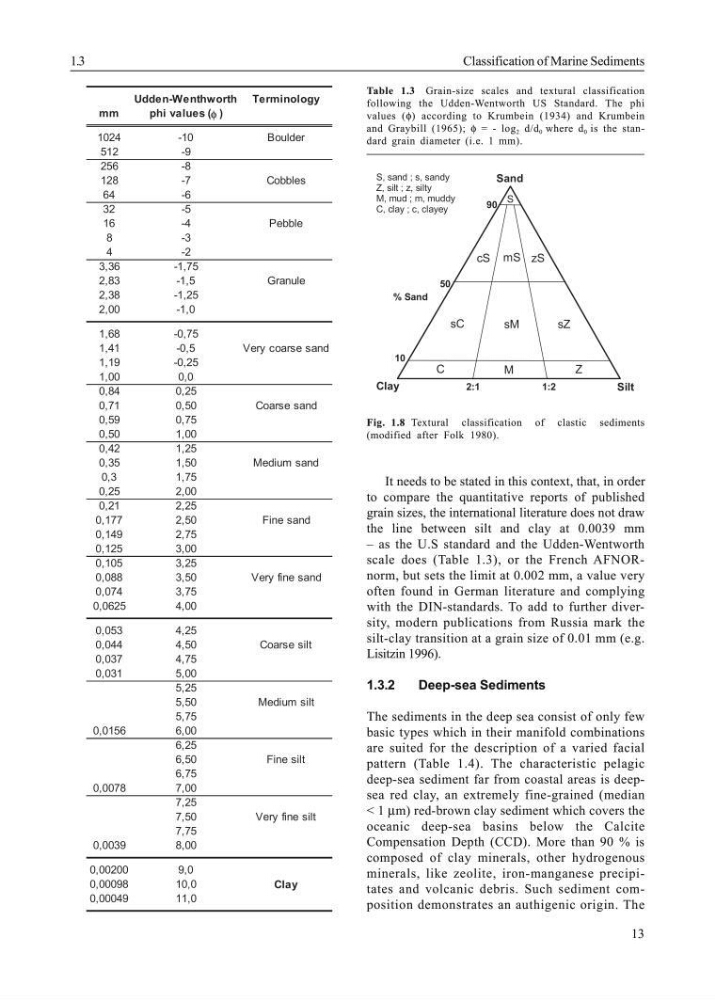
It needs to be stated in this context, that, in order
to compare the quantitative reports of published
grain sizes, the international literature does not draw
the line between silt and clay at 0.0039 mm
– as the U.S standard and the Udden-Wentworth
scale does (Table 1.3), or the French AFNORnorm, but sets the limit at 0.002 mm, a value very
often found in German literature and complying
with the DIN-standards. To add to further diversity, modern publications from Russia mark the
silt-clay transition at a grain size of 0.01 mm (e.g.
Lisitzin 1996).
1.3.2
Deep-sea Sediments
The sediments in the deep sea consist of only few
basic types which in their manifold combinations
are suited for the description of a varied facial
pattern (Table 1.4). The characteristic pelagic
deep-sea sediment far from coastal areas is deepsea red clay, an extremely fine-grained (median
< 1 µm) red-brown clay sediment which covers the
oceanic deep-sea basins below the Calcite
Compensation Depth (CCD). More than 90 % is
composed of clay minerals, other hydrogenous
minerals, like zeolite, iron-manganese precipitates and volcanic debris. Such sediment composition demonstrates an authigenic origin. The
1.3
Classification of Marine Sediments
Udden-Wenthworth Terminology
mm
phi values (φ )
1024
-10
Boulder
512
-9
256
-8
128
-7
Cobbles
64
-6
32
-5
16
-4
Pebble
8
- 3
4
- 2
3,36
-1,75
2,83
-1,5
Granule
2,38
-1,25
2,00
-1,0
1,68
-0,75
1,41
-0,5
Very coarse sand
1,19
-0,25
1,00
0,0
0,84
0,25
0,71
0,50
Coarse sand
0,59
0,75
0,50
1,00
0,42
1,25
0,35
1,50
Medium sand
0,3
1,75
0,25
2,00
0,21
2,25
0,177
2,50
Fine sand
0,149
2,75
0,125
3,00
0,105
3,25
0,088
3,50
Very fine sand
0,074
3,75
0,0625
4,00
0,053
4,25
0,044
4,50
Coarse silt
0,037
4,75
0,031
5,00
5,25
5,50
Medium silt
5,75
0,0156
6,00
6,25
6,50
Fine silt
6,75
0,0078
7,00
7,25
7,50
Very fine silt
7,75
0,0039
8,00
0,00200
9,0
0,00098
10,0
Clay
0,00049
11,0
Table 1.3 Grain-size scales and textural classification
following the Udden-Wentworth US Standard. The phi
values (φ) according to Krumbein (1934) and Krumbein
and Graybill (1965); φ = - log 2 d/d 0 where d 0 is the standard grain diameter (i.e. 1 mm).
10
50
90
S
cS mS zS
sC
sM
sZ
C
M
Z
Silt
Clay
Sand
% Sand
2:1
1:2
S, sand ; s, sandy
Z, silt ; z, silty
M, mud ; m, muddy
C, clay ; c, clayey
Fig. 1.8 Textural classification of clastic sediments
(modified after Folk 1980).
It needs to be stated in this context, that, in order
to compare the quantitative reports of published
grain sizes, the international literature does not draw
the line between silt and clay at 0.0039 mm
– as the U.S standard and the Udden-Wentworth
scale does (Table 1.3), or the French AFNORnorm, but sets the limit at 0.002 mm, a value very
often found in German literature and complying
with the DIN-standards. To add to further diversity, modern publications from Russia mark the
silt-clay transition at a grain size of 0.01 mm (e.g.
Lisitzin 1996).
1.3.2
Deep-sea Sediments
The sediments in the deep sea consist of only few
basic types which in their manifold combinations
are suited for the description of a varied facial
pattern (Table 1.4). The characteristic pelagic
deep-sea sediment far from coastal areas is deepsea red clay, an extremely fine-grained (median
< 1 µm) red-brown clay sediment which covers the
oceanic deep-sea basins below the Calcite
Compensation Depth (CCD). More than 90 % is
composed of clay minerals, other hydrogenous
minerals, like zeolite, iron-manganese precipitates and volcanic debris. Such sediment composition demonstrates an authigenic origin. The
1.3
Classification of Marine Sediments
Udden-Wenthworth Terminology
mm
phi values (φ )
1024
-10
Boulder
512
-9
256
-8
128
-7
Cobbles
64
-6
32
-5
16
-4
Pebble
8
- 3
4
- 2
3,36
-1,75
2,83
-1,5
Granule
2,38
-1,25
2,00
-1,0
1,68
-0,75
1,41
-0,5
Very coarse sand
1,19
-0,25
1,00
0,0
0,84
0,25
0,71
0,50
Coarse sand
0,59
0,75
0,50
1,00
0,42
1,25
0,35
1,50
Medium sand
0,3
1,75
0,25
2,00
0,21
2,25
0,177
2,50
Fine sand
0,149
2,75
0,125
3,00
0,105
3,25
0,088
3,50
Very fine sand
0,074
3,75
0,0625
4,00
0,053
4,25
0,044
4,50
Coarse silt
0,037
4,75
0,031
5,00
5,25
5,50
Medium silt
5,75
0,0156
6,00
6,25
6,50
Fine silt
6,75
0,0078
7,00
7,25
7,50
Very fine silt
7,75
0,0039
8,00
0,00200
9,0
0,00098
10,0
Clay
0,00049
11,0
Table 1.3 Grain-size scales and textural classification
following the Udden-Wentworth US Standard. The phi
values (φ) according to Krumbein (1934) and Krumbein
and Graybill (1965); φ = - log 2 d/d 0 where d 0 is the standard grain diameter (i.e. 1 mm).
10
50
90
S
cS mS zS
sC
sM
sZ
C
M
Z
Silt
Clay
Sand
% Sand
2:1
1:2
S, sand ; s, sandy
Z, silt ; z, silty
M, mud ; m, muddy
C, clay ; c, clayey
Fig. 1.8 Textural classification of clastic sediments
(modified after Folk 1980).