

11
1.3
Classification of Marine
Sediments
As yet, there is no general classification scheme
applicable to marine sediments that combines all
the essential characteristics pertaining to a sediment. A large number of different schemes has
been proposed in the literature which focus either
on origin, grain-size distribution, chemical and
mineralogical features of the sediment components, or the facial development of the sediments
– all depending on the specific problem under
study. The advantages and disadvantages of the
various schemes will not be of any concern here.
In the following, an attempt will be made to give a
comprehensive concise summary, based on the
combination of the various concepts.
Murray and Renard (1891) early introduced a
basically simple concept which in its essentials
differentiated according to the area of sediment
deposition as well as to sediment sources. It distinguished (i) “shallow-water deposits from lowwater mark to 100 fathoms”, (ii) “terrigenous deposits in deep and shallow water close to land”,
i.e. the combined terrigenous deposits from the
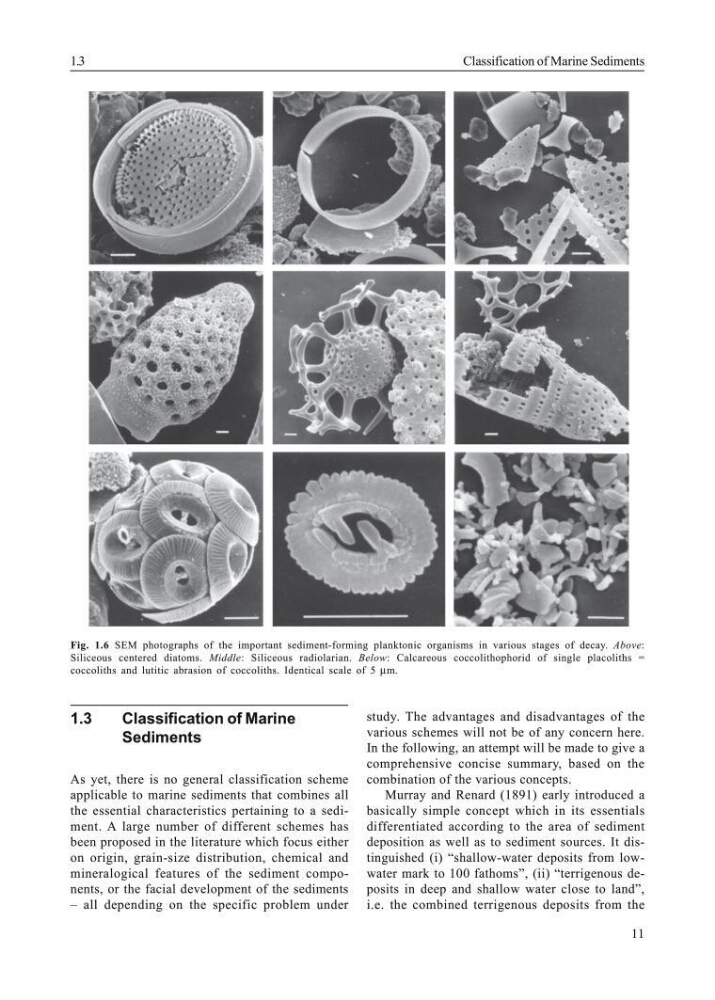
Fig. 1.6 SEM photographs of the important sediment-forming planktonic organisms in various stages of decay. Above:
Siliceous centered diatoms. Middle: Siliceous radiolarian. Below: Calcareous coccolithophorid of single placoliths =
coccoliths and lutitic abrasion of coccoliths. Identical scale of 5 µm.
1.3
Classification of Marine Sediments
1.3
Classification of Marine
Sediments
As yet, there is no general classification scheme
applicable to marine sediments that combines all
the essential characteristics pertaining to a sediment. A large number of different schemes has
been proposed in the literature which focus either
on origin, grain-size distribution, chemical and
mineralogical features of the sediment components, or the facial development of the sediments
– all depending on the specific problem under
study. The advantages and disadvantages of the
various schemes will not be of any concern here.
In the following, an attempt will be made to give a
comprehensive concise summary, based on the
combination of the various concepts.
Murray and Renard (1891) early introduced a
basically simple concept which in its essentials
differentiated according to the area of sediment
deposition as well as to sediment sources. It distinguished (i) “shallow-water deposits from lowwater mark to 100 fathoms”, (ii) “terrigenous deposits in deep and shallow water close to land”,
i.e. the combined terrigenous deposits from the
Fig. 1.6 SEM photographs of the important sediment-forming planktonic organisms in various stages of decay. Above:
Siliceous centered diatoms. Middle: Siliceous radiolarian. Below: Calcareous coccolithophorid of single placoliths =
coccoliths and lutitic abrasion of coccoliths. Identical scale of 5 µm.
1.3
Classification of Marine Sediments