

253
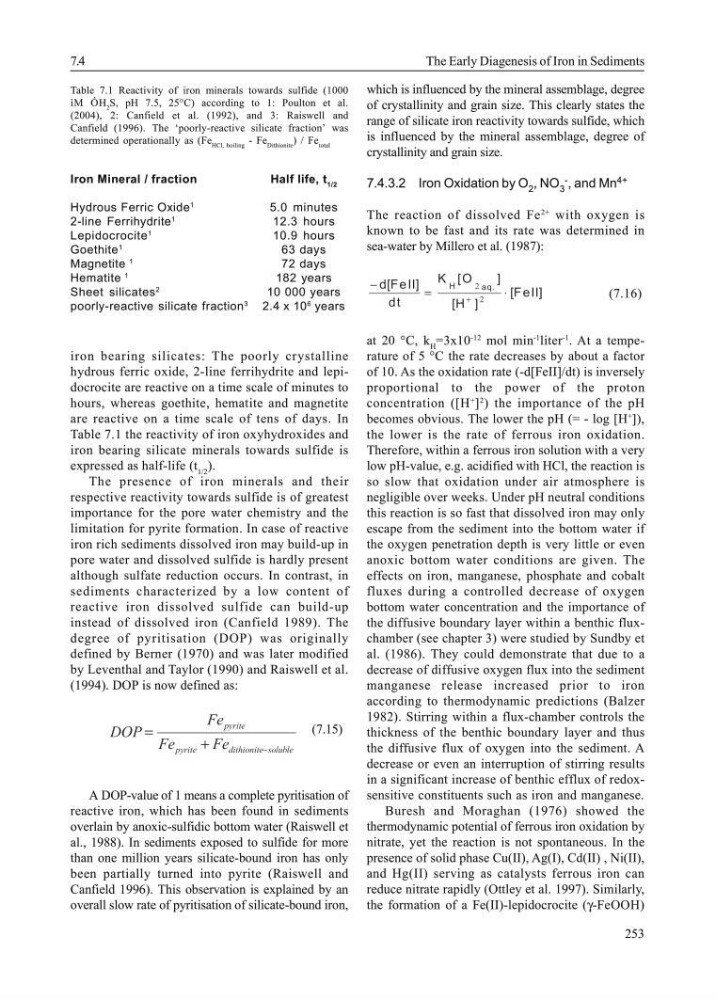
iron bearing silicates: The poorly crystalline
hydrous ferric oxide, 2-line ferrihydrite and lepidocrocite are reactive on a time scale of minutes to
hours, whereas goethite, hematite and magnetite
are reactive on a time scale of tens of days. In
Table 7.1 the reactivity of iron oxyhydroxides and
iron bearing silicate minerals towards sulfide is
expressed as half-life (t 1/2 ).
The presence of iron minerals and their
respective reactivity towards sulfide is of greatest
importance for the pore water chemistry and the
limitation for pyrite formation. In case of reactive
iron rich sediments dissolved iron may build-up in
pore water and dissolved sulfide is hardly present
although sulfate reduction occurs. In contrast, in
sediments characterized by a low content of
reactive iron dissolved sulfide can build-up
instead of dissolved iron (Canfield 1989). The
degree of pyritisation (DOP) was originally
defined by Berner (1970) and was later modified
by Leventhal and Taylor (1990) and Raiswell et al.
(1994). DOP is now defined as:
le
lub
so
dithionite
pyrite
pyrite
Fe
Fe
Fe
DOP
−
+
=
(7.15)
A DOP-value of 1 means a complete pyritisation of
reactive iron, which has been found in sediments
overlain by anoxic-sulfidic bottom water (Raiswell et
al., 1988). In sediments exposed to sulfide for more
than one million years silicate-bound iron has only
been partially turned into pyrite (Raiswell and
Canfield 1996). This observation is explained by an
overall slow rate of pyritisation of silicate-bound iron,
which is influenced by the mineral assemblage, degree
of crystallinity and grain size. This clearly states the
range of silicate iron reactivity towards sulfide, which
is influenced by the mineral assemblage, degree of
crystallinity and grain size.
7.4.3.2 Iron Oxidation by O 2 , NO 3
- , and Mn 4+
The reaction of dissolved Fe
2+
with oxygen is
known to be fast and its rate was determined in
sea-water by Millero et al. (1987):
−
=
⋅
+
d FeII
dt
K O
H
FeII
H
aq
[
]
[
]
[
]
[
]
.
2
2
(7.16)
at 20 °C, k H =3x10
-12
mol min
-1
liter
-1
. At a temperature of 5 °C the rate decreases by about a factor
of 10. As the oxidation rate (-d[FeII]/dt) is inversely
proportional to the power of the proton
concentration ([H
+
]
2
) the importance of the pH
becomes obvious. The lower the pH (= - log [H
+
]),
the lower is the rate of ferrous iron oxidation.
Therefore, within a ferrous iron solution with a very
low pH-value, e.g. acidified with HCl, the reaction is
so slow that oxidation under air atmosphere is
negligible over weeks. Under pH neutral conditions
this reaction is so fast that dissolved iron may only
escape from the sediment into the bottom water if
the oxygen penetration depth is very little or even
anoxic bottom water conditions are given. The
effects on iron, manganese, phosphate and cobalt
fluxes during a controlled decrease of oxygen
bottom water concentration and the importance of
the diffusive boundary layer within a benthic fluxchamber (see chapter 3) were studied by Sundby et
al. (1986). They could demonstrate that due to a
decrease of diffusive oxygen flux into the sediment
manganese release increased prior to iron
according to thermodynamic predictions (Balzer
1982). Stirring within a flux-chamber controls the
thickness of the benthic boundary layer and thus
the diffusive flux of oxygen into the sediment. A
decrease or even an interruption of stirring results
in a significant increase of benthic efflux of redoxsensitive constituents such as iron and manganese.
Buresh and Moraghan (1976) showed the
thermodynamic potential of ferrous iron oxidation by
nitrate, yet the reaction is not spontaneous. In the
presence of solid phase Cu(II), Ag(I), Cd(II) , Ni(II),
and Hg(II) serving as catalysts ferrous iron can
reduce nitrate rapidly (Ottley et al. 1997). Similarly,
the formation of a Fe(II)-lepidocrocite (γ-FeOOH)
7.4
The Early Diagenesis of Iron in Sediments
Table 7.1 Reactivity of iron minerals towards sulfide (1000
ìM ÓH 2 S, pH 7.5, 25°C) according to 1: Poulton et al.
(2004), 2: Canfield et al. (1992), and 3: Raiswell and
Canfield (1996). The ‘poorly-reactive silicate fraction’ was
determined operationally as (Fe HCl, boiling - Fe Dithionite ) / Fe total
Iron Mineral / fraction
Half life, t 1/2
Hydrous Ferric Oxide
1
5.0 minutes
2-line Ferrihydrite
1
12.3 hours
Lepidocrocite
1
10.9 hours
Goethite
1
63 days
Magnetite
1
72 days
Hematite
1
182 years
Sheet silicates
2
10 000 years
poorly-reactive silicate fraction
3
2.4 x 10
6
years
iron bearing silicates: The poorly crystalline
hydrous ferric oxide, 2-line ferrihydrite and lepidocrocite are reactive on a time scale of minutes to
hours, whereas goethite, hematite and magnetite
are reactive on a time scale of tens of days. In
Table 7.1 the reactivity of iron oxyhydroxides and
iron bearing silicate minerals towards sulfide is
expressed as half-life (t 1/2 ).
The presence of iron minerals and their
respective reactivity towards sulfide is of greatest
importance for the pore water chemistry and the
limitation for pyrite formation. In case of reactive
iron rich sediments dissolved iron may build-up in
pore water and dissolved sulfide is hardly present
although sulfate reduction occurs. In contrast, in
sediments characterized by a low content of
reactive iron dissolved sulfide can build-up
instead of dissolved iron (Canfield 1989). The
degree of pyritisation (DOP) was originally
defined by Berner (1970) and was later modified
by Leventhal and Taylor (1990) and Raiswell et al.
(1994). DOP is now defined as:
le
lub
so
dithionite
pyrite
pyrite
Fe
Fe
Fe
DOP
−
+
=
(7.15)
A DOP-value of 1 means a complete pyritisation of
reactive iron, which has been found in sediments
overlain by anoxic-sulfidic bottom water (Raiswell et
al., 1988). In sediments exposed to sulfide for more
than one million years silicate-bound iron has only
been partially turned into pyrite (Raiswell and
Canfield 1996). This observation is explained by an
overall slow rate of pyritisation of silicate-bound iron,
which is influenced by the mineral assemblage, degree
of crystallinity and grain size. This clearly states the
range of silicate iron reactivity towards sulfide, which
is influenced by the mineral assemblage, degree of
crystallinity and grain size.
7.4.3.2 Iron Oxidation by O 2 , NO 3
- , and Mn 4+
The reaction of dissolved Fe
2+
with oxygen is
known to be fast and its rate was determined in
sea-water by Millero et al. (1987):
−
=
⋅
+
d FeII
dt
K O
H
FeII
H
aq
[
]
[
]
[
]
[
]
.
2
2
(7.16)
at 20 °C, k H =3x10
-12
mol min
-1
liter
-1
. At a temperature of 5 °C the rate decreases by about a factor
of 10. As the oxidation rate (-d[FeII]/dt) is inversely
proportional to the power of the proton
concentration ([H
+
]
2
) the importance of the pH
becomes obvious. The lower the pH (= - log [H
+
]),
the lower is the rate of ferrous iron oxidation.
Therefore, within a ferrous iron solution with a very
low pH-value, e.g. acidified with HCl, the reaction is
so slow that oxidation under air atmosphere is
negligible over weeks. Under pH neutral conditions
this reaction is so fast that dissolved iron may only
escape from the sediment into the bottom water if
the oxygen penetration depth is very little or even
anoxic bottom water conditions are given. The
effects on iron, manganese, phosphate and cobalt
fluxes during a controlled decrease of oxygen
bottom water concentration and the importance of
the diffusive boundary layer within a benthic fluxchamber (see chapter 3) were studied by Sundby et
al. (1986). They could demonstrate that due to a
decrease of diffusive oxygen flux into the sediment
manganese release increased prior to iron
according to thermodynamic predictions (Balzer
1982). Stirring within a flux-chamber controls the
thickness of the benthic boundary layer and thus
the diffusive flux of oxygen into the sediment. A
decrease or even an interruption of stirring results
in a significant increase of benthic efflux of redoxsensitive constituents such as iron and manganese.
Buresh and Moraghan (1976) showed the
thermodynamic potential of ferrous iron oxidation by
nitrate, yet the reaction is not spontaneous. In the
presence of solid phase Cu(II), Ag(I), Cd(II) , Ni(II),
and Hg(II) serving as catalysts ferrous iron can
reduce nitrate rapidly (Ottley et al. 1997). Similarly,
the formation of a Fe(II)-lepidocrocite (γ-FeOOH)
7.4
The Early Diagenesis of Iron in Sediments
Table 7.1 Reactivity of iron minerals towards sulfide (1000
ìM ÓH 2 S, pH 7.5, 25°C) according to 1: Poulton et al.
(2004), 2: Canfield et al. (1992), and 3: Raiswell and
Canfield (1996). The ‘poorly-reactive silicate fraction’ was
determined operationally as (Fe HCl, boiling - Fe Dithionite ) / Fe total
Iron Mineral / fraction
Half life, t 1/2
Hydrous Ferric Oxide
1
5.0 minutes
2-line Ferrihydrite
1
12.3 hours
Lepidocrocite
1
10.9 hours
Goethite
1
63 days
Magnetite
1
72 days
Hematite
1
182 years
Sheet silicates
2
10 000 years
poorly-reactive silicate fraction
3
2.4 x 10
6
years