

7
The Biogeochemistry of Iron
252
composition of dissolved compounds in solution
is complex and may have significant influence on
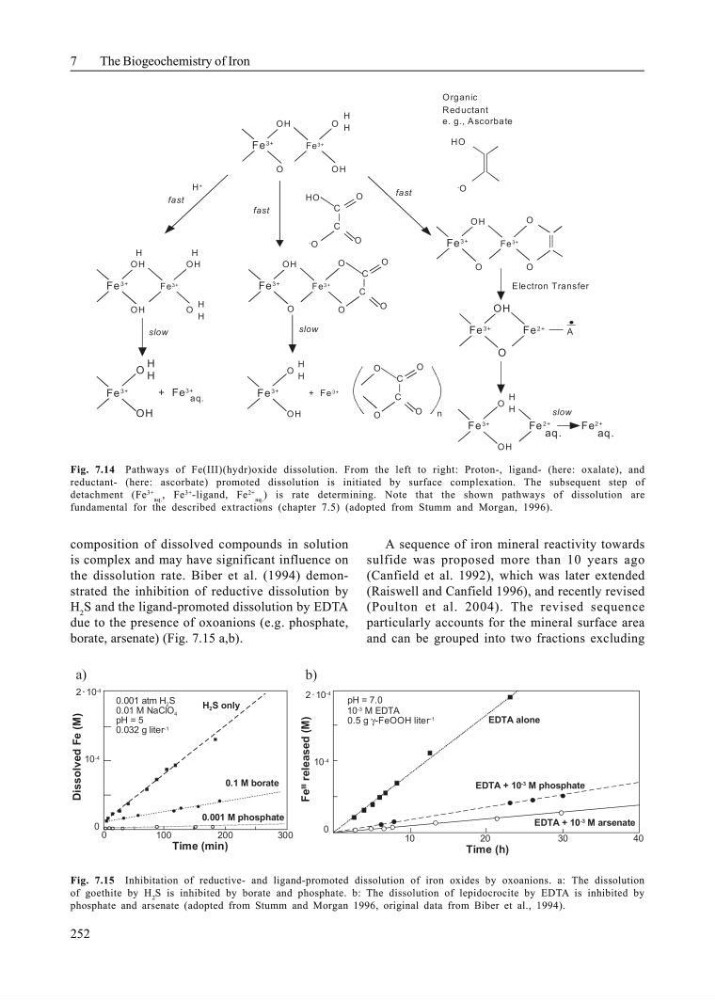
the dissolution rate. Biber et al. (1994) demonstrated the inhibition of reductive dissolution by
H 2 S and the ligand-promoted dissolution by EDTA
due to the presence of oxoanions (e.g. phosphate,
borate, arsenate) (Fig. 7.15 a,b).
A sequence of iron mineral reactivity towards
sulfide was proposed more than 10 years ago
(Canfield et al. 1992), which was later extended
(Raiswell and Canfield 1996), and recently revised
(Poulton et al. 2004). The revised sequence
particularly accounts for the mineral surface area
and can be grouped into two fractions excluding
2 10 -4
10 -4
0 0
100
200
300
Time (min)
Dissolved Fe (M)
H 2 S only
0.1 M borate
0.001 M phosphate
0.001 atm H 2 S
0.01 M NaClO 4
pH = 5
0.032 g liter -1
a)
pH = 7.0
10
-3 M EDTA
0.5 g γ-FeOOH liter
-1
10
20
30
40
EDTA + 10
-3 M arsenate
EDTA + 10
-3 M phosphate
EDTA alone
Time (h)
Fe III
released (M)
b)
2 10 -4
10 -4
0
Fig. 7.15 Inhibitation of reductive- and ligand-promoted dissolution of iron oxides by oxoanions. a: The dissolution
of goethite by H 2 S is inhibited by borate and phosphate. b: The dissolution of lepidocrocite by EDTA is inhibited by
phosphate and arsenate (adopted from Stumm and Morgan 1996, original data from Biber et al., 1994).
slow
fast
fast
A
Electron Transfer
H +
Organic
Red uctant
e. g., Ascorbate
Fe 3+
Fe
3+
OH
O
OH
OH
H
H
Fe
3+
O H
H
+ Fe
3+
OH
Fe 3+
Fe
3+
O
O
O
OH
O
C
O
C
- O
HO
O
C
O
C
Fe 3+
Fe
3+
O
OH
O
OH
H
H
Fe
3+
Fe
3+
O
O
O
OH
H
H
slow
Fe
3+
O H
H
+ Fe 3+
OH
O
O
O
C
O
C
n
Fe
3+
O H
H
OH
Fe
2+
aq.
aq.
Fe
2+
aq.
slow
Fe 2+
Fe 3+
O
OH
- O
HO
fast
Fig. 7.14 Pathways of Fe(III)(hydr)oxide dissolution. From the left to right: Proton-, ligand- (here: oxalate), and
reductant- (here: ascorbate) promoted dissolution is initiated by surface complexation. The subsequent step of
detachment (Fe
3+
aq.
, Fe
3+ -ligand, Fe
2+
aq.
) is rate determining. Note that the shown pathways of dissolution are
fundamental for the described extractions (chapter 7.5) (adopted from Stumm and Morgan, 1996).
The Biogeochemistry of Iron
252
composition of dissolved compounds in solution
is complex and may have significant influence on
the dissolution rate. Biber et al. (1994) demonstrated the inhibition of reductive dissolution by
H 2 S and the ligand-promoted dissolution by EDTA
due to the presence of oxoanions (e.g. phosphate,
borate, arsenate) (Fig. 7.15 a,b).
A sequence of iron mineral reactivity towards
sulfide was proposed more than 10 years ago
(Canfield et al. 1992), which was later extended
(Raiswell and Canfield 1996), and recently revised
(Poulton et al. 2004). The revised sequence
particularly accounts for the mineral surface area
and can be grouped into two fractions excluding
2 10 -4
10 -4
0 0
100
200
300
Time (min)
Dissolved Fe (M)
H 2 S only
0.1 M borate
0.001 M phosphate
0.001 atm H 2 S
0.01 M NaClO 4
pH = 5
0.032 g liter -1
a)
pH = 7.0
10
-3 M EDTA
0.5 g γ-FeOOH liter
-1
10
20
30
40
EDTA + 10
-3 M arsenate
EDTA + 10
-3 M phosphate
EDTA alone
Time (h)
Fe III
released (M)
b)
2 10 -4
10 -4
0
Fig. 7.15 Inhibitation of reductive- and ligand-promoted dissolution of iron oxides by oxoanions. a: The dissolution
of goethite by H 2 S is inhibited by borate and phosphate. b: The dissolution of lepidocrocite by EDTA is inhibited by
phosphate and arsenate (adopted from Stumm and Morgan 1996, original data from Biber et al., 1994).
slow
fast
fast
A
Electron Transfer
H +
Organic
Red uctant
e. g., Ascorbate
Fe 3+
Fe
3+
OH
O
OH
OH
H
H
Fe
3+
O H
H
+ Fe
3+
OH
Fe 3+
Fe
3+
O
O
O
OH
O
C
O
C
- O
HO
O
C
O
C
Fe 3+
Fe
3+
O
OH
O
OH
H
H
Fe
3+
Fe
3+
O
O
O
OH
H
H
slow
Fe
3+
O H
H
+ Fe 3+
OH
O
O
O
C
O
C
n
Fe
3+
O H
H
OH
Fe
2+
aq.
aq.
Fe
2+
aq.
slow
Fe 2+
Fe 3+
O
OH
- O
HO
fast
Fig. 7.14 Pathways of Fe(III)(hydr)oxide dissolution. From the left to right: Proton-, ligand- (here: oxalate), and
reductant- (here: ascorbate) promoted dissolution is initiated by surface complexation. The subsequent step of
detachment (Fe
3+
aq.
, Fe
3+ -ligand, Fe
2+
aq.
) is rate determining. Note that the shown pathways of dissolution are
fundamental for the described extractions (chapter 7.5) (adopted from Stumm and Morgan, 1996).