

7
The Biogeochemistry of Iron
254
surface complex was found to catalyze chemodenitrification (Sørensen and Thorling 1991). The
potential significance of microorganisms inducing
ferrous iron oxidation was pointed out within the
last years (Widdel et al. 1993; Straub et al. 1996).
Ferrous iron was found to serve as electron donor
in cultures of nitrate-reducing bacteria. Even in
the presence of acetate as typical electron donor
ferrous iron was additionally oxidized. This implies
that iron oxide formation typically occurring at the
interface of nitrate and iron bearing pore water is
at least in parts microbially mediated. Ehrenreich
and Widdel (1994) have described a microbial
mechanism of pure anaerobic oxidation by iron
oxidizing photoautotrophs. This exciting observation challenges the conviction that the earliest
iron oxidation on earth occurred during the buildup of free oxygen. One may now speculate that
the accumulation of the Banded Iron Formation
(Archaic age, ~ 3 billions years B.P.) was
microbiologically induced under suboxic/anoxic
conditions. Similarly, manganese oxidation rates in
natural environments were determined to be
considerably higher than determined in laboratory
studies under abiotic conditions implying a
microbially mediated manganese oxidation
(Thamdrup et al. 1994; Wehrli et al. 1995).
Ferrous iron oxidation by manganese oxide
was found to be especially fast as long as no iron
oxyhydroxide precipitates, which presumably
blocks reactive sites on the manganese oxide
surface (Postma 1985). The oxidation of ferrous
iron by manganese oxide has been proven to be
important for the interpretation of pore water
profiles and the precipitation of authigenic phases
(Canfield et al. 1993a; Haese et al. 2000; van der
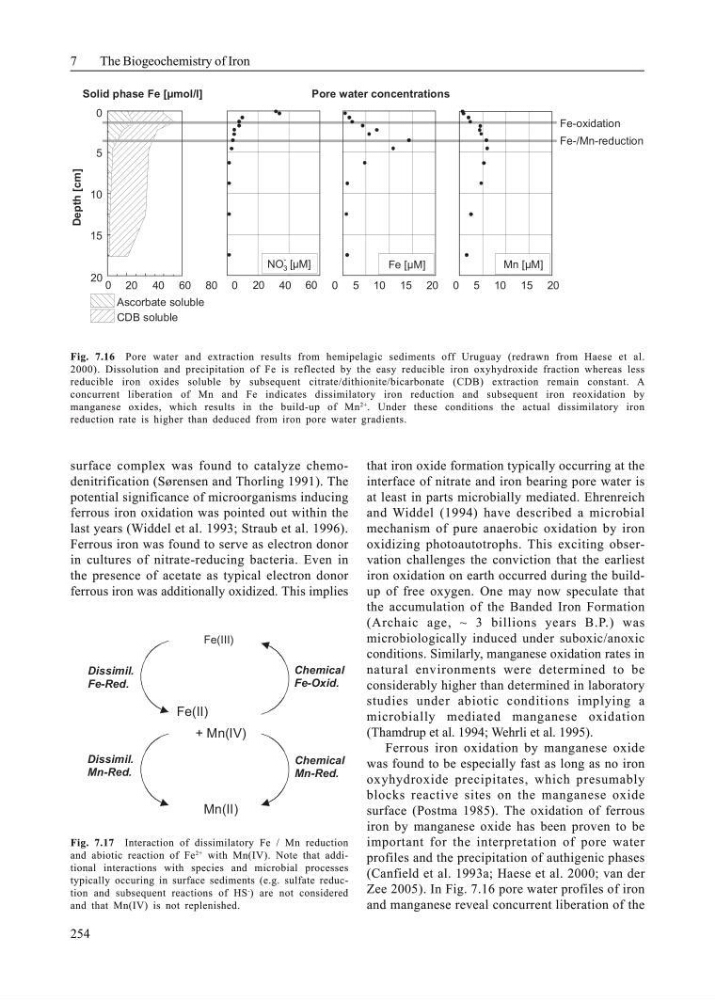
Zee 2005). In Fig. 7.16 pore water profiles of iron
and manganese reveal concurrent liberation of the
Pore water concentrations
Solid phase Fe [µmol/l]
0 20 40 60 80
0 5 10 15 20 0 5 10 15 20
0
5
10
15
20
0 20 40 60
Ascorbate soluble
CDB soluble
Fe-oxidation
Fe-/Mn-reduction
Depth [cm]
NO [µM]
3
-
Fe [µM]
Mn [µM]
Fig. 7.16 Pore water and extraction results from hemipelagic sediments off Uruguay (redrawn from Haese et al.
2000). Dissolution and precipitation of Fe is reflected by the easy reducible iron oxyhydroxide fraction whereas less
reducible iron oxides soluble by subsequent citrate/dithionite/bicarbonate (CDB) extraction remain constant. A
concurrent liberation of Mn and Fe indicates dissimilatory iron reduction and subsequent iron reoxidation by
manganese oxides, which results in the build-up of Mn
2+ . Under these conditions the actual dissimilatory iron
reduction rate is higher than deduced from iron pore water gradients.
Fe(III)
Fe(II)
+ Mn(IV)
Mn(II)
Dissimil.
Fe-Red.
Chemical
Fe-Oxid.
Chemical
Mn-Red.
Dissimil.
Mn-Red.
Fig. 7.17 Interaction of dissimilatory Fe / Mn reduction
and abiotic reaction of Fe
2+ with Mn(IV). Note that additional interactions with species and microbial processes
typically occuring in surface sediments (e.g. sulfate reduction and subsequent reactions of HS
- ) are not considered
and that Mn(IV) is not replenished.
The Biogeochemistry of Iron
254
surface complex was found to catalyze chemodenitrification (Sørensen and Thorling 1991). The
potential significance of microorganisms inducing
ferrous iron oxidation was pointed out within the
last years (Widdel et al. 1993; Straub et al. 1996).
Ferrous iron was found to serve as electron donor
in cultures of nitrate-reducing bacteria. Even in
the presence of acetate as typical electron donor
ferrous iron was additionally oxidized. This implies
that iron oxide formation typically occurring at the
interface of nitrate and iron bearing pore water is
at least in parts microbially mediated. Ehrenreich
and Widdel (1994) have described a microbial
mechanism of pure anaerobic oxidation by iron
oxidizing photoautotrophs. This exciting observation challenges the conviction that the earliest
iron oxidation on earth occurred during the buildup of free oxygen. One may now speculate that
the accumulation of the Banded Iron Formation
(Archaic age, ~ 3 billions years B.P.) was
microbiologically induced under suboxic/anoxic
conditions. Similarly, manganese oxidation rates in
natural environments were determined to be
considerably higher than determined in laboratory
studies under abiotic conditions implying a
microbially mediated manganese oxidation
(Thamdrup et al. 1994; Wehrli et al. 1995).
Ferrous iron oxidation by manganese oxide
was found to be especially fast as long as no iron
oxyhydroxide precipitates, which presumably
blocks reactive sites on the manganese oxide
surface (Postma 1985). The oxidation of ferrous
iron by manganese oxide has been proven to be
important for the interpretation of pore water
profiles and the precipitation of authigenic phases
(Canfield et al. 1993a; Haese et al. 2000; van der
Zee 2005). In Fig. 7.16 pore water profiles of iron
and manganese reveal concurrent liberation of the
Pore water concentrations
Solid phase Fe [µmol/l]
0 20 40 60 80
0 5 10 15 20 0 5 10 15 20
0
5
10
15
20
0 20 40 60
Ascorbate soluble
CDB soluble
Fe-oxidation
Fe-/Mn-reduction
Depth [cm]
NO [µM]
3
-
Fe [µM]
Mn [µM]
Fig. 7.16 Pore water and extraction results from hemipelagic sediments off Uruguay (redrawn from Haese et al.
2000). Dissolution and precipitation of Fe is reflected by the easy reducible iron oxyhydroxide fraction whereas less
reducible iron oxides soluble by subsequent citrate/dithionite/bicarbonate (CDB) extraction remain constant. A
concurrent liberation of Mn and Fe indicates dissimilatory iron reduction and subsequent iron reoxidation by
manganese oxides, which results in the build-up of Mn
2+ . Under these conditions the actual dissimilatory iron
reduction rate is higher than deduced from iron pore water gradients.
Fe(III)
Fe(II)
+ Mn(IV)
Mn(II)
Dissimil.
Fe-Red.
Chemical
Fe-Oxid.
Chemical
Mn-Red.
Dissimil.
Mn-Red.
Fig. 7.17 Interaction of dissimilatory Fe / Mn reduction
and abiotic reaction of Fe
2+ with Mn(IV). Note that additional interactions with species and microbial processes
typically occuring in surface sediments (e.g. sulfate reduction and subsequent reactions of HS
- ) are not considered
and that Mn(IV) is not replenished.