

249
Taylor (1961) found a maximum of one-third mole
percent Al substitution for Fe within goethite
and a maximum of one-sixth substitution was
determined for hematite in soils (Schwertmann et
al. 1979). As a product of terrestrial weathering
magnetites usually contain minor amounts of
Ti(IV) (ionic radius: 0.69 Å) as a substitution for
Fe which is then called titano-magnetite. In
contrast, bio-mineralized magnetite is a pure iron
oxide. Different colors of iron oxides / oxyhydroxide are immediately apparent in nature. This
holds true for different pure iron oxides, for different grain sizes of one oxide (e.g. goethite) as
well as for distinct substitutions for Fe, e.g. by
Mn or Cr (Schwertmann and Cornell 1991). The
color of synthetic minerals and natural sediment
can be quantitatively determined by reflectance
spectroscopy (e.g. Morris et al. 1985).
In the presence of water the surface of an iron
oxide is completely hydroxylated which can be
understood as a two-step reaction which is
shown schematically in Fig. 7.11.
As iron oxides / oxyhydroxide have a very
high affinity for the adsorption of anions as well
as cations under natural conditions the early
diagenetic reactivity of iron is often of great
significance for the behavior of compounds such
as trace metals, phosphate and organic acids.
The adsorption on iron oxides is caused by the
hydroxylation of the mineral surface (S-OH).
Depending on the pH of ambient water protonation
or deprotonation occurs according to
S-OH + H + ⇔
S-OH 2
+
(7.6)
S-OH + OH - ⇔
S-O - + H 2 O
(7.7)
As a result, the surface charge and the
surface potential vary depending on the concentration of H
+
ions in solution. Apart from the pH
the surface charge is influenced by the concentration of the electrolyte and the valence of ions
in solution. pH-values where the net surface
charge is zero are called points of zero charge
(pzc). For pure synthetic iron oxides these vary
between a pH of 7 and 9. An excess of positive or
negative charge is balanced by the equivalent
amount of anions or cations. As representative
for the adsorption of cations (Cu
2+
), anions
(H 2 PO 4
-
) and organic compounds (oxalate) the
following reactions are given:
(7.8)
(7.9)
(7.10)
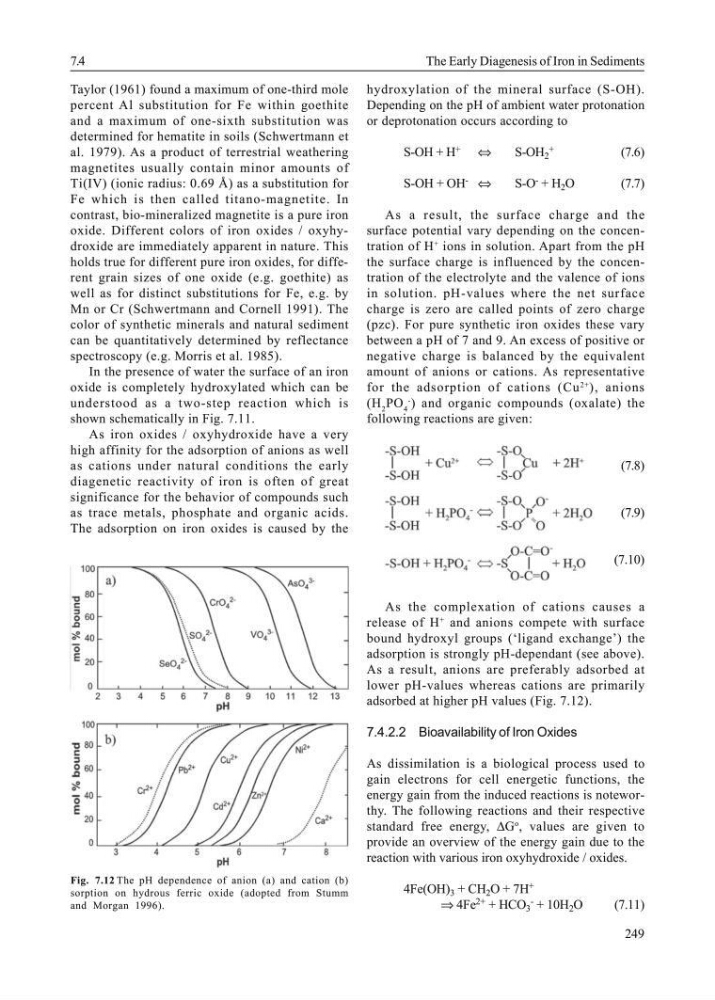
As the complexation of cations causes a
release of H
+
and anions compete with surface
bound hydroxyl groups (‘ligand exchange’) the
adsorption is strongly pH-dependant (see above).
As a result, anions are preferably adsorbed at
lower pH-values whereas cations are primarily
adsorbed at higher pH values (Fig. 7.12).
7.4.2.2 Bioavailability of Iron Oxides
As dissimilation is a biological process used to
gain electrons for cell energetic functions, the
energy gain from the induced reactions is noteworthy. The following reactions and their respective
standard free energy, ∆G
o
, values are given to
provide an overview of the energy gain due to the
reaction with various iron oxyhydroxide / oxides.
4Fe(OH) 3 + CH 2 O + 7H +
⇒ 4Fe 2+ + HCO 3
- + 10H 2 O
(7.11)
7.4
The Early Diagenesis of Iron in Sediments
Fig. 7.12 The pH dependence of anion (a) and cation (b)
sorption on hydrous ferric oxide (adopted from Stumm
and Morgan 1996).
Taylor (1961) found a maximum of one-third mole
percent Al substitution for Fe within goethite
and a maximum of one-sixth substitution was
determined for hematite in soils (Schwertmann et
al. 1979). As a product of terrestrial weathering
magnetites usually contain minor amounts of
Ti(IV) (ionic radius: 0.69 Å) as a substitution for
Fe which is then called titano-magnetite. In
contrast, bio-mineralized magnetite is a pure iron
oxide. Different colors of iron oxides / oxyhydroxide are immediately apparent in nature. This
holds true for different pure iron oxides, for different grain sizes of one oxide (e.g. goethite) as
well as for distinct substitutions for Fe, e.g. by
Mn or Cr (Schwertmann and Cornell 1991). The
color of synthetic minerals and natural sediment
can be quantitatively determined by reflectance
spectroscopy (e.g. Morris et al. 1985).
In the presence of water the surface of an iron
oxide is completely hydroxylated which can be
understood as a two-step reaction which is
shown schematically in Fig. 7.11.
As iron oxides / oxyhydroxide have a very
high affinity for the adsorption of anions as well
as cations under natural conditions the early
diagenetic reactivity of iron is often of great
significance for the behavior of compounds such
as trace metals, phosphate and organic acids.
The adsorption on iron oxides is caused by the
hydroxylation of the mineral surface (S-OH).
Depending on the pH of ambient water protonation
or deprotonation occurs according to
S-OH + H + ⇔
S-OH 2
+
(7.6)
S-OH + OH - ⇔
S-O - + H 2 O
(7.7)
As a result, the surface charge and the
surface potential vary depending on the concentration of H
+
ions in solution. Apart from the pH
the surface charge is influenced by the concentration of the electrolyte and the valence of ions
in solution. pH-values where the net surface
charge is zero are called points of zero charge
(pzc). For pure synthetic iron oxides these vary
between a pH of 7 and 9. An excess of positive or
negative charge is balanced by the equivalent
amount of anions or cations. As representative
for the adsorption of cations (Cu
2+
), anions
(H 2 PO 4
-
) and organic compounds (oxalate) the
following reactions are given:
(7.8)
(7.9)
(7.10)
As the complexation of cations causes a
release of H
+
and anions compete with surface
bound hydroxyl groups (‘ligand exchange’) the
adsorption is strongly pH-dependant (see above).
As a result, anions are preferably adsorbed at
lower pH-values whereas cations are primarily
adsorbed at higher pH values (Fig. 7.12).
7.4.2.2 Bioavailability of Iron Oxides
As dissimilation is a biological process used to
gain electrons for cell energetic functions, the
energy gain from the induced reactions is noteworthy. The following reactions and their respective
standard free energy, ∆G
o
, values are given to
provide an overview of the energy gain due to the
reaction with various iron oxyhydroxide / oxides.
4Fe(OH) 3 + CH 2 O + 7H +
⇒ 4Fe 2+ + HCO 3
- + 10H 2 O
(7.11)
7.4
The Early Diagenesis of Iron in Sediments
Fig. 7.12 The pH dependence of anion (a) and cation (b)
sorption on hydrous ferric oxide (adopted from Stumm
and Morgan 1996).