

7
The Biogeochemistry of Iron
248
compounds through the activity of hydrolytic
enzymes which are produced by a variety of
microorganisms. Subsequently, these intermediate
products can be used for the dissimilatory ferric
iron reduction.
7.4.2
Solid Phase Ferric Iron and its
Bioavailability
Solid phase ferric iron is present in various iron
bearing minerals and amorphous phases of marine
sediments. Two major groups can be distinguished: Iron oxyhydroxides (including iron
oxides) and (sheet) silicates. As the iron bearing
mineral assemblage varies considerably among
different depositional environments the microbiological availability of specific Fe(III)-bearing
compounds can be highly variable.
7.4.2.1 Properties of Iron Oxides
During terrestrial weathering a minor amount of
the released iron from silicates (biotite, pyroxene,
amphibole, olivine) is incorporated into clay
minerals and a major fraction serves for the
formation of iron oxides. Among iron oxides
goethite (α-FeOOH) and hematite (α-Fe 2 O 3 ) are
the most abundant and are mostly associated
with each other. Lepidocrocite (γ-FeOOH), maghemite (γ-Fe 2 O 3 ) and magnetite (Fe
2+
Fe 2
3+
O 4 ) are
generally quantitatively less abundant. Yet, with
respect to the magnetization of the sediment
magnetite and maghemite are of great importance
due to their ferrimagnetic character (chapter 2).
Iron phases precipitating from solution are
collectively called iron oxyhydroxide. By means
of mineralogical identification methods (X-ray
diffraction, infrared and Mössbauer spectroscopy) the precipitate may be completely amorphous representing a ferric gel or it may be a
poorly crystallized, water containing phase such
as ferrihydrite (5Fe 2 O 3 ·9H 2 O). Formerly this
fraction was called ‘amorphous Fe(III)hydroxide’
(Böhm 1925). Aging causes these earliest precipitates to increase their crystallinity, which
means an increase in the ordering of the crystal
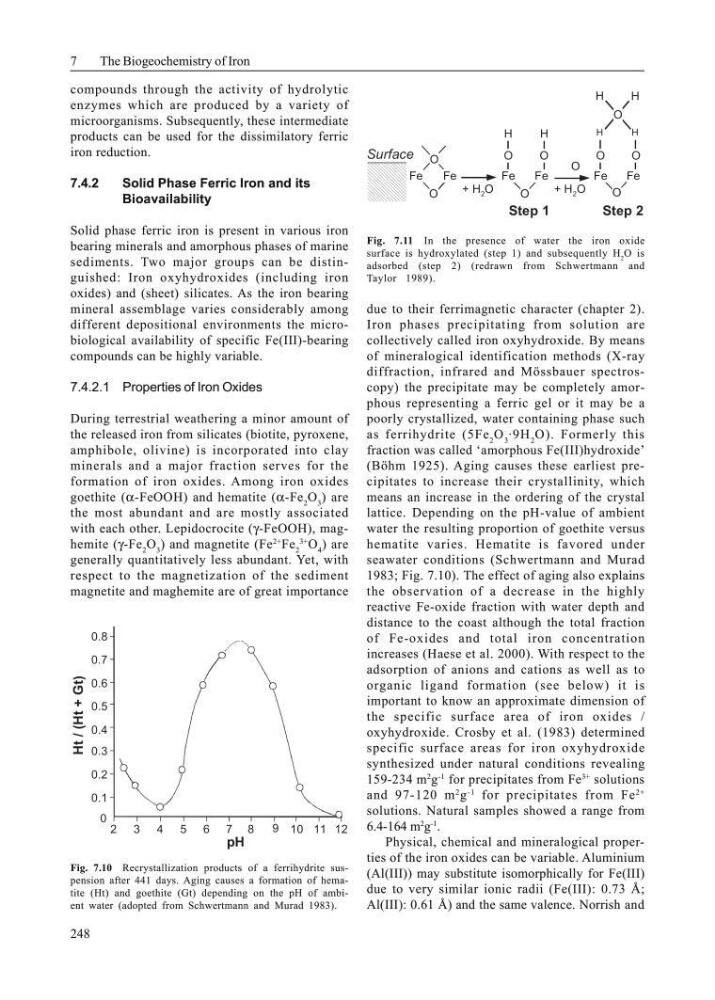
lattice. Depending on the pH-value of ambient
water the resulting proportion of goethite versus
hematite varies. Hematite is favored under
seawater conditions (Schwertmann and Murad
1983; Fig. 7.10). The effect of aging also explains
the observation of a decrease in the highly
reactive Fe-oxide fraction with water depth and
distance to the coast although the total fraction
of Fe-oxides and total iron concentration
increases (Haese et al. 2000). With respect to the
adsorption of anions and cations as well as to
organic ligand formation (see below) it is
important to know an approximate dimension of
the specific surface area of iron oxides /
oxyhydroxide. Crosby et al. (1983) determined
specific surface areas for iron oxyhydroxide
synthesized under natural conditions revealing
159-234 m
2
g
-1
for precipitates from Fe
3+
solutions
and 97-120 m
2
g
-1
for precipitates from Fe
2+
solutions. Natural samples showed a range from
6.4-164 m
2
g
-1
.
Physical, chemical and mineralogical properties of the iron oxides can be variable. Aluminium
(Al(III)) may substitute isomorphically for Fe(III)
due to very similar ionic radii (Fe(III): 0.73 Å;
Al(III): 0.61 Å) and the same valence. Norrish and
Fig. 7.10 Recrystallization products of a ferrihydrite suspension after 441 days. Aging causes a formation of hematite (Ht) and goethite (Gt) depending on the pH of ambient water (adopted from Schwertmann and Murad 1983).
Fig. 7.11 In the presence of water the iron oxide
surface is hydroxylated (step 1) and subsequently H 2 O is
adsorbed (step 2) (redrawn from Schwertmann and
Taylor 1989).
2 3 4 5 6 7 8
9 10 11 12
0.8
0.7
0.6
0.5
0.4
0.3
0.2
0.1
0
pH
Ht / (Ht + Gt)
Step 1
Step 2
O
H
Fe
+ H 2 O
O
O
O
O
+ H 2 O
Fe
Fe
Fe
Fe
Fe
O
O
O
O
O
H
H
H
Surface
H
H
The Biogeochemistry of Iron
248
compounds through the activity of hydrolytic
enzymes which are produced by a variety of
microorganisms. Subsequently, these intermediate
products can be used for the dissimilatory ferric
iron reduction.
7.4.2
Solid Phase Ferric Iron and its
Bioavailability
Solid phase ferric iron is present in various iron
bearing minerals and amorphous phases of marine
sediments. Two major groups can be distinguished: Iron oxyhydroxides (including iron
oxides) and (sheet) silicates. As the iron bearing
mineral assemblage varies considerably among
different depositional environments the microbiological availability of specific Fe(III)-bearing
compounds can be highly variable.
7.4.2.1 Properties of Iron Oxides
During terrestrial weathering a minor amount of
the released iron from silicates (biotite, pyroxene,
amphibole, olivine) is incorporated into clay
minerals and a major fraction serves for the
formation of iron oxides. Among iron oxides
goethite (α-FeOOH) and hematite (α-Fe 2 O 3 ) are
the most abundant and are mostly associated
with each other. Lepidocrocite (γ-FeOOH), maghemite (γ-Fe 2 O 3 ) and magnetite (Fe
2+
Fe 2
3+
O 4 ) are
generally quantitatively less abundant. Yet, with
respect to the magnetization of the sediment
magnetite and maghemite are of great importance
due to their ferrimagnetic character (chapter 2).
Iron phases precipitating from solution are
collectively called iron oxyhydroxide. By means
of mineralogical identification methods (X-ray
diffraction, infrared and Mössbauer spectroscopy) the precipitate may be completely amorphous representing a ferric gel or it may be a
poorly crystallized, water containing phase such
as ferrihydrite (5Fe 2 O 3 ·9H 2 O). Formerly this
fraction was called ‘amorphous Fe(III)hydroxide’
(Böhm 1925). Aging causes these earliest precipitates to increase their crystallinity, which
means an increase in the ordering of the crystal
lattice. Depending on the pH-value of ambient
water the resulting proportion of goethite versus
hematite varies. Hematite is favored under
seawater conditions (Schwertmann and Murad
1983; Fig. 7.10). The effect of aging also explains
the observation of a decrease in the highly
reactive Fe-oxide fraction with water depth and
distance to the coast although the total fraction
of Fe-oxides and total iron concentration
increases (Haese et al. 2000). With respect to the
adsorption of anions and cations as well as to
organic ligand formation (see below) it is
important to know an approximate dimension of
the specific surface area of iron oxides /
oxyhydroxide. Crosby et al. (1983) determined
specific surface areas for iron oxyhydroxide
synthesized under natural conditions revealing
159-234 m
2
g
-1
for precipitates from Fe
3+
solutions
and 97-120 m
2
g
-1
for precipitates from Fe
2+
solutions. Natural samples showed a range from
6.4-164 m
2
g
-1
.
Physical, chemical and mineralogical properties of the iron oxides can be variable. Aluminium
(Al(III)) may substitute isomorphically for Fe(III)
due to very similar ionic radii (Fe(III): 0.73 Å;
Al(III): 0.61 Å) and the same valence. Norrish and
Fig. 7.10 Recrystallization products of a ferrihydrite suspension after 441 days. Aging causes a formation of hematite (Ht) and goethite (Gt) depending on the pH of ambient water (adopted from Schwertmann and Murad 1983).
Fig. 7.11 In the presence of water the iron oxide
surface is hydroxylated (step 1) and subsequently H 2 O is
adsorbed (step 2) (redrawn from Schwertmann and
Taylor 1989).
2 3 4 5 6 7 8
9 10 11 12
0.8
0.7
0.6
0.5
0.4
0.3
0.2
0.1
0
pH
Ht / (Ht + Gt)
Step 1
Step 2
O
H
Fe
+ H 2 O
O
O
O
O
+ H 2 O
Fe
Fe
Fe
Fe
Fe
O
O
O
O
O
H
H
H
Surface
H
H