

247
7.4.1
Dissimilatory Iron Reduction
Iron (and manganese) can be reduced enzymatically by various pathways, which are summarized in great detail by Lovley (1991). One of the
prerequisites is the direct contact between the
bacteria and solid phase ferric iron (Munch and
Ottow 1982). The following given equations shall
be considered as representative for a series of
reactions within each group.
1. Fermentative Fe 3+ -reduction:
C 6 H 12 O 6 + 24Fe 3+ + 12H 2 O
⇒ 6HCO 3
- + 24Fe 2+ + 30H +
(7.1)
2. Sulfur-oxidizing Fe 3+ -reduction:
S 0 + 6Fe 3+ + 4H 2 O
⇒ HSO 4
- + 6Fe 2+ + 7H +
(7.2)
3. Hydrogen-oxidizing Fe 3+ -reduction:
H 2 + 2Fe 3+ ⇒ 2H + + 2Fe 2+
(7.3)
4. Organic-acid-oxidizing Fe 3+ -reduction:
acetate - + 8Fe 3+ + 4H 2 O
⇒ 2HCO 3
- + 8Fe 2+ + 9H +
(7.4)
5. Aromatic-compound-oxidizing Fe 3+ -reduction:
phenol + 28Fe 3+ + 17H 2 O
⇒ 6HCO 3
- + 28Fe 2+ + 34H +
(7.5)
For the case of fermentative Fe(III)-reduction it is
important to note that during fermentation Fe(III)
only serves as a minor sink for electrons and that
organic substrates are primarily transformed to
organic acids or alcohols.
A review of organisms reducing Fe(III), the
respective electron donors and the applied forms
of Fe(III) is given by Lovley (1987) and Lovley et
al. (1997). In Figure 7.8 a typical result of ferric
iron reduction mediated by a distinct ferric iron
reducing bacteria (i.e. Geobacter metallireducens)
and an appropriate electron donor (i.e. acetate) is
shown. Note that the reproduction (cell numbers)
ceases although acetate and ferric iron are still
present. This is a general observation, which is
explained by the limited bioavailability of the ferric
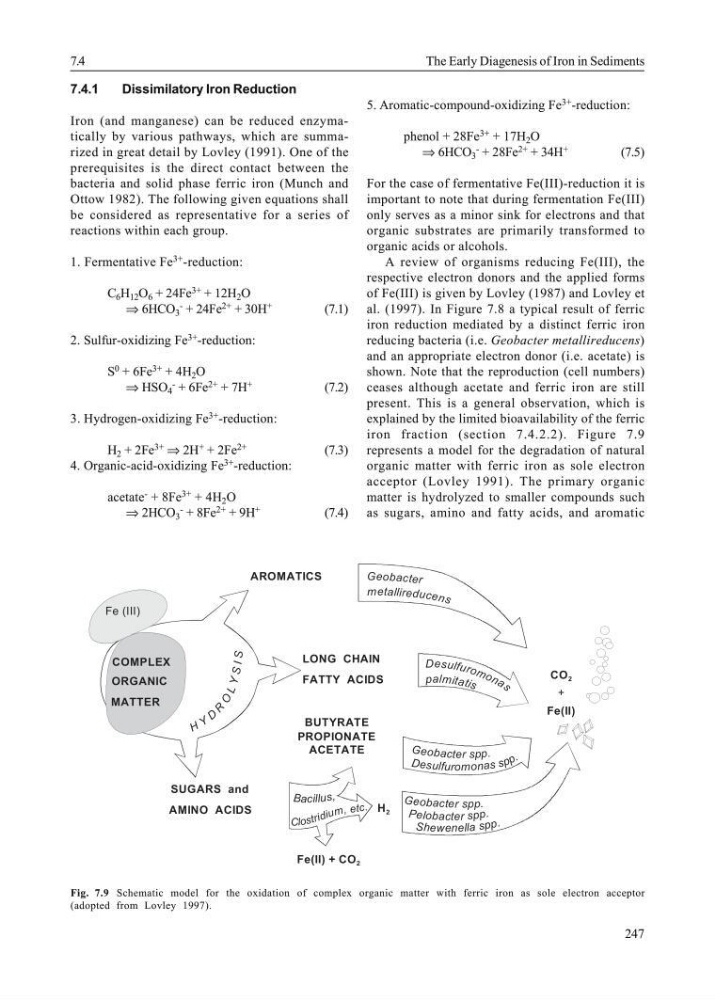
iron fraction (section 7.4.2.2). Figure 7.9
represents a model for the degradation of natural
organic matter with ferric iron as sole electron
acceptor (Lovley 1991). The primary organic
matter is hydrolyzed to smaller compounds such
as sugars, amino and fatty acids, and aromatic
7.4
The Early Diagenesis of Iron in Sediments
Fe (III)
COMPLEX
ORGANIC
MATTER
AROMATICS
LONG CHAIN
FATTY ACIDS
SUGARS and
AMINO ACIDS
BUTYRATE
PROPIONATE
ACETATE
H 2
Fe(II) + CO 2
metallire du ce n s
Geoba cte r
Desu lfu ro m o n a s
palmit at is
De sul furomonas s p p .
G eo bac ter spp.
Ge oba cter spp.
Pe lobacter spp .
She wenella sp p .
CO 2
+
Fe(II)
Clos tr id iu m , et c.
Bacillus ,
H Y
D
R
O
L Y S I S
Fig. 7.9 Schematic model for the oxidation of complex organic matter with ferric iron as sole electron acceptor
(adopted from Lovley 1997).
7.4.1
Dissimilatory Iron Reduction
Iron (and manganese) can be reduced enzymatically by various pathways, which are summarized in great detail by Lovley (1991). One of the
prerequisites is the direct contact between the
bacteria and solid phase ferric iron (Munch and
Ottow 1982). The following given equations shall
be considered as representative for a series of
reactions within each group.
1. Fermentative Fe 3+ -reduction:
C 6 H 12 O 6 + 24Fe 3+ + 12H 2 O
⇒ 6HCO 3
- + 24Fe 2+ + 30H +
(7.1)
2. Sulfur-oxidizing Fe 3+ -reduction:
S 0 + 6Fe 3+ + 4H 2 O
⇒ HSO 4
- + 6Fe 2+ + 7H +
(7.2)
3. Hydrogen-oxidizing Fe 3+ -reduction:
H 2 + 2Fe 3+ ⇒ 2H + + 2Fe 2+
(7.3)
4. Organic-acid-oxidizing Fe 3+ -reduction:
acetate - + 8Fe 3+ + 4H 2 O
⇒ 2HCO 3
- + 8Fe 2+ + 9H +
(7.4)
5. Aromatic-compound-oxidizing Fe 3+ -reduction:
phenol + 28Fe 3+ + 17H 2 O
⇒ 6HCO 3
- + 28Fe 2+ + 34H +
(7.5)
For the case of fermentative Fe(III)-reduction it is
important to note that during fermentation Fe(III)
only serves as a minor sink for electrons and that
organic substrates are primarily transformed to
organic acids or alcohols.
A review of organisms reducing Fe(III), the
respective electron donors and the applied forms
of Fe(III) is given by Lovley (1987) and Lovley et
al. (1997). In Figure 7.8 a typical result of ferric
iron reduction mediated by a distinct ferric iron
reducing bacteria (i.e. Geobacter metallireducens)
and an appropriate electron donor (i.e. acetate) is
shown. Note that the reproduction (cell numbers)
ceases although acetate and ferric iron are still
present. This is a general observation, which is
explained by the limited bioavailability of the ferric
iron fraction (section 7.4.2.2). Figure 7.9
represents a model for the degradation of natural
organic matter with ferric iron as sole electron
acceptor (Lovley 1991). The primary organic
matter is hydrolyzed to smaller compounds such
as sugars, amino and fatty acids, and aromatic
7.4
The Early Diagenesis of Iron in Sediments
Fe (III)
COMPLEX
ORGANIC
MATTER
AROMATICS
LONG CHAIN
FATTY ACIDS
SUGARS and
AMINO ACIDS
BUTYRATE
PROPIONATE
ACETATE
H 2
Fe(II) + CO 2
metallire du ce n s
Geoba cte r
Desu lfu ro m o n a s
palmit at is
De sul furomonas s p p .
G eo bac ter spp.
Ge oba cter spp.
Pe lobacter spp .
She wenella sp p .
CO 2
+
Fe(II)
Clos tr id iu m , et c.
Bacillus ,
H Y
D
R
O
L Y S I S
Fig. 7.9 Schematic model for the oxidation of complex organic matter with ferric iron as sole electron acceptor
(adopted from Lovley 1997).