

245
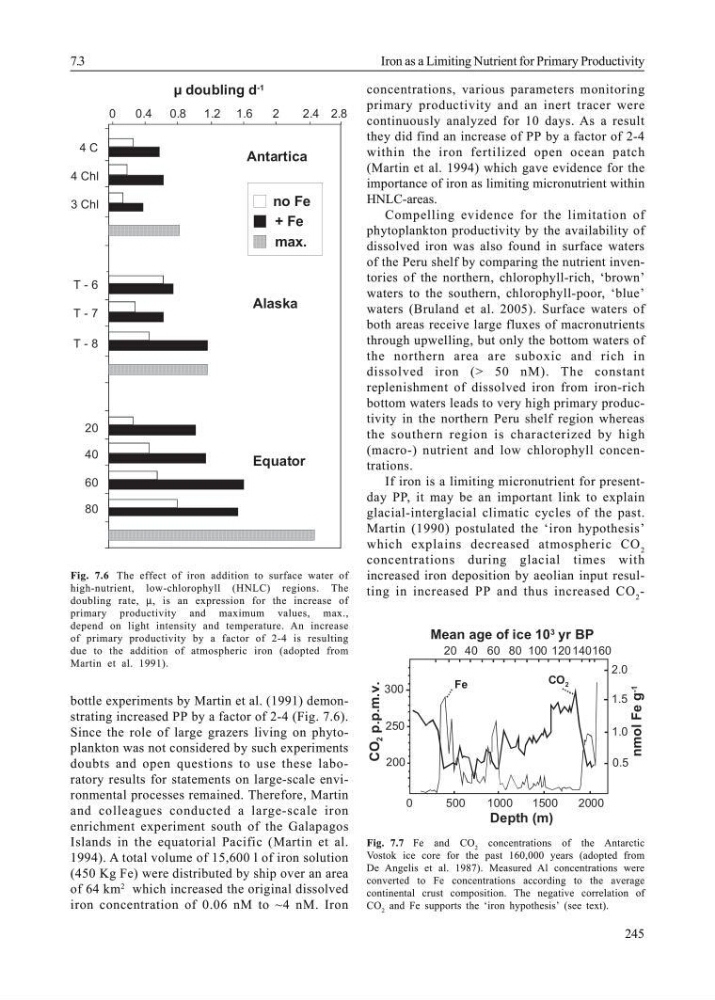
bottle experiments by Martin et al. (1991) demonstrating increased PP by a factor of 2-4 (Fig. 7.6).
Since the role of large grazers living on phytoplankton was not considered by such experiments
doubts and open questions to use these laboratory results for statements on large-scale environmental processes remained. Therefore, Martin
and colleagues conducted a large-scale iron
enrichment experiment south of the Galapagos
Islands in the equatorial Pacific (Martin et al.
1994). A total volume of 15,600 l of iron solution
(450 Kg Fe) were distributed by ship over an area
of 64 km
2
which increased the original dissolved
iron concentration of 0.06 nM to ~4 nM. Iron
concentrations, various parameters monitoring
primary productivity and an inert tracer were
continuously analyzed for 10 days. As a result
they did find an increase of PP by a factor of 2-4
within the iron fertilized open ocean patch
(Martin et al. 1994) which gave evidence for the
importance of iron as limiting micronutrient within
HNLC-areas.
Compelling evidence for the limitation of
phytoplankton productivity by the availability of
dissolved iron was also found in surface waters
of the Peru shelf by comparing the nutrient inventories of the northern, chlorophyll-rich, ‘brown’
waters to the southern, chlorophyll-poor, ‘blue’
waters (Bruland et al. 2005). Surface waters of
both areas receive large fluxes of macronutrients
through upwelling, but only the bottom waters of
the northern area are suboxic and rich in
dissolved iron (> 50 nM). The constant
replenishment of dissolved iron from iron-rich
bottom waters leads to very high primary productivity in the northern Peru shelf region whereas
the southern region is characterized by high
(macro-) nutrient and low chlorophyll concentrations.
If iron is a limiting micronutrient for presentday PP, it may be an important link to explain
glacial-interglacial climatic cycles of the past.
Martin (1990) postulated the ‘iron hypothesis’
which explains decreased atmospheric CO 2
concentrations during glacial times with
increased iron deposition by aeolian input resulting in increased PP and thus increased CO 2 -
Fig. 7.7 Fe and CO 2 concentrations of the Antarctic
Vostok ice core for the past 160,000 years (adopted from
De Angelis et al. 1987). Measured Al concentrations were
converted to Fe concentrations according to the average
continental crust composition. The negative correlation of
CO 2 and Fe supports the ‘iron hypothesis’ (see text).
Fig. 7.6 The effect of iron addition to surface water of
high-nutrient, low-chlorophyll (HNLC) regions. The
doubling rate, µ, is an expression for the increase of
primary productivity and maximum values, max.,
depend on light intensity and temperature. An increase
of primary productivity by a factor of 2-4 is resulting
due to the addition of atmospheric iron (adopted from
Martin et al. 1991).
7.3
Iron as a Limiting Nutrient for Primary Productivity
µ doubling d -1
Antartica
Alaska
Equator
80
60
40
20
T - 8
T - 7
T - 6
3 Chl
4 Chl
4 C
0
0.4
0.8
1.2 1.6
2
2.4 2.8
no Fe
+ Fe
max.
Mean age of ice 10
3
yr BP
CO
2 p.p.m.v.
Depth (m)
nmol Fe g
-1
CO 2
Fe
0
500
1000
1500
2000
0.5
1.0
1.5
2.0
200
250
300
20 40 60 80 100 120 140160
bottle experiments by Martin et al. (1991) demonstrating increased PP by a factor of 2-4 (Fig. 7.6).
Since the role of large grazers living on phytoplankton was not considered by such experiments
doubts and open questions to use these laboratory results for statements on large-scale environmental processes remained. Therefore, Martin
and colleagues conducted a large-scale iron
enrichment experiment south of the Galapagos
Islands in the equatorial Pacific (Martin et al.
1994). A total volume of 15,600 l of iron solution
(450 Kg Fe) were distributed by ship over an area
of 64 km
2
which increased the original dissolved
iron concentration of 0.06 nM to ~4 nM. Iron
concentrations, various parameters monitoring
primary productivity and an inert tracer were
continuously analyzed for 10 days. As a result
they did find an increase of PP by a factor of 2-4
within the iron fertilized open ocean patch
(Martin et al. 1994) which gave evidence for the
importance of iron as limiting micronutrient within
HNLC-areas.
Compelling evidence for the limitation of
phytoplankton productivity by the availability of
dissolved iron was also found in surface waters
of the Peru shelf by comparing the nutrient inventories of the northern, chlorophyll-rich, ‘brown’
waters to the southern, chlorophyll-poor, ‘blue’
waters (Bruland et al. 2005). Surface waters of
both areas receive large fluxes of macronutrients
through upwelling, but only the bottom waters of
the northern area are suboxic and rich in
dissolved iron (> 50 nM). The constant
replenishment of dissolved iron from iron-rich
bottom waters leads to very high primary productivity in the northern Peru shelf region whereas
the southern region is characterized by high
(macro-) nutrient and low chlorophyll concentrations.
If iron is a limiting micronutrient for presentday PP, it may be an important link to explain
glacial-interglacial climatic cycles of the past.
Martin (1990) postulated the ‘iron hypothesis’
which explains decreased atmospheric CO 2
concentrations during glacial times with
increased iron deposition by aeolian input resulting in increased PP and thus increased CO 2 -
Fig. 7.7 Fe and CO 2 concentrations of the Antarctic
Vostok ice core for the past 160,000 years (adopted from
De Angelis et al. 1987). Measured Al concentrations were
converted to Fe concentrations according to the average
continental crust composition. The negative correlation of
CO 2 and Fe supports the ‘iron hypothesis’ (see text).
Fig. 7.6 The effect of iron addition to surface water of
high-nutrient, low-chlorophyll (HNLC) regions. The
doubling rate, µ, is an expression for the increase of
primary productivity and maximum values, max.,
depend on light intensity and temperature. An increase
of primary productivity by a factor of 2-4 is resulting
due to the addition of atmospheric iron (adopted from
Martin et al. 1991).
7.3
Iron as a Limiting Nutrient for Primary Productivity
µ doubling d -1
Antartica
Alaska
Equator
80
60
40
20
T - 8
T - 7
T - 6
3 Chl
4 Chl
4 C
0
0.4
0.8
1.2 1.6
2
2.4 2.8
no Fe
+ Fe
max.
Mean age of ice 10
3
yr BP
CO
2 p.p.m.v.
Depth (m)
nmol Fe g
-1
CO 2
Fe
0
500
1000
1500
2000
0.5
1.0
1.5
2.0
200
250
300
20 40 60 80 100 120 140160