

7
The Biogeochemistry of Iron
244
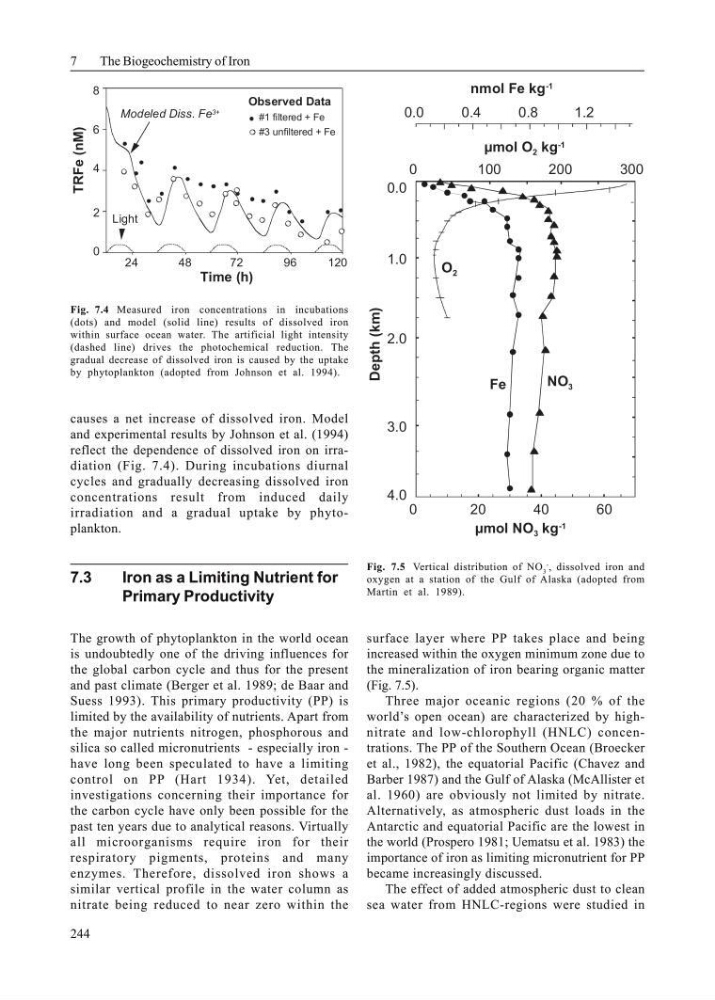
causes a net increase of dissolved iron. Model
and experimental results by Johnson et al. (1994)
reflect the dependence of dissolved iron on irradiation (Fig. 7.4). During incubations diurnal
cycles and gradually decreasing dissolved iron
concentrations result from induced daily
irradiation and a gradual uptake by phytoplankton.
7.3
Iron as a Limiting Nutrient for
Primary Productivity
The growth of phytoplankton in the world ocean
is undoubtedly one of the driving influences for
the global carbon cycle and thus for the present
and past climate (Berger et al. 1989; de Baar and
Suess 1993). This primary productivity (PP) is
limited by the availability of nutrients. Apart from
the major nutrients nitrogen, phosphorous and
silica so called micronutrients - especially iron -
have long been speculated to have a limiting
control on PP (Hart 1934). Yet, detailed
investigations concerning their importance for
the carbon cycle have only been possible for the
past ten years due to analytical reasons. Virtually
all microorganisms require iron for their
respiratory pigments, proteins and many
enzymes. Therefore, dissolved iron shows a
similar vertical profile in the water column as
nitrate being reduced to near zero within the
surface layer where PP takes place and being
increased within the oxygen minimum zone due to
the mineralization of iron bearing organic matter
(Fig. 7.5).
Three major oceanic regions (20 % of the
world’s open ocean) are characterized by highnitrate and low-chlorophyll (HNLC) concentrations. The PP of the Southern Ocean (Broecker
et al., 1982), the equatorial Pacific (Chavez and
Barber 1987) and the Gulf of Alaska (McAllister et
al. 1960) are obviously not limited by nitrate.
Alternatively, as atmospheric dust loads in the
Antarctic and equatorial Pacific are the lowest in
the world (Prospero 1981; Uematsu et al. 1983) the
importance of iron as limiting micronutrient for PP
became increasingly discussed.
The effect of added atmospheric dust to clean
sea water from HNLC-regions were studied in
Fig. 7.5 Vertical distribution of NO 3
- , dissolved iron and
oxygen at a station of the Gulf of Alaska (adopted from
Martin et al. 1989).
µmol O 2 kg -1
Depth (km)
µmol NO 3 kg -1
nmol Fe kg
-1
0.0
1.0
2.0
3.0
4.0
0.0
0.4
0.8
1.2
300
200
100
0
0
2 0
4 0
6 0
Fe
NO 3
O 2
Modeled Diss. Fe 3+
Observed Data
#1 filtered + Fe
#3 unfiltered + Fe
120
96
72
48
24
0
2
4
6
8
Time (h)
TRFe (nM)
Light
Fig. 7.4 Measured iron concentrations in incubations
(dots) and model (solid line) results of dissolved iron
within surface ocean water. The artificial light intensity
(dashed line) drives the photochemical reduction. The
gradual decrease of dissolved iron is caused by the uptake
by phytoplankton (adopted from Johnson et al. 1994).
The Biogeochemistry of Iron
244
causes a net increase of dissolved iron. Model
and experimental results by Johnson et al. (1994)
reflect the dependence of dissolved iron on irradiation (Fig. 7.4). During incubations diurnal
cycles and gradually decreasing dissolved iron
concentrations result from induced daily
irradiation and a gradual uptake by phytoplankton.
7.3
Iron as a Limiting Nutrient for
Primary Productivity
The growth of phytoplankton in the world ocean
is undoubtedly one of the driving influences for
the global carbon cycle and thus for the present
and past climate (Berger et al. 1989; de Baar and
Suess 1993). This primary productivity (PP) is
limited by the availability of nutrients. Apart from
the major nutrients nitrogen, phosphorous and
silica so called micronutrients - especially iron -
have long been speculated to have a limiting
control on PP (Hart 1934). Yet, detailed
investigations concerning their importance for
the carbon cycle have only been possible for the
past ten years due to analytical reasons. Virtually
all microorganisms require iron for their
respiratory pigments, proteins and many
enzymes. Therefore, dissolved iron shows a
similar vertical profile in the water column as
nitrate being reduced to near zero within the
surface layer where PP takes place and being
increased within the oxygen minimum zone due to
the mineralization of iron bearing organic matter
(Fig. 7.5).
Three major oceanic regions (20 % of the
world’s open ocean) are characterized by highnitrate and low-chlorophyll (HNLC) concentrations. The PP of the Southern Ocean (Broecker
et al., 1982), the equatorial Pacific (Chavez and
Barber 1987) and the Gulf of Alaska (McAllister et
al. 1960) are obviously not limited by nitrate.
Alternatively, as atmospheric dust loads in the
Antarctic and equatorial Pacific are the lowest in
the world (Prospero 1981; Uematsu et al. 1983) the
importance of iron as limiting micronutrient for PP
became increasingly discussed.
The effect of added atmospheric dust to clean
sea water from HNLC-regions were studied in
Fig. 7.5 Vertical distribution of NO 3
- , dissolved iron and
oxygen at a station of the Gulf of Alaska (adopted from
Martin et al. 1989).
µmol O 2 kg -1
Depth (km)
µmol NO 3 kg -1
nmol Fe kg
-1
0.0
1.0
2.0
3.0
4.0
0.0
0.4
0.8
1.2
300
200
100
0
0
2 0
4 0
6 0
Fe
NO 3
O 2
Modeled Diss. Fe 3+
Observed Data
#1 filtered + Fe
#3 unfiltered + Fe
120
96
72
48
24
0
2
4
6
8
Time (h)
TRFe (nM)
Light
Fig. 7.4 Measured iron concentrations in incubations
(dots) and model (solid line) results of dissolved iron
within surface ocean water. The artificial light intensity
(dashed line) drives the photochemical reduction. The
gradual decrease of dissolved iron is caused by the uptake
by phytoplankton (adopted from Johnson et al. 1994).