

243
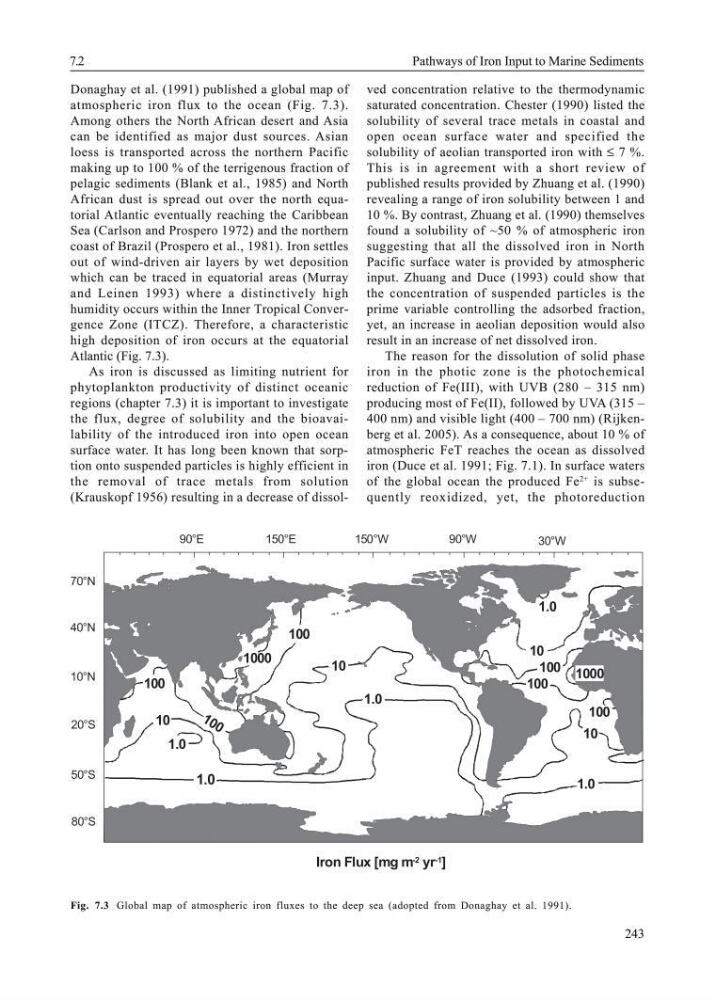
Donaghay et al. (1991) published a global map of
atmospheric iron flux to the ocean (Fig. 7.3).
Among others the North African desert and Asia
can be identified as major dust sources. Asian
loess is transported across the northern Pacific
making up to 100 % of the terrigenous fraction of
pelagic sediments (Blank et al., 1985) and North
African dust is spread out over the north equatorial Atlantic eventually reaching the Caribbean
Sea (Carlson and Prospero 1972) and the northern
coast of Brazil (Prospero et al., 1981). Iron settles
out of wind-driven air layers by wet deposition
which can be traced in equatorial areas (Murray
and Leinen 1993) where a distinctively high
humidity occurs within the Inner Tropical Convergence Zone (ITCZ). Therefore, a characteristic
high deposition of iron occurs at the equatorial
Atlantic (Fig. 7.3).
As iron is discussed as limiting nutrient for
phytoplankton productivity of distinct oceanic
regions (chapter 7.3) it is important to investigate
the flux, degree of solubility and the bioavailability of the introduced iron into open ocean
surface water. It has long been known that sorption onto suspended particles is highly efficient in
the removal of trace metals from solution
(Krauskopf 1956) resulting in a decrease of dissolved concentration relative to the thermodynamic
saturated concentration. Chester (1990) listed the
solubility of several trace metals in coastal and
open ocean surface water and specified the
solubility of aeolian transported iron with ≤ 7 %.
This is in agreement with a short review of
published results provided by Zhuang et al. (1990)
revealing a range of iron solubility between 1 and
10 %. By contrast, Zhuang et al. (1990) themselves
found a solubility of ~50 % of atmospheric iron
suggesting that all the dissolved iron in North
Pacific surface water is provided by atmospheric
input. Zhuang and Duce (1993) could show that
the concentration of suspended particles is the
prime variable controlling the adsorbed fraction,
yet, an increase in aeolian deposition would also
result in an increase of net dissolved iron.
The reason for the dissolution of solid phase
iron in the photic zone is the photochemical
reduction of Fe(III), with UVB (280 – 315 nm)
producing most of Fe(II), followed by UVA (315 –
400 nm) and visible light (400 – 700 nm) (Rijkenberg et al. 2005). As a consequence, about 10 % of
atmospheric FeT reaches the ocean as dissolved
iron (Duce et al. 1991; Fig. 7.1). In surface waters
of the global ocean the produced Fe
2+
is subsequently reoxidized, yet, the photoreduction
Fig. 7.3 Global map of atmospheric iron fluxes to the deep sea (adopted from Donaghay et al. 1991).
100
100
100
10
1.0
1.0
10
1.0
10
1.0
1.0
10
100
1000
100
1 0 0
90°E
150°E
150°W
90°W
30°W
10°N
20°S
50°S
80°S
70°N
40°N
1000
Iron Flux [mg m -2 yr -1 ]
7.2
Pathways of Iron Input to Marine Sediments
Donaghay et al. (1991) published a global map of
atmospheric iron flux to the ocean (Fig. 7.3).
Among others the North African desert and Asia
can be identified as major dust sources. Asian
loess is transported across the northern Pacific
making up to 100 % of the terrigenous fraction of
pelagic sediments (Blank et al., 1985) and North
African dust is spread out over the north equatorial Atlantic eventually reaching the Caribbean
Sea (Carlson and Prospero 1972) and the northern
coast of Brazil (Prospero et al., 1981). Iron settles
out of wind-driven air layers by wet deposition
which can be traced in equatorial areas (Murray
and Leinen 1993) where a distinctively high
humidity occurs within the Inner Tropical Convergence Zone (ITCZ). Therefore, a characteristic
high deposition of iron occurs at the equatorial
Atlantic (Fig. 7.3).
As iron is discussed as limiting nutrient for
phytoplankton productivity of distinct oceanic
regions (chapter 7.3) it is important to investigate
the flux, degree of solubility and the bioavailability of the introduced iron into open ocean
surface water. It has long been known that sorption onto suspended particles is highly efficient in
the removal of trace metals from solution
(Krauskopf 1956) resulting in a decrease of dissolved concentration relative to the thermodynamic
saturated concentration. Chester (1990) listed the
solubility of several trace metals in coastal and
open ocean surface water and specified the
solubility of aeolian transported iron with ≤ 7 %.
This is in agreement with a short review of
published results provided by Zhuang et al. (1990)
revealing a range of iron solubility between 1 and
10 %. By contrast, Zhuang et al. (1990) themselves
found a solubility of ~50 % of atmospheric iron
suggesting that all the dissolved iron in North
Pacific surface water is provided by atmospheric
input. Zhuang and Duce (1993) could show that
the concentration of suspended particles is the
prime variable controlling the adsorbed fraction,
yet, an increase in aeolian deposition would also
result in an increase of net dissolved iron.
The reason for the dissolution of solid phase
iron in the photic zone is the photochemical
reduction of Fe(III), with UVB (280 – 315 nm)
producing most of Fe(II), followed by UVA (315 –
400 nm) and visible light (400 – 700 nm) (Rijkenberg et al. 2005). As a consequence, about 10 % of
atmospheric FeT reaches the ocean as dissolved
iron (Duce et al. 1991; Fig. 7.1). In surface waters
of the global ocean the produced Fe
2+
is subsequently reoxidized, yet, the photoreduction
Fig. 7.3 Global map of atmospheric iron fluxes to the deep sea (adopted from Donaghay et al. 1991).
100
100
100
10
1.0
1.0
10
1.0
10
1.0
1.0
10
100
1000
100
1 0 0
90°E
150°E
150°W
90°W
30°W
10°N
20°S
50°S
80°S
70°N
40°N
1000
Iron Flux [mg m -2 yr -1 ]
7.2
Pathways of Iron Input to Marine Sediments