

7
The Biogeochemistry of Iron
242
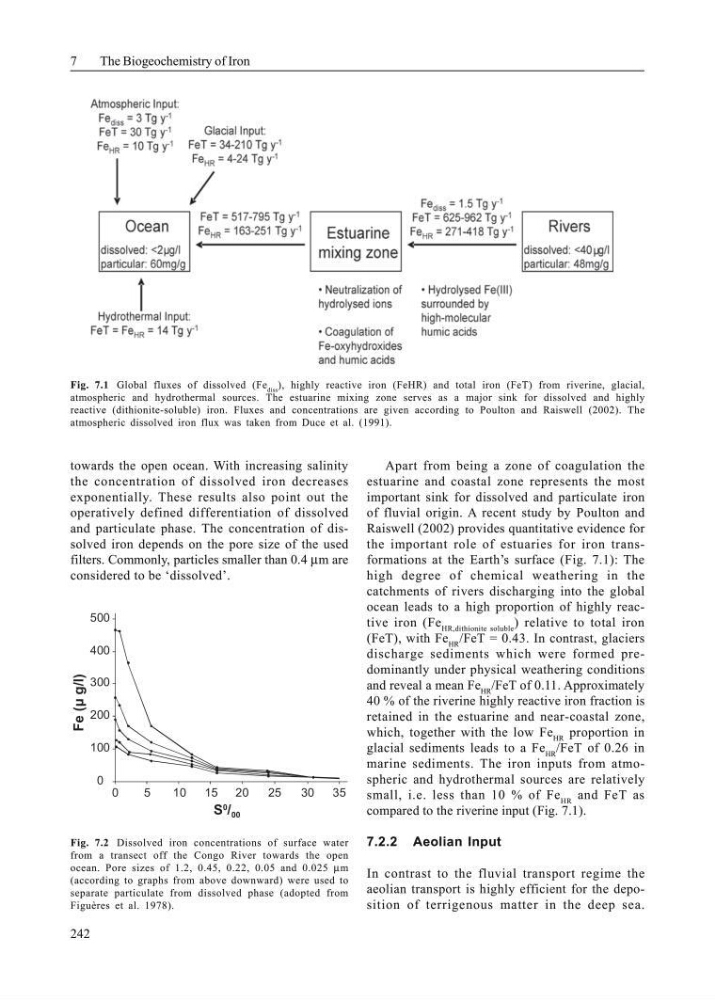
towards the open ocean. With increasing salinity
the concentration of dissolved iron decreases
exponentially. These results also point out the
operatively defined differentiation of dissolved
and particulate phase. The concentration of dissolved iron depends on the pore size of the used
filters. Commonly, particles smaller than 0.4 µm are
considered to be ‘dissolved’.
Fig. 7.2 Dissolved iron concentrations of surface water
from a transect off the Congo River towards the open
ocean. Pore sizes of 1.2, 0.45, 0.22, 0.05 and 0.025 µm
(according to graphs from above downward) were used to
separate particulate from dissolved phase (adopted from
Figuères et al. 1978).
Fig. 7.1 Global fluxes of dissolved (Fe diss ), highly reactive iron (FeHR) and total iron (FeT) from riverine, glacial,
atmospheric and hydrothermal sources. The estuarine mixing zone serves as a major sink for dissolved and highly
reactive (dithionite-soluble) iron. Fluxes and concentrations are given according to Poulton and Raiswell (2002). The
atmospheric dissolved iron flux was taken from Duce et al. (1991).
100
0
0
200
300
400
500
5
10
15 20
25
30
35
S
0
/ 00
Fe (µ g/l)
Apart from being a zone of coagulation the
estuarine and coastal zone represents the most
important sink for dissolved and particulate iron
of fluvial origin. A recent study by Poulton and
Raiswell (2002) provides quantitative evidence for
the important role of estuaries for iron transformations at the Earth’s surface (Fig. 7.1): The
high degree of chemical weathering in the
catchments of rivers discharging into the global
ocean leads to a high proportion of highly reactive iron (Fe HR,dithionite soluble ) relative to total iron
(FeT), with Fe HR /FeT = 0.43. In contrast, glaciers
discharge sediments which were formed predominantly under physical weathering conditions
and reveal a mean Fe HR /FeT of 0.11. Approximately
40 % of the riverine highly reactive iron fraction is
retained in the estuarine and near-coastal zone,
which, together with the low Fe HR proportion in
glacial sediments leads to a Fe HR /FeT of 0.26 in
marine sediments. The iron inputs from atmospheric and hydrothermal sources are relatively
small, i.e. less than 10 % of Fe HR and FeT as
compared to the riverine input (Fig. 7.1).
7.2.2 Aeolian Input
In contrast to the fluvial transport regime the
aeolian transport is highly efficient for the deposition of terrigenous matter in the deep sea.
The Biogeochemistry of Iron
242
towards the open ocean. With increasing salinity
the concentration of dissolved iron decreases
exponentially. These results also point out the
operatively defined differentiation of dissolved
and particulate phase. The concentration of dissolved iron depends on the pore size of the used
filters. Commonly, particles smaller than 0.4 µm are
considered to be ‘dissolved’.
Fig. 7.2 Dissolved iron concentrations of surface water
from a transect off the Congo River towards the open
ocean. Pore sizes of 1.2, 0.45, 0.22, 0.05 and 0.025 µm
(according to graphs from above downward) were used to
separate particulate from dissolved phase (adopted from
Figuères et al. 1978).
Fig. 7.1 Global fluxes of dissolved (Fe diss ), highly reactive iron (FeHR) and total iron (FeT) from riverine, glacial,
atmospheric and hydrothermal sources. The estuarine mixing zone serves as a major sink for dissolved and highly
reactive (dithionite-soluble) iron. Fluxes and concentrations are given according to Poulton and Raiswell (2002). The
atmospheric dissolved iron flux was taken from Duce et al. (1991).
100
0
0
200
300
400
500
5
10
15 20
25
30
35
S
0
/ 00
Fe (µ g/l)
Apart from being a zone of coagulation the
estuarine and coastal zone represents the most
important sink for dissolved and particulate iron
of fluvial origin. A recent study by Poulton and
Raiswell (2002) provides quantitative evidence for
the important role of estuaries for iron transformations at the Earth’s surface (Fig. 7.1): The
high degree of chemical weathering in the
catchments of rivers discharging into the global
ocean leads to a high proportion of highly reactive iron (Fe HR,dithionite soluble ) relative to total iron
(FeT), with Fe HR /FeT = 0.43. In contrast, glaciers
discharge sediments which were formed predominantly under physical weathering conditions
and reveal a mean Fe HR /FeT of 0.11. Approximately
40 % of the riverine highly reactive iron fraction is
retained in the estuarine and near-coastal zone,
which, together with the low Fe HR proportion in
glacial sediments leads to a Fe HR /FeT of 0.26 in
marine sediments. The iron inputs from atmospheric and hydrothermal sources are relatively
small, i.e. less than 10 % of Fe HR and FeT as
compared to the riverine input (Fig. 7.1).
7.2.2 Aeolian Input
In contrast to the fluvial transport regime the
aeolian transport is highly efficient for the deposition of terrigenous matter in the deep sea.